Children at the campfire: rules and tasks
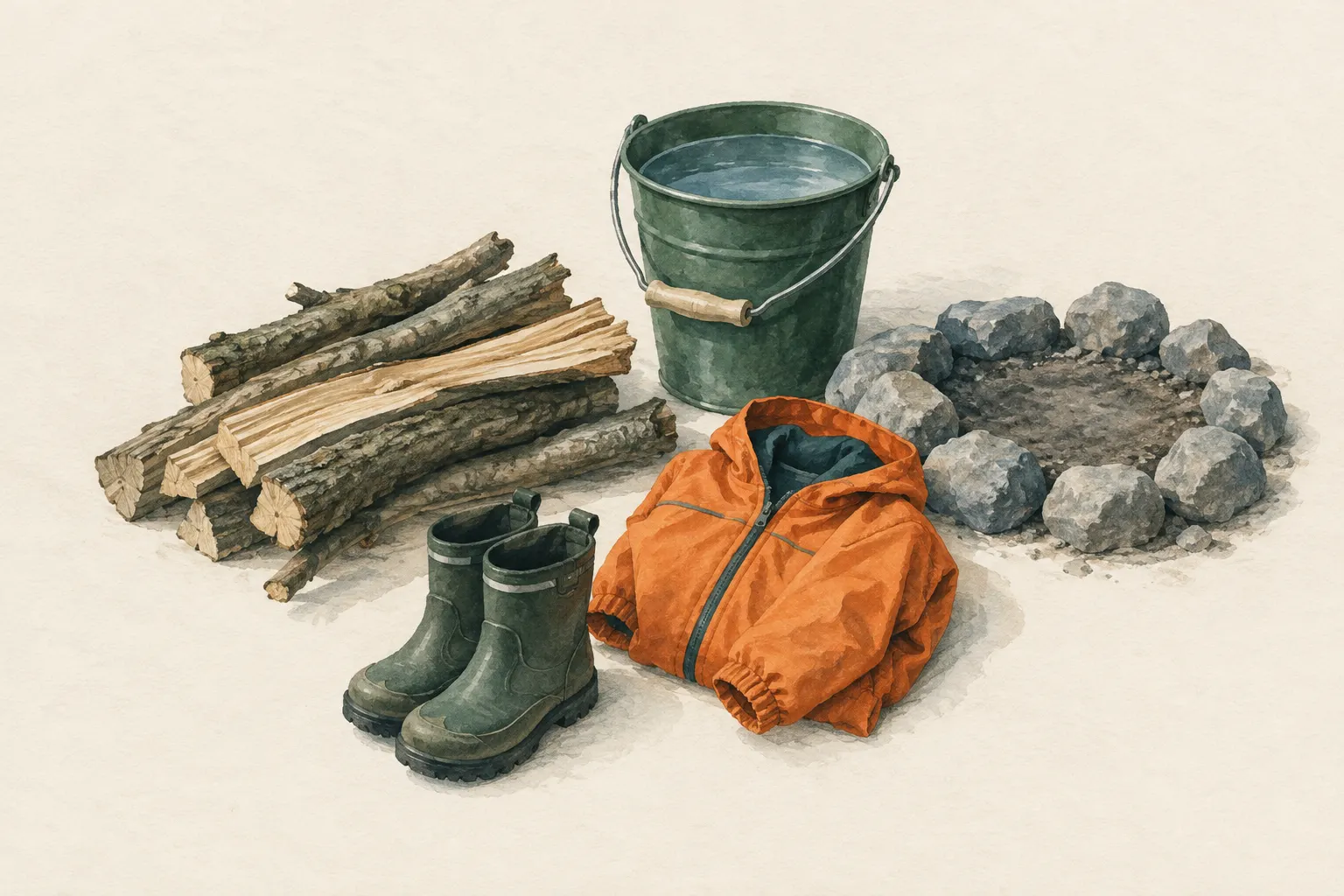
Children love fire but underestimate heat, embers and hot objects. A marked safety circle, fixed seats, no running or rough play near the fire, close-fitting clothing and one adult who is always responsible prevent most accidents. Age-appropriate tasks – collecting wood, keeping extinguishing water ready, helping to put the fire out – make children participants rather than spectators.
- Explain rules before lighting; constant supervision
Explained simply
A campfire is something very special for children. But children easily underestimate how hot it is. The heat reaches further than you think, embers sometimes look grey and harmless, and stones and sticks by the fire stay hot for a long time, even though you cannot tell by looking at them.
That is why there are fixed rules: a circle is drawn around the fire, and you may only go inside it with permission. No running and no pushing at the fire, nothing is thrown into it, and burning sticks are not waved around. Long hair is tied back, and one adult always keeps watch.
Children can help too: sorting wood, guarding the water bucket or stirring while the fire is put out. And everyone should know what to do if clothing catches fire: stop, drop to the ground, cover your face with your hands and roll.
Why children are particularly at risk
Over the years, adults have learned how heat feels and when it gets too close. Children do not yet have this sense. They judge poorly how far heat radiates, how long embers, stones of the fire ring and stick tips stay hot and how quickly loose clothing catches fire. On top of this come curiosity, the urge to move and play – three things that quickly lead to tripping and falling at a fire.
Burns are among the common injuries in childhood, and campfires, barbecues and hot embers are typical causes. Toddlers do not yet understand rules reliably; they need supervision within arm's reach or on a lap. Older children can keep to rules well if they understand them and if the adults follow them themselves.
The most important rules
A clearly visible safety circle made of sticks, stones or a line in the sand marks the boundary. You only go inside the circle with permission. Explain the rules before the fire is lit, not only when something happens: no running, no pushing, nothing thrown into the fire, no waving burning sticks around, no touching hot things.
Agree fixed seats at a safe distance, not downwind, so that nobody sits in the smoke or gets hit by sparks. Long hair is tied back, wide sleeves and loose scarves stay away. Close-fitting clothing made of cotton or wool is better than synthetics, which can melt and stick to the skin.
When toasting twist bread and marshmallows, long sticks and patience help: cook over coals instead of holding the food in the flames. Hot stick tips go straight into the water bucket or the fire after eating. Melted marshmallow sugar is very hot and sticky – let it cool first.
Safety: what to watch out for
Never throw aerosol cans, batteries, glass, closed cans or bottles into the fire – they can burst or explode. And do not use accelerants: children copy what adults do, and what an adult does “just this once”, a child may later try alone.
If clothing is burning, running away is the worst thing to do, because the draught fans the flames. The right thing is: stop, drop to the ground, cover your face with your hands and roll back and forth until the flames are smothered. Practise this playfully with children before it is needed.
Cool burns immediately with cool, not ice-cold, running water. For children, for large or deep burns and for burns to the face or hands, call the local emergency number (112 in the EU). The responsible adult must not supervise “on the side” while cooking or on the phone – if they have to do something else, they explicitly hand over supervision to someone else.
Tasks children can take on
Children who are allowed to help turn from spectators into participants – and participants are more likely to stick to rules. Younger children can sort wood by size, from as thin as a matchstick to as thick as an arm. They can guard the water bucket and make sure it stays full.
Older children can build the fire under guidance, light it and help put it out at the end: pouring water, stirring, checking with the back of the hand whether heat is still rising. Finally, show together how a fire is put out completely, and leave the fire site only when everything is cold.
Good to know
Children who learn early how to make and extinguish a fire safely often handle it more responsibly later than children for whom fire remains a prohibition and a mystery. Fire-prevention campaigns therefore explicitly address children too.
But rules never replace supervision. Even the most sensible child can trip. And before every fire, with children too: check local rules and wildfire danger and make fires only at a safe, permitted fire site.
Step by step
Mark a safety circle
Mark a clearly visible circle around the fire site (sticks, stones, a line in the sand). Inside the circle only with permission.
- 1
Mark a safety circle
Mark a clearly visible circle around the fire site (sticks, stones, a line in the sand). Inside the circle only with permission.
- 2
Explain rules
Before lighting: no running, no pushing, nothing thrown into the fire, no waving burning sticks around, no touching hot things.
- 3
Fixed seats
Set seats at a safe distance, not downwind. Toddlers on a lap or within arm's reach.
- 4
Safe twist bread
Use long sticks, cook over coals rather than flames and put hot tips into the water bucket or fire straight after eating. Melted marshmallow sugar is very hot.
- 5
Give tasks
Sorting wood by size, guarding the extinguishing water, helping stir while extinguishing – depending on age.
- 6
Extinguish together
At the end, show how a fire is put out completely and leave the fire site only when everything is cold.
Common mistakes
- Supervising ‘on the side’ while cooking or on the phone
- Playing inside the fire circle
- Letting children touch hot stones of the ring
- Using accelerants that children imitate
- Leaving the fire site with embers still glowing
Quick view
Materials
Water for extinguishing (bucket, canister or pot)
Have several litres ready before lighting.
Sturdy sticks / poles
Long sticks for twist bread and marshmallows
Do not cut live wood where prohibited.
Suitable for
- Family and group camps
- Garden fires
- Scout and school groups
Not suitable for
- Unsupervised play at the fire
- Toddlers without arm's-length supervision
Prerequisites
- One responsible adult who is not distracted
- A safe, permitted fire site
- Extinguishing water
Safety
- Wide sleeves, loose scarves and loose long hair can catch fire; synthetics melt onto the skin. Tie hair back and wear close-fitting cotton or wool clothing.
- Burning clothes: stop, drop to the ground, cover the face with the hands and roll – practise with children before it is needed.
- Cool burns immediately with cool, not ice-cold, running water. For large or deep burns, burns to the face or hands and burns in children, call the local emergency number (112 in the EU).
How it works
Children underestimate how far heat radiates, how long embers, stones and sticks stay hot and how quickly clothing catches fire. Fixed rules and clear boundaries replace this missing sense. Tasks steer curiosity into safe channels.
Advantages
- A great shared experience
- Children learn respect for fire
Disadvantages
- Requires constant attention
Deep knowledge
Background
Burns are among the common injuries in childhood; campfires, barbecues and hot embers are typical causes. Fire-prevention campaigns therefore explicitly address children too.
Children who learn early how to make and extinguish a fire safely often handle it more responsibly later than children for whom fire remains a prohibition and a mystery.
Common mistakes
- Supervising ‘on the side’ while cooking or on the phone
- Playing inside the fire circle
- Letting children touch hot stones of the ring
- Using accelerants that children imitate
- Leaving the fire site with embers still glowing
Limits and risks
- Rules do not replace supervision
- Toddlers do not yet understand rules reliably
Sources
USDA Forest Service / Ad Council / National Association of State Foresters: Campfire Safety (Smokey Bear wildfire prevention campaign)
Campfire safety and fire prevention, including for children
European Resuscitation Council – Resuscitation (journal) (2021): European Resuscitation Council Guidelines 2021: First Aid
Cooling burns with water as first aid