Using a garden fire bowl or fire pit safely
Fire bowls, fire baskets and built fire pits in gardens are popular but not allowed everywhere – rules on open fires, smoke and garden waste vary by municipality, so check local rules. It becomes safe with ample distance from the house, fences, hedges and trees, a stable, non-flammable base, dry untreated wood, extinguishing means within reach and completely cooled ash in a metal container.
- Set up safely once; supervision during the evening
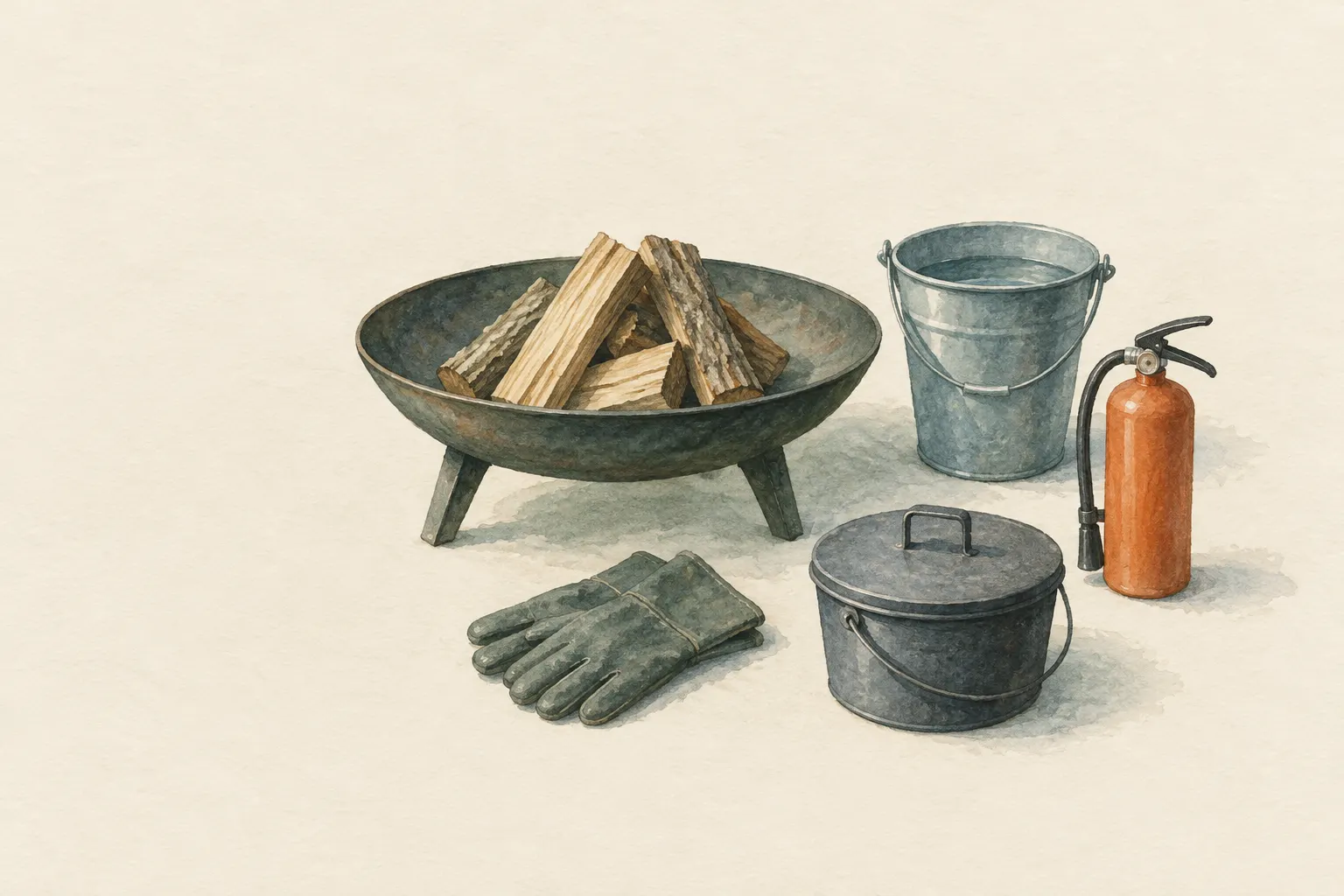
Explained simply
A fire bowl in the garden is like a small campfire at home: you sit together in the evening, look into the flames and perhaps toast twist bread. But it is not allowed everywhere. So adults check with the municipality beforehand what the rules are.
A fire can cause harm in three ways: through heat that it radiates, through sparks that fly and through embers that fall out. Distance helps against all three – from the house, the fence, the hedge and trees – and so does ground that cannot burn, such as stone slabs or gravel.
Very important: one adult always keeps watch, water for putting out the fire is ready, and nobody ever pours spirit or petrol into the fire. Ash often stays hot for days, so it only goes into a metal bucket with a lid once it has cooled.
How it works
A garden fire is safe when radiant heat, sparks and embers cannot reach anything flammable. You feel radiant heat on your face when you sit close to the fire – it can also heat wooden fences, garden furniture or hedges so much that they catch fire. Sparks fly with the rising hot air and the wind. Embers fall out or stay in the ash.
Distance protects against radiation, a non-flammable base against falling embers, and a spark screen – a mesh lid over the bowl – catches many sparks. Supervision and extinguishing means within reach catch whatever happens anyway. Only all these building blocks together make a garden fire safe.
What really matters
First, clarify the rules. Whether open fires are allowed in gardens, whether a drought ban currently applies and how smoke is to be handled are regulated very differently by municipalities. Tenancy agreements and house rules may also say something about it. The atlas deliberately does not state specific regulations or distances – ask locally.
The spot: stone, paving or gravel, with generous distance from the house, shed, fence, hedge, trees and woodpiles. Not on a wooden deck or artificial turf unless the manufacturer explicitly allows it, and not under trees, roofs or awnings. Balconies and covered patios are no place for a fire bowl.
The wood: only dry and untreated. To light it, use fire-lighters and thin, dry kindling. Garden waste, packaging and rubbish do not belong in the fire – they smoke heavily, and burning them is regulated separately or prohibited in many places.
Safety: what to watch out for
Never pour methylated spirit, lighter fluid, petrol or other liquids onto the fire or embers. The vapours can ignite explosively, and the flash of flame can badly injure people nearby.
A fire bowl never belongs in a garage, conservatory, tent or under a roof – there is a risk of fire and carbon monoxide poisoning. One adult remains responsible the whole time and never leaves the fire unattended, not even to burn out. Children and pets keep their distance. A connected garden hose, a bucket of water or a fire extinguisher is within reach, and if it gets windy the fire is made smaller or put out.
Ash can contain hot spots for a long time, even for days. At the end, put the fire out with water and stir. Put the cooled ash into a metal container with a lid and place it away from buildings – never in the wheelie bin or a plastic composter.
Typical situations
The garden is a good place to practise making fire: water and help are close by, and you can calmly try out how different lays burn. Cooking over coals can also be learned well here.
Be considerate towards the neighbours. Smoke can drift into open windows or make washing smell of smoke. Using dry wood and keeping the fire small avoids most problems. Gas fire tables produce hardly any smoke and can be switched off; use them only outdoors according to the manufacturer's instructions, and store gas cylinders as required.
Remember too: the fire bowl does not replace fire safety in the home. Smoke alarms and a fire extinguisher belong in every household anyway.
Step by step
Check rules
Check with the municipality whether open fires are allowed in gardens and whether any drought bans apply. Observe tenancy agreements and house rules.
- 1
Check rules
Check with the municipality whether open fires are allowed in gardens and whether any drought bans apply. Observe tenancy agreements and house rules.
- 2
Placement
Set up on stone, paving or gravel with generous distance from the house, shed, fence, hedge, trees and woodpiles – not on a wooden deck or artificial turf unless the manufacturer explicitly allows it.
- 3
Have extinguishing means ready
Have a connected garden hose or a bucket of water or fire extinguisher within reach.
- 4
Light
Light with fire-lighters and dry kindling, never with fuel liquids. Add only dry, untreated wood; use a spark screen if available.
- 5
Supervise
One adult stays responsible. Keep children and pets at a distance. Reduce or put out the fire if it gets windy.
- 6
Extinguish and ash
Let it burn down, extinguish with water and stir. Put cooled ash into a metal container with a lid.
Common mistakes
- Fire bowl on a wooden deck or under trees
- Pouring on spirit or lighter fluid
- Burning garden waste and packaging
- Warm ash in the wheelie bin
- Leaving the fire to burn out unattended
Quick view
Materials
Fire bowl / fire basket
Only on non-flammable ground.
Never indoors or under roofs.
Dry firewood
Dry and untreated
Collect only where permitted.
Water for extinguishing (bucket, canister or pot)
Garden hose, bucket or fire extinguisher
Have several litres ready before lighting.
Galvanised bucket
Metal container with lid for ash
Do not heat: the zinc coating can release harmful fumes when heated.
Suitable for
- Evenings in the garden
- Practising fire-making at home
- Cooking over coals
Not suitable for
- Balconies and covered patios
- Drought, wind and fire bans
- Burning garden waste and rubbish
Prerequisites
- Garden fires are permitted locally
- Level, non-flammable spot
- Extinguishing means within reach
Safety
- Ash can contain hot embers for a long time, even days. Store it only once cooled, in a metal container with a lid and away from buildings – never in a plastic bin or composter.
- Never leave a fire unattended, not even briefly. Keep extinguishing water within reach.
How it works
A garden fire is safe when radiant heat, sparks and embers cannot reach anything flammable. Distance, a non-flammable base and a spark screen limit these three routes; extinguishing means and supervision catch whatever happens anyway.
Advantages
- Controlled, raised fire site
- Good practice environment
- Water and help close by
Disadvantages
- Smoke may bother neighbours
- Not allowed everywhere
- Ash must be disposed of safely
Deep knowledge
Background
Legal rules for garden fires range, depending on country and municipality, from ‘allowed with consideration’ to ‘permit required’ or ‘prohibited’; burning garden waste is regulated separately in many places. The atlas does not state specific regulations – please check locally.
The fire bowl does not replace fire safety in the home: smoke alarms and a fire extinguisher belong in every household anyway.
Variants
- Gas fire pit
- Gas fire tables produce hardly any smoke and can be switched off. Use them only according to the manufacturer's instructions and outdoors, and store gas cylinders as required.
Common mistakes
- Fire bowl on a wooden deck or under trees
- Pouring on spirit or lighter fluid
- Burning garden waste and packaging
- Warm ash in the wheelie bin
- Leaving the fire to burn out unattended
Limits and risks
- No substitute for local permission
- Not in drought and wind
Material alternatives
Derived from material properties: a substitute must have all relevant properties. Observe the notes on the substitute.
- Fire bowl / fire basket
- Metal pot (stainless steel, aluminium, titanium) (Hot – scalding risk.), Single-wall stainless steel bottle (Heat only single-wall bottles without paint/plastic; remove the lid before heating.), Small metal tin with lid (Burn off coated or painted tins outdoors first.), Cast-iron pot with lid (Dutch oven) (Gets very hot and stays hot for a long time – handle only with gloves or a lid lifter.)
- Dry firewood
- Tinder (Carry in waterproof packaging.), Char cloth (charred cotton) (Store dry in a tin.), Finest-grade steel wool (Store separately from batteries – fire risk.), Fatwood (resin-rich wood) (Collect only dead wood where permitted.), Stove fuel (canister, liquid fuel, alcohol) (Store fuels apart from food and in original containers or bottles intended for them.), Petroleum jelly cotton balls (Use only pure cotton.)
- Galvanised bucket
- Single-wall stainless steel bottle (Heat only single-wall bottles without paint/plastic; remove the lid before heating.), Double-wall insulated bottle (Never heat directly.), PET bottle (clear, max. 2 litres) (Do not heat or place in a fire.), Food-grade water container (Only use containers that never held chemicals or fuel.), Used chemical or fuel container (Never for drinking water or food – residues cannot be reliably removed.), Waterproof case or bag, Airtight food-grade storage container (Fill only when clean and completely dry; never use containers that previously held chemicals.), Wildlife-resistant food container (Where specific containers are required, use only approved models – check local rules.), Small metal tin with lid (Burn off coated or painted tins outdoors first.), Collapsible water container or bag (Protect from sharp objects.), Food-grade water bag (Use only for drinking water, never for chemicals or fuel.), Fermentation jar or crock (Use only food-grade containers of glass, food-safe glazed stoneware or food-grade plastic – no metal containers for acidic food.), Resealable food bags (Use only bags intended for food; do not use with boiling water unless the manufacturer explicitly allows it.)
Results come exclusively from structured entries. No improvised instructions are generated.
Sources
USDA Forest Service / Ad Council / National Association of State Foresters: Campfire Safety (Smokey Bear wildfire prevention campaign)
Clearance, supervision, extinguishing means and complete extinguishing
Centers for Disease Control and Prevention: Carbon Monoxide Poisoning – Prevention guidance
No combustion in enclosed or partly enclosed spaces