Home fire safety: smoke alarms, extinguishers, escape route
Smoke alarms wake you in time, a clear escape route gets everyone out, and an extinguisher or fire blanket only helps with a small starting fire. In crises with candles, backup heaters and improvisation the fire risk rises. Basic rule: saving people comes before fighting the fire – get out, close the door, call the emergency number.
- A few hours to set up, monthly test
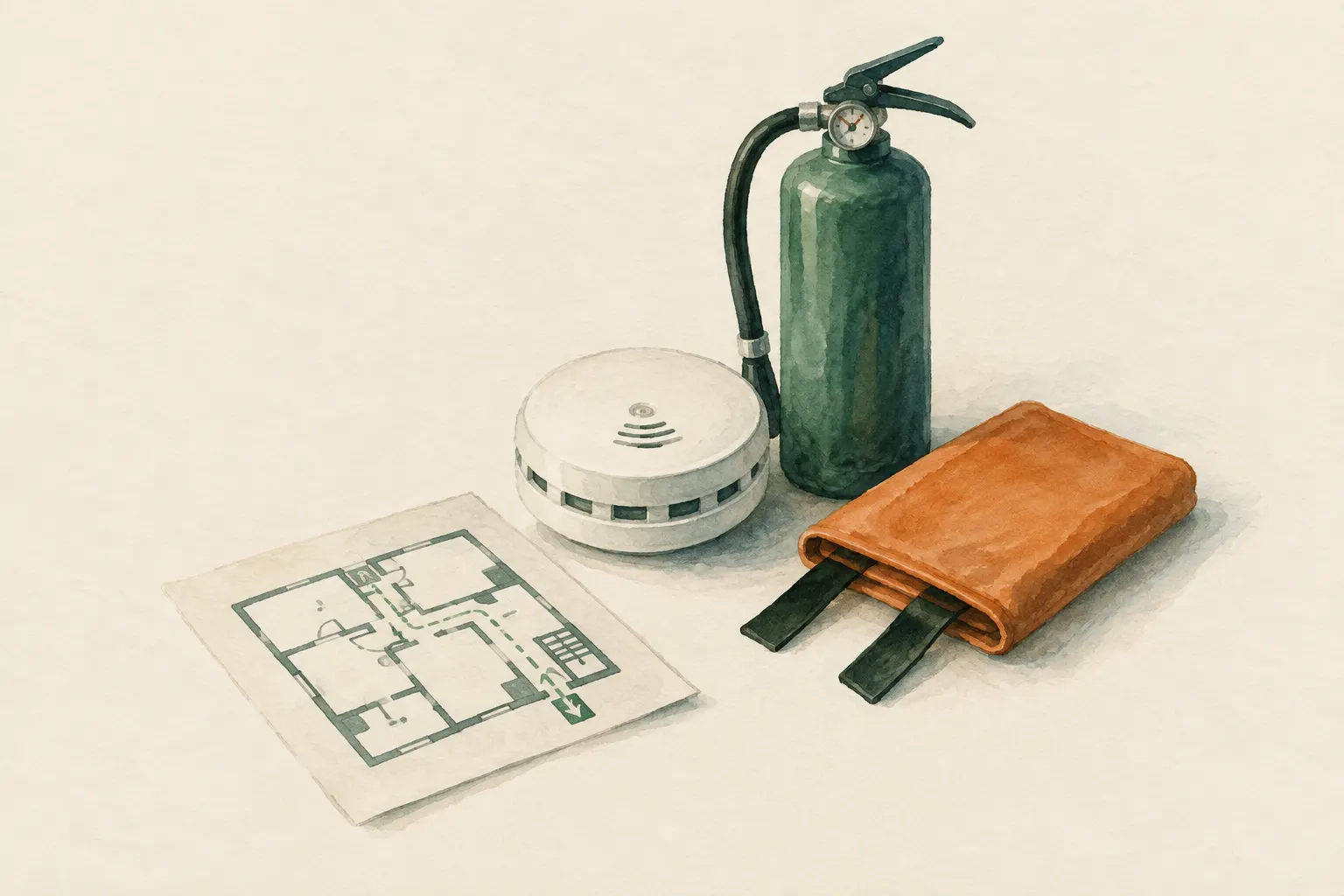
Explained simply
A smoke alarm is like a guard dog that never sleeps. If there is a fire at night, you often do not notice it in your sleep – smoke does not wake you up, it makes you even drowsier. But the smoke alarm, so to speak, smells the smoke and beeps loudly so that everyone wakes up in time and gets out.
The most important rule in a fire is: people come before things. If there is a fire and it is not tiny, you go out immediately with everyone, close the doors behind you and call the emergency number (112 in the EU) from outside. You never go back in to fetch something – not even your favourite toy or your phone.
And an important kitchen tip: you never put water on burning fat or oil in a pan. The water turns to steam in a flash and throws burning fat upwards – there is a huge fireball. Instead, turn off the heat and put a lid or a fire blanket on top.
How it works
Most victims of home fires do not die from the flames but from the smoke – often while asleep. Fire smoke contains toxic gases, including carbon monoxide, which you cannot smell. People who are asleep are not reliably woken by it. A smoke alarm detects smoke early and wakes you with a loud tone. It buys you the crucial minutes to get out.
A fire grows frighteningly fast in a room. In the first seconds, a starting fire – such as a burning pan or a wastepaper basket – can sometimes still be smothered with simple means. After that, furniture, curtains and ceiling heat up, smoke fills the room from top to bottom, and soon only escape helps.
Closed doors slow fire and smoke. That is why you close the doors behind you on your way out, and why it makes sense to close the bedroom door at night. Because hot smoke rises, the air near the floor often stays breathable longer – in a smoky hallway it can help to move bent over or on all fours.
What really matters
Smoke alarms belong on the ceiling in bedrooms, children's rooms and hallways used as escape routes – and at least one on every level. In many regions they are required, but numbers and locations differ – check local rules. Test every alarm once a month with the test button, and replace batteries and units as the manufacturer specifies. Never take the battery out just because the alarm beeps when you cook.
An escape plan means: for every room you know two ways out, such as the door and a window. You agree on a meeting point outside, for example the street lamp in front of the house, so you can see straight away whether everyone is there. Escape routes are kept clear, and the house key is kept within reach at a fixed place at night. Practise the plan together so that children know it too.
Fire blankets and extinguishers are meant for small starting fires. The fire blanket hangs near the kitchen, the extinguisher clearly visible near the exit, so that you have your escape route behind you while fighting the fire. Read the instructions before you need them – the label also says which fires the extinguisher is suitable for – and have it serviced as the manufacturer specifies.
Safety: when there is a fire
If a fire spreads or the room is smoky: get everyone out immediately, close doors behind you and call the local emergency number (112 in the EU) from outside. Say where the fire is, what is burning and whether anyone is still inside the building. Do not go back in – not for pets, not for valuables. Tell the responders who or what is still inside.
Before opening a closed door, feel with the back of your hand whether the door or the handle is hot. If it is hot, there may be fire behind it – then take another way. If no way is clear, stay in a room with the door closed, seal the gap under the door with cloths, make yourself noticed at the window and call the emergency number. Do not use a lift in a fire.
Only fight a fire if it is small, your escape route stays clear behind you and you feel confident. Never put water on burning fat or oil: turn off the heat, put on a lid or fire blanket and leave it until everything has cooled down – or use an extinguisher rated for it. If clothing catches fire: stop, drop to the ground, cover your face with your hands and roll back and forth.
Typical situations during crises
During long power cuts, many people turn to candles – and the fire risk rises. Battery-powered lights are much safer. If you do use candles: never unattended, never near curtains, paper or children, and always on a fireproof, stable base. Put out all candles before going to sleep.
Backup heaters are a second fire source. They need distance from furniture, curtains and laundry, and only appliances approved for indoor use belong in the home. Never run grills, camping stoves, patio heaters or generators indoors – besides the fire risk, they produce carbon monoxide. A carbon monoxide alarm is a separate device for that; a smoke alarm does not detect carbon monoxide.
In a crisis especially, the fire service may take longer because many incidents are running at once. That is one more reason to stop fires from starting in the first place: do not leave cooking unattended, do not overload power strips, and store flammable supplies such as fuels separately and according to the manufacturer's instructions.
How to practise it
Walk through the home together and show the two ways out of every room. Let the smoke alarm beep once using the test button so that children in particular know the sound and understand: this noise means get out right away. Then walk together to the meeting point outside. Children should also learn not to hide – firefighters find them less easily under a bed or in a wardrobe.
Practise once how to pull a fire blanket out of its case and hold it in front of you so your hands are protected – without a real fire. Using a fire extinguisher is best learned on a course, such as those sometimes offered by fire services or relief organisations. Real fire for practice never belongs in the home.
Ready.gov recommends smoke alarms on every level and in sleeping areas, monthly tests, a practised escape plan and the rule “get out, stay out, call for help”. Germany's BBK lists smoke alarms, fire extinguishers and fire blankets as part of household preparedness. For advice on your home or on extinguishing agents in detail, the local fire service is the right contact.
Step by step
Smoke alarms
Mount alarms on the ceiling in bedrooms, children's rooms and hallways used as escape routes; at least one on every level. Test monthly with the test button.
- 1
Smoke alarms
Mount alarms on the ceiling in bedrooms, children's rooms and hallways used as escape routes; at least one on every level. Test monthly with the test button.
- 2
Escape plan
Know two ways out of every room, agree a meeting point outside, keep escape routes clear, keep keys within reach. Practise together.
- 3
Keep extinguishing aids ready
Fire blanket near the kitchen, extinguisher clearly visible near the exit. Read the instructions beforehand; service as the manufacturer specifies.
- 4
Small fire
Only fight it if the fire is small, your escape route stays clear behind you and you feel confident. Otherwise get out immediately.
- 5
During crises
Never leave candles unattended; keep them away from curtains on a fireproof base. Prefer battery lights. Keep backup heaters well away from flammable materials.
Common mistakes
- Taking the battery out of the alarm because it is annoying
- Putting water on a fat fire
- Going back in to fetch things
- An extinguisher nobody knows how to use
Quick view
Materials
Smoke alarm
Test regularly; never take the battery out for other uses.
Household fire extinguisher
Only for small, starting fires; observe the fire class and service interval stated by the manufacturer.
Fire blanket
Hang within reach near the kitchen, but not directly above the cooker.
Headlamp / flashlight
Suitable for
- Every household
- Crisis periods with candles and backup heating
- Households with children, older or disabled people
Not suitable for
- Fighting larger fires – that is the fire service's job
Prerequisites
- Enough smoke alarms
- A known escape route and meeting point
Safety
- In many regions smoke alarms are required; numbers and locations differ – check local rules.
How it works
Most victims of home fires die from smoke, often while asleep. Smoke alarms buy the crucial minutes to escape. A starting fire can sometimes be smothered with simple means in the first seconds; after that it grows so quickly that only escape helps. Closed doors slow fire and smoke.
Advantages
- Saves lives at low cost
- Easy to implement
Disadvantages
- Maintenance and testing are often forgotten
Deep knowledge
Background
In its home fire guidance, Ready.gov recommends smoke alarms on every level and in sleeping areas, monthly tests, a practised escape plan and the rule "get out, stay out, call for help".
The BBK guide lists smoke alarms, fire extinguishers and fire blankets as part of household preparedness.
Variants
- Interconnected alarms
- Interconnected alarms sound in all rooms at once – helpful in larger flats and houses.
Common mistakes
- Taking the battery out of the alarm because it is annoying
- Putting water on a fat fire
- Going back in to fetch things
- An extinguisher nobody knows how to use
Limits and risks
- No detailed advice on fire classes or extinguishing agents
- No substitute for fire safety advice from the fire service
Material alternatives
Derived from material properties: a substitute must have all relevant properties. Observe the notes on the substitute.
- Headlamp / flashlight
- Mobile phone (The battery drains quickly in cold and with continuous screen and GPS use.), Battery lantern / LED light
Results come exclusively from structured entries. No improvised instructions are generated.
Sources
Ready.gov – U.S. Federal Emergency Management Agency (FEMA): Home Fires
Smoke alarms, monthly tests, escape plan, get out and call
Bundesamt für Bevölkerungsschutz und Katastrophenhilfe (BBK), Deutschland: Ratgeber für Notfallvorsorge und richtiges Handeln in Notsituationen
Smoke alarms, extinguishers, fire blankets in preparedness