Improvising light – safely and without open flames indoors
A headlamp and a filled water bottle make a glare-free room light; white walls, mirrors and foil spread light. Improvised oil lamps, tin-can heaters or candle hacks from the internet do not belong in homes, though: fire and carbon monoxide risk.
- A few minutes
Explained simply
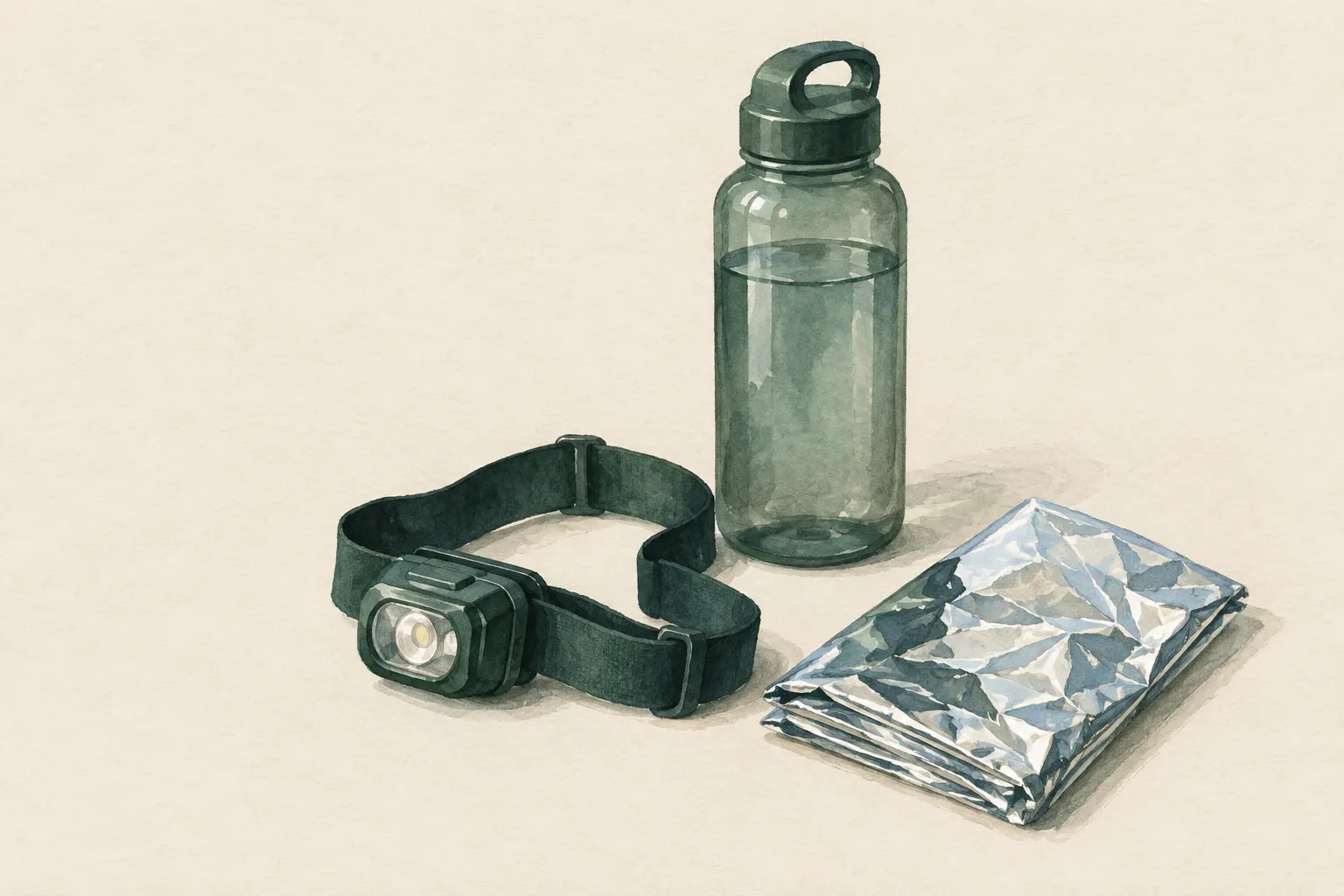
When the power goes out, it gets dark. The safest solution is battery light: a torch, a headlamp or a battery-powered lantern. Such lamps hardly get hot, make no smoke and cannot set anything on fire. With a simple trick a headlamp even becomes a room light: strap it around a bottle filled with water so the light shines into the bottle. The water spreads the light, and the whole bottle glows like a lantern.
Candles are more dangerous because they have an open flame. If you do use a candle, only in a stable, non-flammable holder, well away from curtains and paper, and only while an adult is there. When you go to sleep, every candle is put out.
Home-made oil lamps, can burners, or barbecues and gas stoves used for light or heat indoors are off-limits. They can start fires and produce carbon monoxide – a gas you can neither see nor smell and that is very dangerous.
How it works
LEDs are small, very efficient light sources. They turn far more electricity into light than old incandescent bulbs and therefore hardly get warm. In return they send their light out in a tight beam in one direction. That is good for lighting a path, but unpleasant in a room: the bright spot dazzles, and next to it everything stays dark.
This is where scattering helps. Water in a bottle bends the light at the curved surface and redirects it in many directions. A milky plastic or a little soapy water strengthens the scattering further. That way a harsh point of light becomes an evenly glowing bottle that lights up a table without dazzling.
Light surfaces do the same on a larger scale. A white wall or ceiling throws light back into the room, a mirror behind the lamp adds noticeably to the effect, and kitchen foil spreads it too. Instead of pointing the lamp at yourself, point it at a light surface – and the whole room becomes brighter.
Gear and materials
The basic kit for power cuts is simple: one torch or headlamp per person, a battery lantern for the room and enough spare batteries. Headlamps have the advantage of keeping both hands free – when cooking, looking after children or on the stairs. Many have several brightness levels; the low one is enough for most tasks and lasts much longer.
Store spare batteries cool and dry in their packaging or a box, so their terminals do not touch metal objects such as keys or coins. For longer storage, take batteries out of devices, because they can leak and damage the lamp. Check your lamps regularly, for example twice a year.
Lamps that need no battery change are also useful, such as those with a crank or a small solar panel, as are small lights or glow strips to mark stairs and exits. Your phone has a torch, but its battery may be needed for emergency calls and information – use it only as a last reserve.
Safety: what to watch out for
Authorities recommend torches rather than candles during power cuts, because candles are a common cause of fires – especially when people are fumbling in the dark, tired, or have children and pets in the room. If you do use candles, only in stable, non-flammable holders on a firm surface, with plenty of distance from curtains, furniture, paper and blankets. Never leave them unattended, never alone with children or animals, and put them out before you leave the room or go to sleep.
Improvised oil lamps, can burners and “candle hacks” from the internet do not belong in homes. They tip over easily, get unexpectedly hot, and burning fat or oil is very hard to put out. Barbecues, gas stoves, patio heaters or generators are likewise never run indoors, in tents, garages or vehicles – not for light and not for warmth.
The reason is carbon monoxide. This gas forms when something burns with too little air. It is invisible and odourless and can be fatal. Typical signs are headache, dizziness and nausea, often in several people at once. Then get everyone outside immediately and call the local emergency number (112 in the EU). Working smoke alarms and, where available, carbon monoxide alarms are an important protection.
What really matters
Light where you need it, instead of making the whole room bright: a bottle lantern on the table, a headlamp for moving around, a small light on the stairs. That way the batteries last much longer. Do not point bright lamps straight into other people's eyes; point them at a wall or ceiling instead.
Your eyes adjust to darkness, but it takes quite a while. A brief glance into a bright lamp undoes that adjustment again. That is why many headlamps have a red light, which dazzles the eyes less and is good for finding your way in a tent or at night.
Always keep the lamps in the same, easy-to-reach place – next to the bed or by the front door, for instance. In a power cut at night you do not want to be searching in the dark.
How to practise it
Hold a small “power cut evening” with your family: lights off, and then manage only with lamps and batteries. Build a bottle lantern together, try out how much light a white wall reflects, and see whether everyone can find their lamp in the dark. Children usually have great fun doing this and lose some of their fear of the dark.
Afterwards you know whether there are enough lamps and batteries, which lamp suits the table and which the stairs, and where something is still missing. A trial run like this is far more relaxed than the real thing.
Step by step
Water-bottle lantern
Strap a headlamp around a filled bottle with the lamp facing inwards towards the bottle. The bottle glows evenly.
- 1
Water-bottle lantern
Strap a headlamp around a filled bottle with the lamp facing inwards towards the bottle. The bottle glows evenly.
- 2
Reflect
Point the light at a light wall or ceiling or place a mirror behind it.
- 3
Use low settings
Use a low brightness setting, keep spare batteries at hand, one lamp per person for moving around.
- 4
Mark routes
Make stairs and exits visible with small lights or glow strips.
- 5
If candles are used
Only in stable, non-flammable holders, away from curtains, never unattended and never left alone with children or animals.
Common mistakes
- Barbecue or gas stove indoors for light or heat
- Leaving candles burning when going to sleep
- No spare batteries
- Home-made oil lamps from internet videos
Quick view
Materials
Headlamp / flashlight
PET bottle (clear, max. 2 litres)
Clear or milky, filled with water
Do not heat or place in a fire.
Spare batteries
Store cool and dry, observe the expiry date; keep button cells out of children's reach.
Battery lantern / LED light
Suitable for
- Power outages at home
- Tent and camp
- Children's rooms in the dark
Not suitable for
- Open flames indoors, in tents, in vehicles
- Unattended candles
- Barbecues, gas stoves or patio heaters for light or heat indoors
Prerequisites
- Battery-powered light sources and spare batteries
- Working smoke alarms where present
Safety
- Do not shine bright LED lamps directly into other people's eyes; diffuse light is more pleasant.
How it works
LEDs emit directional light and dazzle. Water in a bottle refracts and scatters the light and spreads it all around; light surfaces reflect it back into the room. That way a small light source is enough for a whole table – without heat, smoke or fumes.
Advantages
- No fire or CO risk
- Glare-free
- Uses existing equipment
Disadvantages
- Depends on batteries
- Limited brightness
Deep knowledge
Background
Ready.gov recommends flashlights instead of candles during power outages and warns against running generators, barbecues or stoves indoors. The CDC describes carbon monoxide poisoning from such devices as a preventable hazard.
The water-bottle lantern is a common trick from the outdoor world that comes without extra risks.
Variants
- Phone as emergency light
- A phone torch works with a water bottle too – but it uses battery that may be needed for emergency calls.
Common mistakes
- Barbecue or gas stove indoors for light or heat
- Leaving candles burning when going to sleep
- No spare batteries
- Home-made oil lamps from internet videos
Limits and risks
- No substitute for building emergency lighting
- Not a heating solution
Material alternatives
Derived from material properties: a substitute must have all relevant properties. Observe the notes on the substitute.
- Headlamp / flashlight
- Mobile phone (The battery drains quickly in cold and with continuous screen and GPS use.), Battery lantern / LED light
- Battery lantern / LED light
- Headlamp / flashlight, Mobile phone (The battery drains quickly in cold and with continuous screen and GPS use.)
Results come exclusively from structured entries. No improvised instructions are generated.
Sources
Ready.gov – U.S. Federal Emergency Management Agency (FEMA): Power Outages
Flashlights instead of candles; no generators or barbecues indoors
Centers for Disease Control and Prevention: Carbon Monoxide Poisoning – Prevention guidance
Preventing carbon monoxide poisoning from fuel-burning devices