Headlamp and batteries: choosing, storing, using in the cold
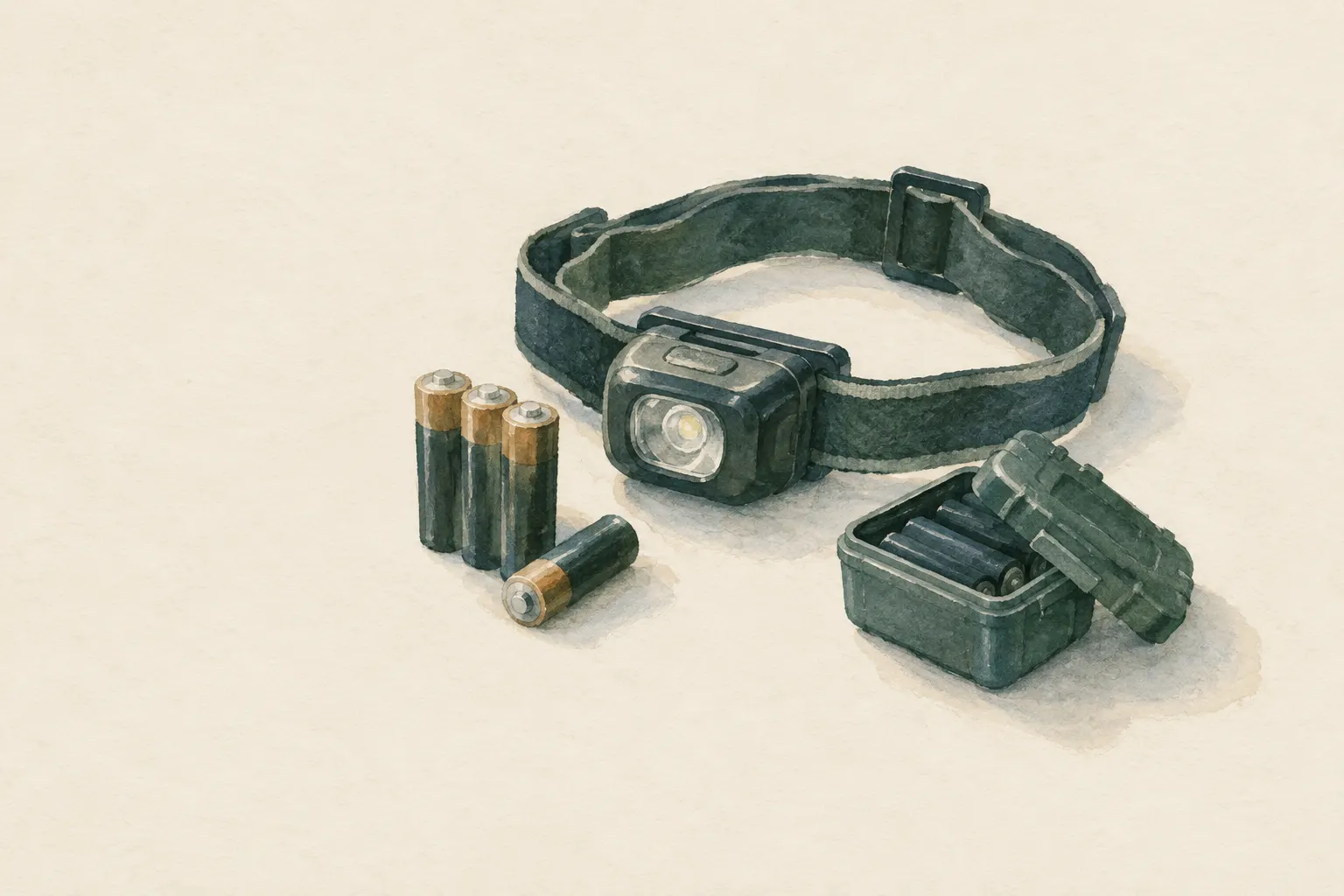
A headlamp keeps your hands free and is one of the most important pieces of emergency gear. What matters is not peak figures but reliable run time, a useful low mode, protection against switching on in the pack and suitable batteries. Cold, storage and self-discharge determine whether the light is really there in an emergency.
- Chosen once; check batteries twice a year
Explained simply
A headlamp is a small lamp you wear on your head with a strap. The light always shines where you look, and your hands stay free – for cooking, pitching a tent or holding on along a dark path. That is why it belongs in every emergency bag and every household.
A lamp is only as good as its batteries. Think of a battery as a water tank: if you open the tap all the way (very bright), the tank empties quickly. If you open it only a little (dim light), it lasts much longer. Cold also makes the tank “sluggish” – cold batteries deliver less power. That is why in winter you keep them warm close to your body.
Batteries, and especially small button cells, do not belong in children's hands. If a child may have swallowed a battery, get medical help straight away or call the emergency number.
How it works
Modern headlamps make light with light-emitting diodes (LEDs), which turn a little electricity into a lot of light. Brightness is often given in lumens – the total amount of light the lamp gives off. More lumens sounds good but also uses more energy. For reading a map, cooking or walking on a known path a low or medium mode is usually enough.
Light is a matter of energy over time. A battery holds a certain amount of energy, and the lamp divides it up: lots of light for a short time or little light for a long time. A useful low mode can last many times longer than the highest one. Many lamps also automatically turn the brightness down after a while so they do not get too hot or to spare the battery.
Cold slows the chemical processes in batteries. The energy is still there, but it is harder to draw out – the lamp gets dimmer or seems to run flat. When the battery warms up again, some of the performance returns. That is why in frost you carry the lamp and spare batteries close to your body and put them in your sleeping bag at night.
Batteries and rechargeables
Roughly, there are three groups. Alkaline batteries are available everywhere but lose a lot of performance in the cold and can leak during long storage in a device. Lithium primary batteries are lighter, usually work better in the cold and store for a long time – whether your lamp tolerates them is stated in the manual. Rechargeable batteries save waste and money over time but need regular recharging, because they slowly discharge even when unused.
Many lamps have a built-in battery that you charge with a cable. That is convenient as long as there is power. During a longer power cut or on a multi-day trip you then need a power bank or another way to charge. For emergency preparedness, a lamp that can also take ordinary batteries is practical.
Lithium rechargeables like neither heat nor damage. Many manufacturers also advise against charging them in freezing conditions. For storage, some manufacturers recommend keeping rechargeables partly charged rather than completely full or empty. Store single-use batteries cool and dry and keep an eye on the expiry date.
What matters when choosing
Do not look only at the highest lumen figure but at how long the lamp lasts in low and medium modes. Figures according to the ANSI/PLATO FL 1 standard make lamps easier to compare, because all manufacturers then measure the same way. The standard does not say, however, whether a lamp suits your purpose.
In practice what matters is: simple operation that works with gloves and when half asleep; a very low mode or red light; protection against rain; a comfortable headband; and a lock against switching on by accident. Without a lock the lamp can switch on in the pack and drain unnoticed. If it has no lock, you can carry one battery reversed or separately.
Red light has a special advantage: your eyes slowly adapt to the little light there is in the dark, and that takes many minutes. Bright white light quickly undoes this adaptation, while dim red light disturbs it less. You also dazzle others in the tent or group less.
Safety: what to watch out for
Stop using lithium batteries and power banks that are damaged, swollen or have become very hot, and charge them only with suitable chargers. Special rules apply to spare batteries and power banks on flights – ask the airline beforehand.
Button cells and small batteries are dangerous for small children if swallowed. Keep them out of children's reach. If you suspect a child has swallowed a battery, seek medical help immediately or call the local emergency number (112 in the EU) – do not wait to see whether symptoms appear.
Civil protection authorities recommend torches or headlamps rather than candles for power cuts, because open flames can start fires. Keep a lamp for each person in the household in a fixed place everyone knows, so it can be found quickly in the dark.
How to keep your light ready
Test lamps and batteries twice a year, for example at the start of summer and of winter. Switch on every mode once, check the contacts for white or greenish deposits (corrosion) and recharge rechargeables. Take empty batteries to the proper collection points, not into household waste.
If you rarely use a lamp, store alkaline batteries separately next to it rather than inside – that way a leak cannot damage the lamp. Get to know the controls in the dark: how do you go straight to the lowest mode? How do you lock the lamp? If you practise this at home, you will manage it in an emergency even with cold fingers.
Step by step
Choose by properties
Look at run time in low and medium modes, not just peak brightness. Figures according to the ANSI/PLATO FL 1 standard make lamps easier to compare. Also important: simple operation with gloves, red light or a very low mode, water resistance and a lock against accidental switching on.
- 1
Choose by properties
Look at run time in low and medium modes, not just peak brightness. Figures according to the ANSI/PLATO FL 1 standard make lamps easier to compare. Also important: simple operation with gloves, red light or a very low mode, water resistance and a lock against accidental switching on.
- 2
Choose the power source
Lamps using standard batteries can be supplied anywhere; built-in batteries need power to recharge. Some lamps can use both. For emergency supplies a lamp that also takes standard batteries is flexible.
- 3
Keep warm in the cold
Carry the lamp, spare batteries and rechargeables close to the body or keep them in the sleeping bag at night. Lithium primary batteries usually work better in the cold than alkaline – check the lamp manufacturer's information on which types are allowed.
- 4
Secure against switching on
Use the lock function or carry one battery reversed or separately so the lamp does not drain unnoticed in the pack.
- 5
Store correctly
Store batteries cool and dry, observe the expiry date, keep rechargeables partly charged for long-term storage if the manufacturer recommends it.
- 6
Check regularly
Test lamps and batteries twice a year, check contacts for corrosion, recharge rechargeables. Dispose of empty batteries properly.
Common mistakes
- Looking only at the highest lumen figure
- Lamp with a flat battery in the go bag
- Leaving alkaline batteries in the device for years
- Spare batteries in an outer pocket in frost
- Lamp switching on inside the pack
Quick view
Materials
Headlamp / flashlight
Spare batteries
Store cool and dry, observe the expiry date; keep button cells out of children's reach.
Power bank
For lamps with a built-in battery
Do not use damaged or swollen batteries; do not charge while covered.
Suitable for
- Emergency kit for every person in the household
- Day trips that may take longer than planned
- Winter activities with short days
Not suitable for
- Long-distance signalling as the only method
- Use in explosive atmospheres without a lamp approved for it
Prerequisites
- Knowing what the lamp is used for (home, hiking, winter)
- The lamp's user manual
Safety
- Do not use lithium batteries and power banks that are damaged, swollen or overheated, and charge them only with suitable chargers. Special rules apply to spare batteries on flights – check with the airline.
- Keep button cells and batteries out of children's reach. If swallowing is suspected, seek medical help immediately or call emergency services.
- Alkaline batteries can leak during long storage in a device and damage contacts. In lamps that are rarely used, store batteries separately or check them regularly.
How it works
Light is a matter of energy over time: high brightness drains batteries quickly, a low mode can last many times longer. Cold slows the chemical processes in batteries, and usable capacity drops. Planning lamp and power source as a system – suitable battery types, kept warm, a reserve – gives reliable light even through a long night.
Advantages
- Hands free
- Small and light
- Versatile for home, car and trips
Disadvantages
- Dependent on batteries or charging power
- Performance drops in the cold
Deep knowledge
Background
The ANSI/PLATO FL 1 standard specifies how manufacturers measure and state figures such as light output, run time and beam distance. It makes figures more comparable but says nothing about whether a lamp is suitable for a particular purpose.
Civil protection authorities such as Germany's BBK and Ready.gov recommend torches or headlamps with spare batteries instead of candles for emergency preparedness.
Variants
- For the household
- At home a room light (lantern) complements the headlamp. Keep a separate lamp for each person in a fixed place.
Common mistakes
- Looking only at the highest lumen figure
- Lamp with a flat battery in the go bag
- Leaving alkaline batteries in the device for years
- Spare batteries in an outer pocket in frost
- Lamp switching on inside the pack
Limits and risks
- No product recommendations
- No detailed information on battery chemistry
Material alternatives
Derived from material properties: a substitute must have all relevant properties. Observe the notes on the substitute.
- Headlamp / flashlight
- Mobile phone (The battery drains quickly in cold and with continuous screen and GPS use.), Battery lantern / LED light
Results come exclusively from structured entries. No improvised instructions are generated.
Sources
Portable Lights American Trade Organization (PLATO) / American National Standards Institute (ANSI): ANSI/PLATO FL 1 – Flashlight Basic Performance Standard
Standardised figures for light output, run time and beam distance
Bundesamt für Bevölkerungsschutz und Katastrophenhilfe (BBK), Deutschland: Ratgeber für Notfallvorsorge und richtiges Handeln in Notsituationen
Torches and spare batteries instead of candles in emergency preparedness
Ready.gov – U.S. Federal Emergency Management Agency (FEMA): Power Outages
Flashlights instead of candles, spare batteries