Packing a day pack
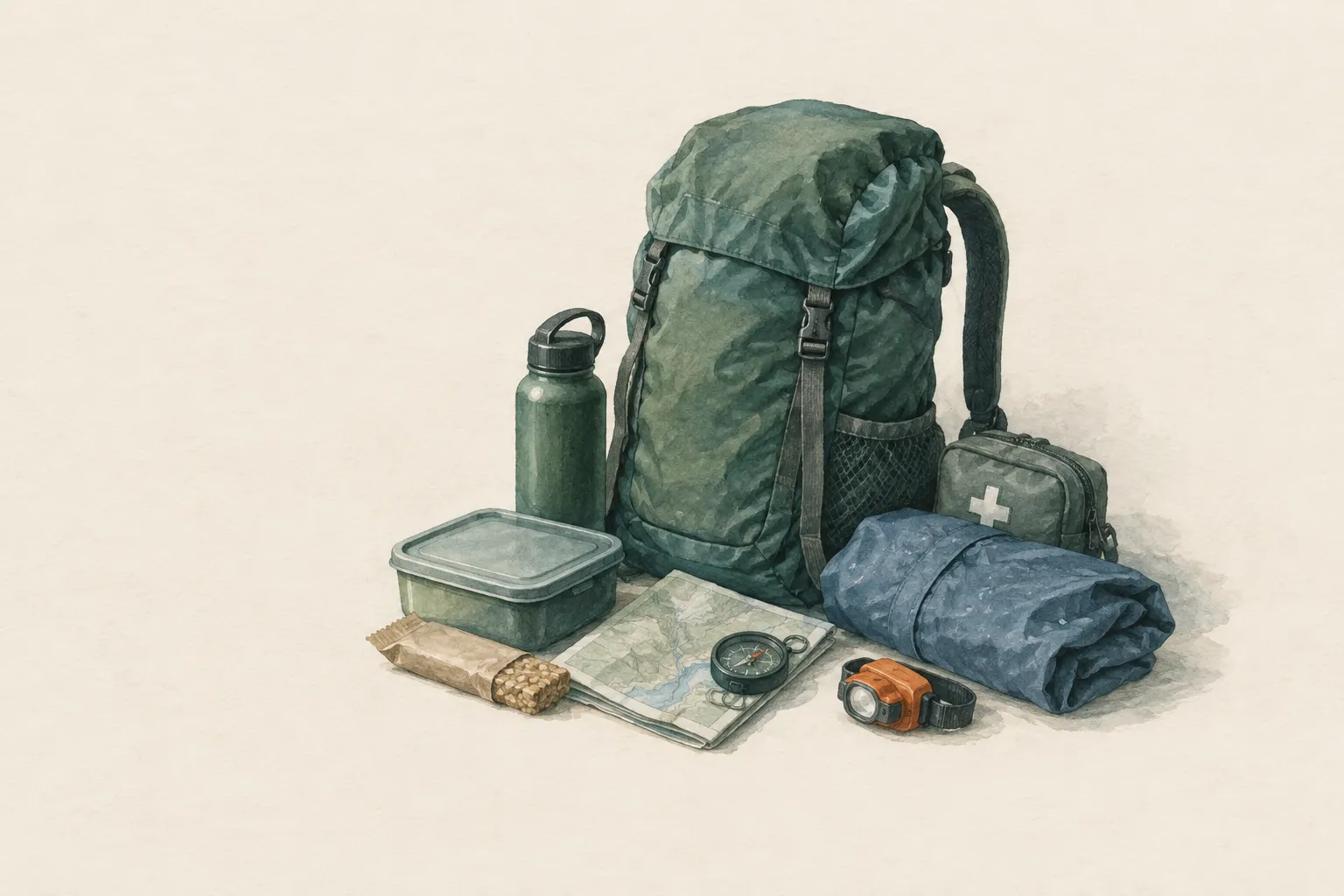
Even a short trip can take longer than planned – through injury, a change in the weather or getting lost. A well-packed day pack therefore contains, alongside food and drink, a small reserve for navigation, light, weather protection, first aid and calling for help. Heavy items sit close to the back, important ones within reach, everything sensitive dry.
- 10–15 minutes before every trip
Explained simply
A day pack is for an outing after which you are back home in the evening. Even so, you pack it as if things might take a bit longer. Because even a short hike can be delayed: someone twists an ankle, a thunderstorm comes up or you lose your way. Then it is good to have a few things with you “just in case” – like a small emergency store on your back.
Besides food and drink, that includes a warm layer, a rain jacket, a lamp, a first-aid kit, a charged phone and a map. Heavy things go close to your back, important things on top, and everything that must not get wet in a waterproof bag.
The most important thing does not fit in any pack, though: tell a trusted person where you are going and when you plan to be back. If something happens, someone then knows where to look for you.
The idea behind it
A day pack does not have to be equipped for every imaginable situation. It is meant to help you get safely through an unplanned delay: a few hours waiting for help, a sudden change in the weather, an unexpected night outdoors. Most day trips go without incident. The reserve is for the few where things turn out differently.
The “Ten Essentials” list has proved its worth. It comes from the mountaineering organisation The Mountaineers and is presented in the handbook “Mountaineering: The Freedom of the Hills” as a list of functions: navigation, light, sun protection, first aid, tools and repair, fire, weather protection and insulation, emergency shelter, extra food and extra water. It is not about particular items but about making sure every function is covered somehow.
The list is a checklist, not a rigid packing scheme. For a walk in the town woods the reserve is smaller than for a mountain hike. In winter more insulation is added, on hot days more water and sun protection. The thought stays the same: what do I need if I am out for much longer than planned?
What matters when packing
Weight: heavy things like water and food belong close to your back and in the middle. That keeps the centre of gravity close to your body, and the pack does not pull you backwards. Light, soft things like clothing go at the bottom or on the outside.
Access: what you need often or quickly on the way goes on top or in outer pockets – rain jacket, snacks, map, sun protection, phone. The first-aid kit does not belong right at the bottom but in a place everyone in the group knows. In an emergency someone other than you may be looking for it.
Protection: pack clothing, electronics and the first-aid kit in waterproof bags, or line the whole pack with one large bag. A rain cover alone does not always keep things dry, because water can get in along the back and the straps. Finally, adjust the straps so nothing swings: hip belt (if any) on the hip bones, shoulder straps snug, chest strap closed.
Typical situations
A change in the weather in the afternoon: it suddenly gets cool, windy and wet. With a rain jacket and a warm layer you carry on calmly or wait somewhere sheltered. Wearing only a T-shirt, you chill quickly – even in summer, especially in the mountains.
An injury: someone twists an ankle and cannot walk any more. It can take a long time for help to arrive. During that time the injured person sits still and cools down. Now a sit pad, emergency blanket, warm layer, hat and something to drink help more than anything else. A whistle helps you be heard and saves strength compared with shouting.
Dusk comes earlier than expected: one detour or a long break, and suddenly it is getting dark. With a headlamp you find your way far more safely than with your phone light – the phone is also your navigation and your way to call for help, so its battery is worth saving.
Safety: what to watch out for
The best gear helps little if nobody knows where you are. Leave your route and planned return time with a trusted person and agree what they will do if you do not get in touch. Check the forecast before setting off and turn back if the weather gets worse than expected.
Do not rely on your phone as your only light and only means of navigation. The battery can run flat, there is often no signal in valleys or forests, and cold makes batteries weaken faster. A paper map and a lamp with its own batteries are a reliable reserve.
In an accident or if someone cannot go on: call the local emergency number (112 in the EU), describe the location as precisely as possible and protect the person from cold and wet – from below too, with something between them and the cold ground. For alpine routes or winter trips in avalanche terrain an ordinary day pack is not enough; they need additional specialist gear and training.
How to make it a routine
Put the basic kit together once and leave it in the pack: first-aid kit, lamp, emergency blanket, whistle, small repair items and a hat. Before each trip you then only add water, food, suitable clothing and the map for the route. That takes a few minutes.
A short checklist by the door helps: phone charged? Water filled? Weather checked? Route and return time left with someone? After the trip, replace straight away whatever was used – plasters, batteries, snacks – so the pack is complete again next time.
Children like carrying their own small pack with a water bottle, snack, whistle and a warm layer. Explain what the whistle is for: anyone who is lost stays where they are and blows it. The adult carries the actual reserve.
Step by step
Cover the functions
Navigation (map, compass, charged phone), light, sun protection, first-aid kit, tool/repair, fire, weather protection and insulation, emergency shelter (e.g. emergency blanket), extra food and water.
- 1
Cover the functions
Navigation (map, compass, charged phone), light, sun protection, first-aid kit, tool/repair, fire, weather protection and insulation, emergency shelter (e.g. emergency blanket), extra food and water.
- 2
Waterproof inside
Put clothing, electronics and the first-aid kit in dry bags or a liner. A rain cover alone does not always keep things dry.
- 3
Distribute weight
Heavy items (water, food) close to the back and in the middle, light bulky clothing at the bottom or outside.
- 4
Pack for access
Rain jacket, snacks, map, sun protection and phone on top or in outer pockets; the first-aid kit easy to find and known to everyone in the group.
- 5
Adjust the pack
Hip belt (if any) on the hip bones, tighten shoulder straps, close the chest strap. Nothing should swing.
- 6
Check before leaving
Phone charged? Water filled? Weather checked? Route and return time left with someone? After the trip replace what was used straight away.
Common mistakes
- Packing only for the fair-weather scenario
- No warm layer in summer
- Phone as the only light and navigation
- First-aid kit buried at the bottom
- Not replacing used items after the trip
Quick view
Materials
Backpack
Dry bag
Or a bin bag as a liner
Rain and wind shell
Dry spare clothing
Warm layer, hat, gloves
Carry it in waterproof packaging – wet clothing barely insulates.
Headlamp / flashlight
Topographic map
Check the publication date – paths and buildings may have changed.
Protect from wet (map case or bag).
Mobile phone
The battery drains quickly in cold and with continuous screen and GPS use.
Do not plan on it as your only means of navigation or emergency calls.
Emergency blanket
Tears easily once punctured; short-term shelter only.
Conductive – keep away from power lines.
Signal whistle
Carry within easy reach, not deep in the pack.
Do not blow right next to other people's ears.
Suitable for
- Day hikes and outings
- Family outings with children
- Basic kit for spontaneous trips
Not suitable for
- Multi-day trips with overnight stays
- Alpine or winter trips in avalanche terrain (additional specialist gear)
Prerequisites
- A planned route with time estimates
- The weather forecast for the day
Safety
- The best gear helps little if no one knows where you are. Tell a trusted person your route and planned return time.
How it works
A day pack is not meant to be equipped for everything but for getting safely through an unplanned delay: a night outdoors, a change in the weather, an injury. The Mountaineers' “Ten Essentials” concept groups this reserve into functions. Packing follows weight (heavy close to the back), access (frequently needed on top) and protection (sensitive items dry).
Advantages
- Makes small emergencies manageable
- Little extra weight
- Quick to pack once assembled
Disadvantages
- More weight than the bare minimum
- Has to be restocked after every trip
Deep knowledge
Background
The “Ten Essentials” list comes from The Mountaineers and is presented in “Mountaineering: The Freedom of the Hills” as a list of functions. It is not a rigid packing scheme but a checklist adapted to the trip, season and group.
The household go bag has a different purpose from the day pack: it is meant to bridge an evacuation. Many items overlap, however.
Variants
- With children
- Children carry their own light pack with water bottle, snack, whistle and a warm layer; the adult carries the reserve.
- In winter
- Extra insulation, spare gloves, a warm drink in an insulated bottle, a sit pad and more light because of the short days.
Common mistakes
- Packing only for the fair-weather scenario
- No warm layer in summer
- Phone as the only light and navigation
- First-aid kit buried at the bottom
- Not replacing used items after the trip
Limits and risks
- No complete gear list for alpine tours
- No product recommendations
Material alternatives
Derived from material properties: a substitute must have all relevant properties. Observe the notes on the substitute.
- Backpack
- Sleeping pad, Dry leaves, grass or conifer boughs (Collect only where allowed; no protected plants. Check for ticks and insects.), Dry spare clothing (Carry it in waterproof packaging – wet clothing barely insulates.), Wool blanket / duvet (Keep away from candles, stoves and heaters.), Insulated cool box (Keeps cold only for a limited time; without ice packs or ice it is not a fridge.), Sleeping bag (Do not store compressed long-term; do not pack away damp.), Newspaper and cardboard (Flammable – keep away from candles, stoves, heaters and embers.), Insulated cooking box (hay box, thermal cooker) (Never put open flame or embers inside – only the hot, closed pot.)
- Rain and wind shell
- Cotton cloth / T-shirt (Removes coarse particles only – no disinfection.)
- Dry spare clothing
- Sleeping pad, Dry leaves, grass or conifer boughs (Collect only where allowed; no protected plants. Check for ticks and insects.), Backpack, Wool blanket / duvet (Keep away from candles, stoves and heaters.), Insulated cool box (Keeps cold only for a limited time; without ice packs or ice it is not a fridge.), Sleeping bag (Do not store compressed long-term; do not pack away damp.), Newspaper and cardboard (Flammable – keep away from candles, stoves, heaters and embers.), Insulated cooking box (hay box, thermal cooker) (Never put open flame or embers inside – only the hot, closed pot.)
- Headlamp / flashlight
- Mobile phone (The battery drains quickly in cold and with continuous screen and GPS use.), Battery lantern / LED light
- Mobile phone
- Headlamp / flashlight, Battery lantern / LED light
Results come exclusively from structured entries. No improvised instructions are generated.
Sources
The Mountaineers Books (2017): Mountaineering: The Freedom of the Hills, 9th edition
“Ten Essentials” as a list of functions for trips
Ready.gov – U.S. Federal Emergency Management Agency (FEMA): Make A Plan
Leaving a plan and agreeing contact