Swedish torch (log candle)
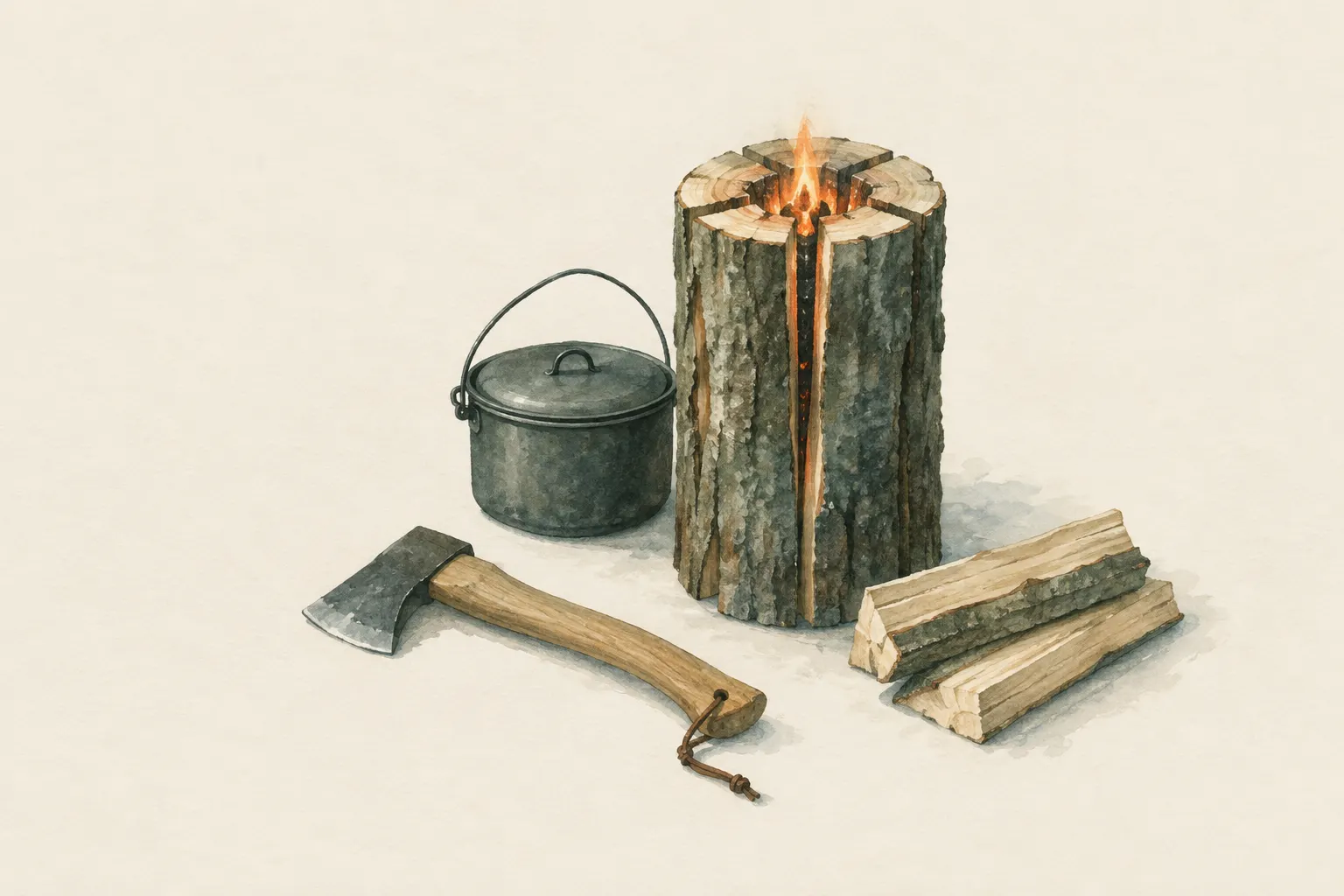
A Swedish torch is an upright, dry log section cut or split lengthwise several times from the top. Lit in the centre, it burns from the top down and offers a small, flat surface for a pot. It is more a fire for permitted fire sites and gardens than for the wilderness, because large logs do not burn completely to ash.
- Preparation with a saw; burns for a long time depending on the log
Explained simply
A Swedish torch is a thick, dry piece of tree trunk standing upright like a giant candle. It is sawn lengthwise several times from the top, so that a star of slots is created. You light it in the middle, and then it burns from the top down and from the inside out – without adding any wood.
The slots work like little chimneys: hot air rises in the middle, and fresh air is drawn in from below. On top there is a small, flat spot where you can put a pot.
The important thing: the log can tip over or fall apart as it burns down. So it belongs only on level, fireproof ground, at a distance from anything that can burn, and with extinguishing water nearby.
How it works
A thick log normally burns poorly because air cannot reach the inside. The lengthwise cuts change that: they form narrow channels through which the fire gets air. Hot gases rise in the middle, and fresh air flows in from below through the slots. This is called the chimney effect or draught.
Because the slots reach only about two thirds to three quarters of the height, the lower part stays in one piece and supports the log. The fire slowly eats its way from the top downwards. A glowing surface forms on top, which is suitable as a small cooking spot for a single pot.
What really matters
The wood must be dry and seasoned. Freshly cut or damp wood hisses, smokes and hardly burns. The cut faces should be as flat as possible so that the log stands securely and a pot sits level on top. Saw the slots crosswise from the top, but never all the way down – otherwise the log falls apart as it burns.
To light it, push tinder and fine shavings into the centre and the upper slots and light them at the top. It takes quite a while until the slots themselves are burning – patience matters more here than more tinder. Instead of saw cuts, you can also split the log into quarters, stand them back together with small spacers and bind them with wire.
When it makes sense – and when not
The Swedish torch is mainly a fire for permitted fire sites, gardens and events. It needs no tending, gives light and a little warmth and offers a small cooking spot. On a solid base it can also work in snow.
In the wilderness it makes less sense. It needs a saw and a thick, dry log, ties up a lot of wood and usually does not burn completely to ash – charred remains are left behind that do not fit the idea of leaving no trace. It is unsuitable in wind and dry conditions, on soft or sloping ground, on meadows and on wooden decks. And it can hardly be regulated: once it burns, it burns for a long time.
Safety: what to watch out for
The log can tip or fall apart as it burns down. Set it up only on level, fireproof ground such as stone, gravel or bare soil, with plenty of distance from buildings, trees and plants. Keep your distance and place pots carefully. As soon as the log becomes unstable, no more pots go on it. Children stay outside a clearly marked area.
Sawing has risks too. Chainsaws belong only in trained hands with protective equipment. With a hand saw, secure the log firmly so it does not roll away. Never use petrol, spirit or other liquids to light it – the vapours can ignite explosively.
A thick log keeps glowing inside for a very long time, even when nothing can be seen on the outside. Extinguish it with plenty of water, split the remains and extinguish again until everything is cold. And above all: check the local rules and the current wildfire danger beforehand.
Good to know
The Swedish torch has many names: Swedish fire log, Finnish candle or log candle. In Scandinavia and Central Europe it is known mainly as a garden and event fire, for example on winter nights.
As a cooking spot it is practical for a single pot but does not replace a stove. If you want to cook regularly, a stove or a keyhole fire at an existing fire site usually serves you better.
Step by step
Choose a site
Choose level, fireproof ground with plenty of distance from buildings, trees and vegetation; have extinguishing water ready.
- 1
Choose a site
Choose level, fireproof ground with plenty of distance from buildings, trees and vegetation; have extinguishing water ready.
- 2
Cut
Secure the log upright and saw several cuts crosswise from the top down to roughly two thirds to three quarters of its height. The lower part stays in one piece.
- 3
Add tinder
Push tinder and fine shavings into the centre and the upper slots.
- 4
Light at the top
Light the tinder at the top. It takes a while until the slots themselves are burning.
- 5
Supervise
Supervise the fire constantly; once the log becomes unstable, stop placing pots on it.
Common mistakes
- Damp or freshly cut wood
- Cuts all the way down, so the log falls apart
- Setting it up on a wooden deck or meadow
- Accelerants to light it
Quick view
Materials
Dry firewood
Dry log section cut square
Collect only where permitted.
Tinder
Carry in waterproof packaging.
Do not use liquid accelerants as tinder.
Water for extinguishing (bucket, canister or pot)
Have several litres ready before lighting.
Suitable for
- Permitted fire sites and gardens
- Light and a small cooking spot
- Snow (on a base)
Not suitable for
- Wind and dry conditions
- Wilderness with a Leave No Trace standard
- Soft or sloping ground
- Wooden decks
Prerequisites
- A dry log with flat cut faces
- A saw and safe sawing technique
- Fireproof, level ground
- Enough extinguishing water
Safety
- Use chainsaws only with training and protective equipment. Secure the log firmly when using a hand saw.
- A large log keeps glowing inside for a long time. Extinguish with plenty of water, split the remains and extinguish again until everything is cold.
How it works
The lengthwise cuts form narrow chimneys: hot air rises in the centre and fresh air is drawn in from below through the slots. The fire therefore burns from the inside out and from the top down without needing more wood.
Advantages
- No refuelling needed
- Small flat cooking surface
- Easy to supervise
Disadvantages
- Needs a saw and a thick, dry log
- Risk of tipping
- Long afterglow, does not burn completely
Deep knowledge
Background
The Swedish torch is known in Scandinavia and Central Europe mainly as a garden and event fire. In the wilderness it makes less sense because it ties up a lot of wood.
As a cooking spot it is practical for a single pot but does not replace a stove.
Variants
- Split variant
- Instead of saw cuts, split the log into quarters, stand them back together with small spacers and bind them with wire.
Common mistakes
- Damp or freshly cut wood
- Cuts all the way down, so the log falls apart
- Setting it up on a wooden deck or meadow
- Accelerants to light it
Limits and risks
- Only with a large, dry log
- Hardly adjustable
Material alternatives
Derived from material properties: a substitute must have all relevant properties. Observe the notes on the substitute.
- Dry firewood
- Tinder (Carry in waterproof packaging.), Char cloth (charred cotton) (Store dry in a tin.), Finest-grade steel wool (Store separately from batteries – fire risk.), Fatwood (resin-rich wood) (Collect only dead wood where permitted.), Stove fuel (canister, liquid fuel, alcohol) (Store fuels apart from food and in original containers or bottles intended for them.), Petroleum jelly cotton balls (Use only pure cotton.)
- Tinder
- Dry firewood (Collect only where permitted.), Char cloth (charred cotton) (Store dry in a tin.), Finest-grade steel wool (Store separately from batteries – fire risk.), Fatwood (resin-rich wood) (Collect only dead wood where permitted.), Stove fuel (canister, liquid fuel, alcohol) (Store fuels apart from food and in original containers or bottles intended for them.), Petroleum jelly cotton balls (Use only pure cotton.)
Results come exclusively from structured entries. No improvised instructions are generated.
Sources
USDA Forest Service / Ad Council / National Association of State Foresters: Campfire Safety (Smokey Bear wildfire prevention campaign)
Safe fire site, supervision and complete extinguishing
Leave No Trace Center for Outdoor Ethics: The Seven Principles of Leave No Trace (Principle 5: Minimize Campfire Impacts)
Small fires with small wood that burns completely to ash