Using a saw and hatchet safely – the basic rules
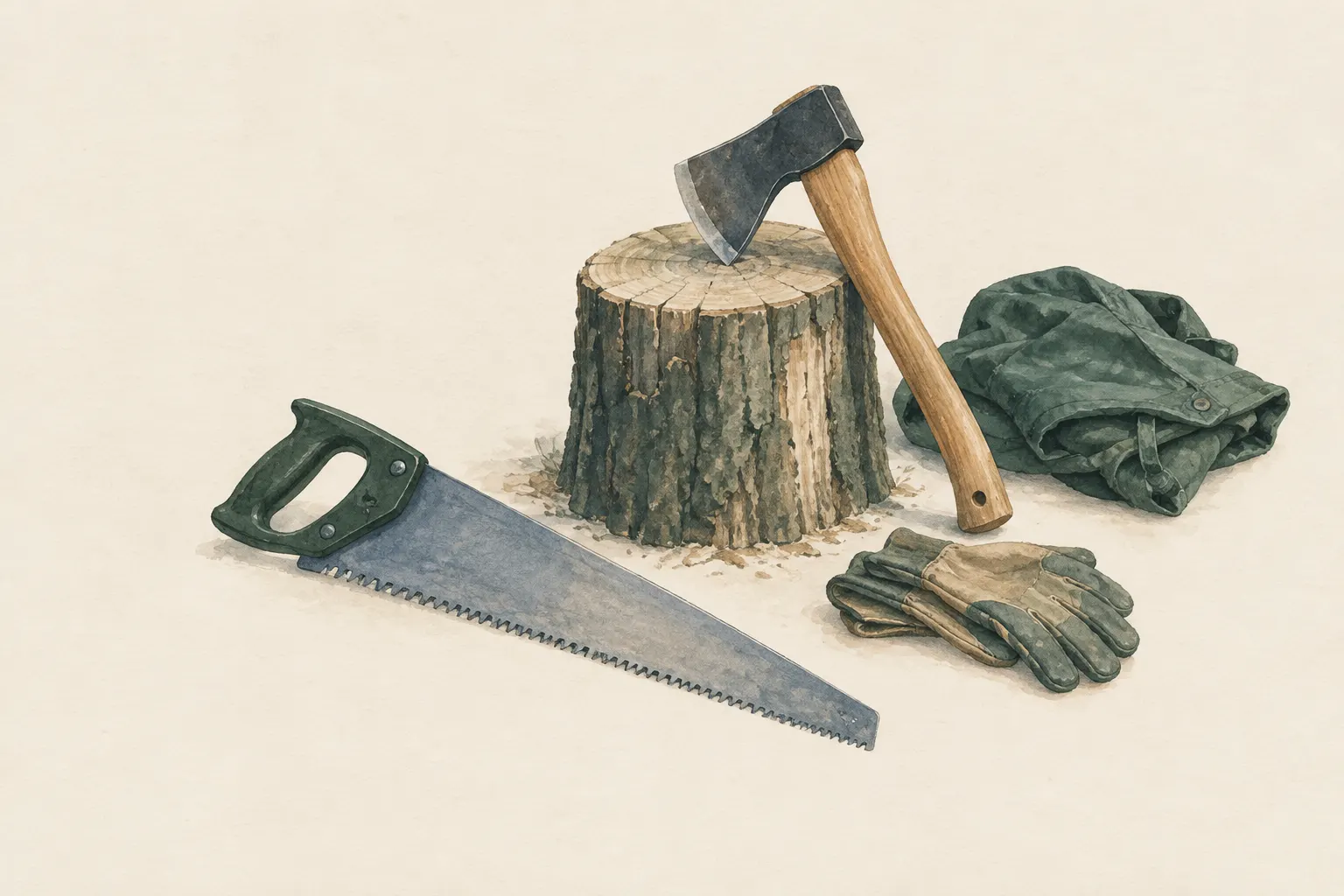
For firewood and simple camp tasks a saw is usually the safer choice: it works slowly and with control. A hatchet is faster, but a deflected blow can cause serious injuries. A firm stance, a clear swing area, a chopping block and distance from other people greatly reduce the risks.
- Instruction and practice about 1–2 hours
Explained simply
A saw and a hatchet help you make wood smaller – for a fire, for example. But the two are very different. A saw works slowly, stroke by stroke. A hatchet, on the other hand, is swung, and a lot of force is stored in the swing – a bit like a playground swing that you can no longer stop halfway.
That is why a saw is usually the better choice for beginners. When you use a hatchet, you stand the wood on a chopping block, a thick block of wood. If the hatchet misses the wood, it then lands in the block and not in your leg. Your hand never holds the wood while you strike.
Nobody may stand near you while you chop – not behind you either. Have a first-aid kit ready. And only use dead wood lying around where that is allowed, or ask the owner of the forest. Living trees stay standing.
How it works
Tool safety is ultimately about controlling energy. A saw releases only a little energy with each stroke. If it jumps out of the cut, the movement is slow and usually harmless, as long as the free hand is not right beside it. That is why the saw counts as a forgiving tool.
A hatchet stores the energy of the whole swing in its head. If it does not strike as planned – because it glances off a knot, breaks through the wood or misses entirely – that energy is released wherever the swing is pointing. In most postures that is towards the leg and foot. So the key question with a hatchet is: where does the swing path end if something goes wrong?
The answer is always a hard target in front of the body: the chopping block or the ground in front of the knees. That is why small hatchets are often used kneeling and with short, controlled blows instead of wide swings.
What really matters
Before each use you check the tool. Is the hatchet head firmly seated on the handle? Does the handle have cracks? Is the edge sharp and are the saw teeth intact? A loose head can fly off, a dull hatchet glances off more easily. Then look around: there must be no branches, lines or people in the way above, beside or behind you. A branch that deflects the swing can turn a well-planned blow into a dangerous one.
When sawing, the wood lies on a stable support such as a sawhorse. You saw with long, steady strokes without forcing, because the teeth do the work. The free hand holds the wood well away from the cut.
With a hatchet, the wood stands on a chopping block, never on the ground or on a stone. Stabilise small pieces with a stick rather than your hand – or saw them instead. Stop when you get tired: most missed blows happen at the end of a work session.
Safety: what to watch out for
The swing area must be clear in every direction, including behind you, because the head can hit someone as you draw back. Keep clearly more distance from others than arm length plus tool length. Onlookers stay outside it, and anyone who wants to enter the area says so first and waits.
Sturdy, closed footwear is part of it, and so is a first-aid kit within reach. With a serious injury, press firmly on the wound and call the local emergency number (112 in the EU). Do not work in the dark, on slippery ground or when exhausted.
After work the edge guard goes on the hatchet and the saw is folded. A hatchet left stuck in the block is a trap: someone can trip over it or reach into it. Felling trees, chainsaws and large axes are a separate field and require training and protective equipment.
When it makes sense – and when not
For kindling and small firewood, thin dead wood that you cut to length with a saw or even snap by hand is often enough. Then you do not need a hatchet at all. A hatchet is worth it mainly for splitting somewhat thicker pieces to get at the dry inside.
Where the wood comes from matters as much as the tool. Cutting living trees and collecting wood are regulated or prohibited in many places, especially in protected areas. Only use dead wood where that is allowed, or wood the landowner has given you permission to use. Check local rules and wildfire warnings before you even start making firewood.
How to practise it
Start with the saw. Practise on a stable horse until you can saw straight without forcing. Notice how the wood behaves: if the blade binds, the piece is supported wrongly. That is a good school for reading wood.
A hatchet is best learned with an instructor. Start with short, thin pieces on a chopping block and work kneeling, so that a missed blow ends in the block or the ground in front of your knees. What matters are small, accurate blows rather than force. Only once that works reliably do you move on to somewhat larger pieces.
Step by step
Check tool and surroundings
Check the head, handle, edge and saw. There must be no branches, lines or people in the way above, beside or behind you. Firm footing, sturdy footwear.
- 1
Check tool and surroundings
Check the head, handle, edge and saw. There must be no branches, lines or people in the way above, beside or behind you. Firm footing, sturdy footwear.
- 2
Saw where possible
Place the wood on a stable support, keep the free hand well away from the blade and saw with long, steady strokes without forcing. Support the workpiece so that the blade does not bind.
Never put your hand right next to the saw cut.
- 3
Hatchet only on a chopping block
For splitting, stand the piece of wood on a chopping block, not on the ground. For small wood work kneeling, so that a glancing blow ends in the block or ground in front of the knees.
- 4
Hands out of the swing path
Never hold the wood with your hand while striking. Stabilise small pieces with a stick or saw them instead.
- 5
Short, controlled blows
Prefer small, accurate blows to wide swings. Stop when tired – most missed blows happen at the end of a work session.
- 6
Store safely
Fit the edge guard or fold the saw. Do not leave a hatchet stuck in wood or the block where someone could trip over or reach into it.
Common mistakes
- Splitting on the ground instead of a chopping block
- Holding the wood with your hand
- Wide swings with a small hatchet
- Continuing to use a loose hatchet head
- Other people within the swing area
Quick view
Materials
Folding saw
Fold or cover the blade after use; saw teeth are very sharp.
Hatchet or small axe
Only with experience or under instruction
Only use with a firmly seated head and sound handle; fit the edge guard when not in use.
Rules on carrying and on cutting wood differ by region – check local rules.
Sturdy closed shoes
Sturdy, closed footwear
First-aid kit (household)
Does not replace a first-aid course; check contents and expiry dates regularly.
Suitable for
- Cutting up dead wood and firewood
- Cutting sticks for camp structures
- Splitting small pieces of wood on a chopping block
Not suitable for
- Felling trees – that requires training and protective equipment
- Working in the dark, on slippery ground or when exhausted
- Striking stones, soil or metal
Prerequisites
- Tools in good condition: firm head, sound handle, sharp edge or saw teeth
- A stable chopping block or sawhorse
- Knowledge of local rules on which wood may be cut
Safety
- Before each use check that the head is firmly seated on the handle and that the handle has no cracks. A loose head can fly off.
- Cutting living trees and collecting wood are regulated or prohibited in many places – only use dead wood where permitted and check local rules.
How it works
Tool safety means controlling the tool's energy. A saw releases little energy per stroke and is therefore forgiving. A hatchet stores a lot of energy in the swing; if it does not strike as planned, that energy is released wherever the swing is pointing. That is why you plan the swing path to end in a hard target, use short, controlled blows where possible and keep your body out of the line of the swing.
Advantages
- Saw: quiet, controlled, suitable for beginners
- Hatchet: fast for splitting, versatile in experienced hands
Disadvantages
- Hatchet: high injury risk when mistakes happen
- Both tools need care and sharp edges
Deep knowledge
Background
The US Forest Service manual "An Ax to Grind" describes choosing, maintaining and safely using axes for forest workers, including checking the tool and keeping a clear work area. Bushcraft textbooks such as those by Ray Mears and Mors Kochanski also recommend kneeling work positions and chopping blocks for small hatchets.
This entry deliberately limits itself to basic rules for small tools. Felling trees, chainsaw work and using large axes require training, protective equipment and, in many countries, certification.
Variants
- Splitting by saw instead of hatchet
- For kindling, thin dead wood that can be cut to length with a saw is often enough. Then the hatchet is not needed at all.
Common mistakes
- Splitting on the ground instead of a chopping block
- Holding the wood with your hand
- Wide swings with a small hatchet
- Continuing to use a loose hatchet head
- Other people within the swing area
Limits and risks
- No felling, no chainsaw
- No legal advice on cutting wood
- Does not replace hands-on instruction
Sources
USDA Forest Service, Missoula Technology and Development Center (Bernie Weisgerber, Bob Beckley) (1999): An Ax to Grind: A Practical Ax Manual
Checking axe and handle, clear work area, safe axe use
Ray Mears – Hodder & Stoughton (2002): Bushcraft
Chopping block and kneeling position with a hatchet, saw in camp
Mors L. Kochanski – Lone Pine Publishing: Bushcraft: Outdoor Skills and Wilderness Survival
Using saw and axe in camp