Preparing tinder, kindling and fuel wood
A fire succeeds before it is lit: if you lay out enough tinder, kindling in several thicknesses and fuel wood, sorted, you need only one attempt. Rule of thumb: prepare twice as much as you think you need.
- 15–30 minutes collecting and preparing
Explained simply
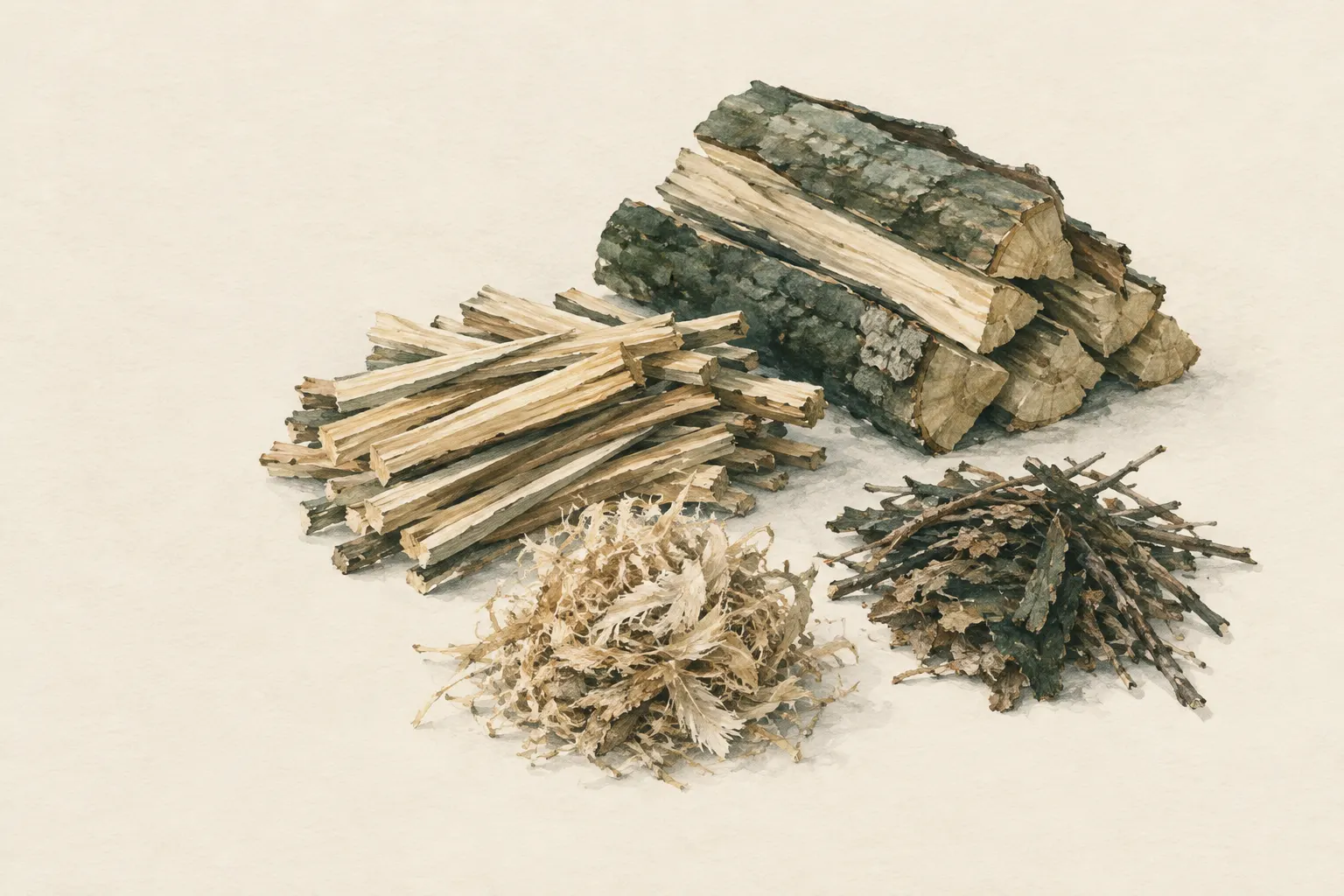
A fire succeeds before you even light it. You need three kinds of material: very fine stuff that catches fire at once (tinder, for example dry grass or thin strips of bark), thin twigs (kindling) and thicker wood (fuel wood).
Think of a relay race: the tinder passes the flame to the thin twigs, the thin twigs pass it to the thicker ones, and the thicker ones to the fuel wood. If one runner is missing, the fire gets stuck. So you sort everything beforehand into little piles from thin to thick and lay it within reach.
Always collect more than you think – about twice as much. Take only dead wood that snaps when you bend it. And if you use a knife: always carve away from your body.
How it works
Each stage of a fire must supply enough heat to ignite the next thicker stage. A match burns for only a few seconds. That is enough to light very fine tinder, but never to get a thick branch burning. The tinder burns a little longer and hotter and lights matchstick-thin twigs. These light pencil-thick ones, those light thumb-thick ones – and only then is there enough heat for fuel wood.
Thin material catches faster because the heat quickly passes all the way through it and because air reaches it from all sides. In thick wood, the heat spreads into the interior and the surface stays too cool for a long time. That is why it is so important not to skip a stage.
Dryness matters more than the type of wood. Damp material first uses up its heat evaporating water. A pile of dry, pencil-thin twigs is therefore worth more than an armful of thick, damp logs.
Gear and materials
Good natural tinder is very fine, fibrous and dry: dry grass, thin peeled birch bark, fine dead conifer twigs, wood shavings. Rub or tease it apart until it is loose and airy like a small bird's nest. Make sure you only take material that is really dry, and do not tear anything off living plants.
Carried tinder is less dependent on the weather: for example cotton wool balls with a little petroleum jelly or ready-made fire-lighter cubes, packed waterproof. It belongs in every emergency kit, because after long rain dry natural material is hard to find.
A knife is helpful but not essential. With it you can split thicker branches and carve shavings or feather sticks: sticks with many fine curls left attached, which catch fire well. Fatwood – heavily resin-soaked pine from old stumps – burns even when slightly damp, but may only be collected where that is permitted.
What really matters
The most important rule: first collect and sort, then light. Anyone who strikes the match first and then looks for wood almost always loses the flame. Lay out three piles of kindling – matchstick-thin, pencil-thick, thumb-thick – and next to them fuel wood of wrist to forearm thickness. These sizes are guidelines, not fixed rules.
Test wood with the snap test: a dead, dry twig breaks with a clear crack. If it only bends, it is green or damp. Dead wood still hanging on a tree or standing upright is usually drier than wood from the ground because it is not lying in wet leaves. Rotten wood that feels spongy burns poorly.
Do not underestimate the amount. A fire for a whole night needs considerably more wood than most people think. Collect while it is light, and keep tinder in your jacket pocket and kindling on a base or under a tarp so it stays dry.
Safety: what to watch out for
When carving and splitting, always work away from your body, sit firmly and keep a distance from other people. Never hold the hand that guides the wood in front of the blade. A cut hand makes everything harder in the field – including making the fire itself.
Collect only dead wood and only where it is permitted. Live trees burn poorly and in many places must not be damaged. In some protected areas collecting deadwood is also prohibited. Whether a fire is allowed at all depends on the local rules and the current wildfire danger – check them beforehand.
How to practise it
Practise the preparation in good weather where fires are allowed, for example at an official fire pit. Set yourself a goal: light the fire with just one match. If that fails, it is almost always because of too little tinder or missing thin stages.
Later you can practise the same thing after a rainy day. Then you notice how much longer the preparation takes and how valuable split wood and carried tinder are. That experience is worth more in an emergency than any new ignition gadget.
Step by step
Gather tinder
Collect a good handful of the finest dry fibres: dry grass, peeled birch bark, fine dead conifer twigs, fine wood shavings. Keep carried tinder (cotton wool with petroleum jelly, fire-lighter cubes) in waterproof packaging as a reserve.
- 1
Gather tinder
Collect a good handful of the finest dry fibres: dry grass, peeled birch bark, fine dead conifer twigs, fine wood shavings. Keep carried tinder (cotton wool with petroleum jelly, fire-lighter cubes) in waterproof packaging as a reserve.
- 2
Sort kindling by thickness
Collect dead, dry twigs that snap rather than bend. Sort into three piles: matchstick-thin, pencil-thick, thumb-thick.
- 3
Lay out fuel wood
Lay out enough dead wood of wrist to forearm thickness before lighting. A night needs considerably more than one expects.
- 4
Split and carve shavings if needed
Split thicker branches that are wet outside: the inside is often dry. Carve shavings or feather sticks (fine curls left attached to the stick) from dry wood.
Carve away from your body.
- 5
Keep it dry
Keep tinder in a jacket pocket or bag, kindling under a tarp or on a base, not directly on wet ground.
Common mistakes
- Lighting first and then looking for wood
- Only tinder and thick logs, no intermediate stages
- Using green or rotten, wet branches
- Too little stock for the planned burn time
Quick view
Materials
Tinder
Carry in waterproof packaging.
Do not use liquid accelerants as tinder.
Dry firewood
Collect only where permitted.
Knife (fixed or locking blade)
For splitting and shavings
Cut away from your body.
Rules on carrying knives differ by region – check local rules.
Suitable for
- Every campfire and cooking fire
- Preparing before dark
- Building a reserve for rain
Not suitable for
- Places where collecting wood or making fires is prohibited
- Cutting live trees
Prerequisites
- Safe handling of a knife, if used
Safety
- When carving and splitting, always work away from your body, sit securely and keep a distance from others. A cut hand makes everything harder in the field.
- Collect only dead wood and only where permitted. Live trees burn poorly and in many places must not be damaged.
How it works
Each fuel stage must deliver enough heat to ignite the next thicker one. If a stage is missing, the chain breaks. Dryness matters more than the wood species: damp material spends its heat evaporating water.
Advantages
- Raises the success rate more than any ignition method
- Saves matches and gas
Disadvantages
- Takes time and energy
- Laborious in wet conditions
Deep knowledge
Background
Survival manuals consistently distinguish tinder, kindling and fuel because these stages need different amounts of heat to ignite. The thicknesses are guidelines, not fixed rules.
In damp climates, preparation is the main part of fire-making; ignition itself takes seconds.
Variants
- Carried tinder
- Cotton wool with petroleum jelly, fire-lighter cubes or commercial fire starters are less weather-dependent than natural material and belong in every emergency kit.
- Fatwood
- Heavily resin-saturated pine from old stumps burns even when slightly damp. Use only where collecting is permitted.
Common mistakes
- Lighting first and then looking for wood
- Only tinder and thick logs, no intermediate stages
- Using green or rotten, wet branches
- Too little stock for the planned burn time
Limits and risks
- Dry natural material may be almost impossible to find in prolonged rain
- Collecting wood is restricted in many places
Material alternatives
Derived from material properties: a substitute must have all relevant properties. Observe the notes on the substitute.
- Tinder
- Dry firewood (Collect only where permitted.), Char cloth (charred cotton) (Store dry in a tin.), Finest-grade steel wool (Store separately from batteries – fire risk.), Fatwood (resin-rich wood) (Collect only dead wood where permitted.), Stove fuel (canister, liquid fuel, alcohol) (Store fuels apart from food and in original containers or bottles intended for them.), Petroleum jelly cotton balls (Use only pure cotton.)
- Dry firewood
- Tinder (Carry in waterproof packaging.), Char cloth (charred cotton) (Store dry in a tin.), Finest-grade steel wool (Store separately from batteries – fire risk.), Fatwood (resin-rich wood) (Collect only dead wood where permitted.), Stove fuel (canister, liquid fuel, alcohol) (Store fuels apart from food and in original containers or bottles intended for them.), Petroleum jelly cotton balls (Use only pure cotton.)
Results come exclusively from structured entries. No improvised instructions are generated.
Sources
Headquarters, Department of the Army (USA) (2002): FM 3-05.70 Survival
Tinder, kindling and fuel and their preparation
Leave No Trace Center for Outdoor Ethics: The Seven Principles of Leave No Trace (Principle 5: Minimize Campfire Impacts)
Use only dead and down wood of small size, do not damage live trees