Fire in rain, wet and snow
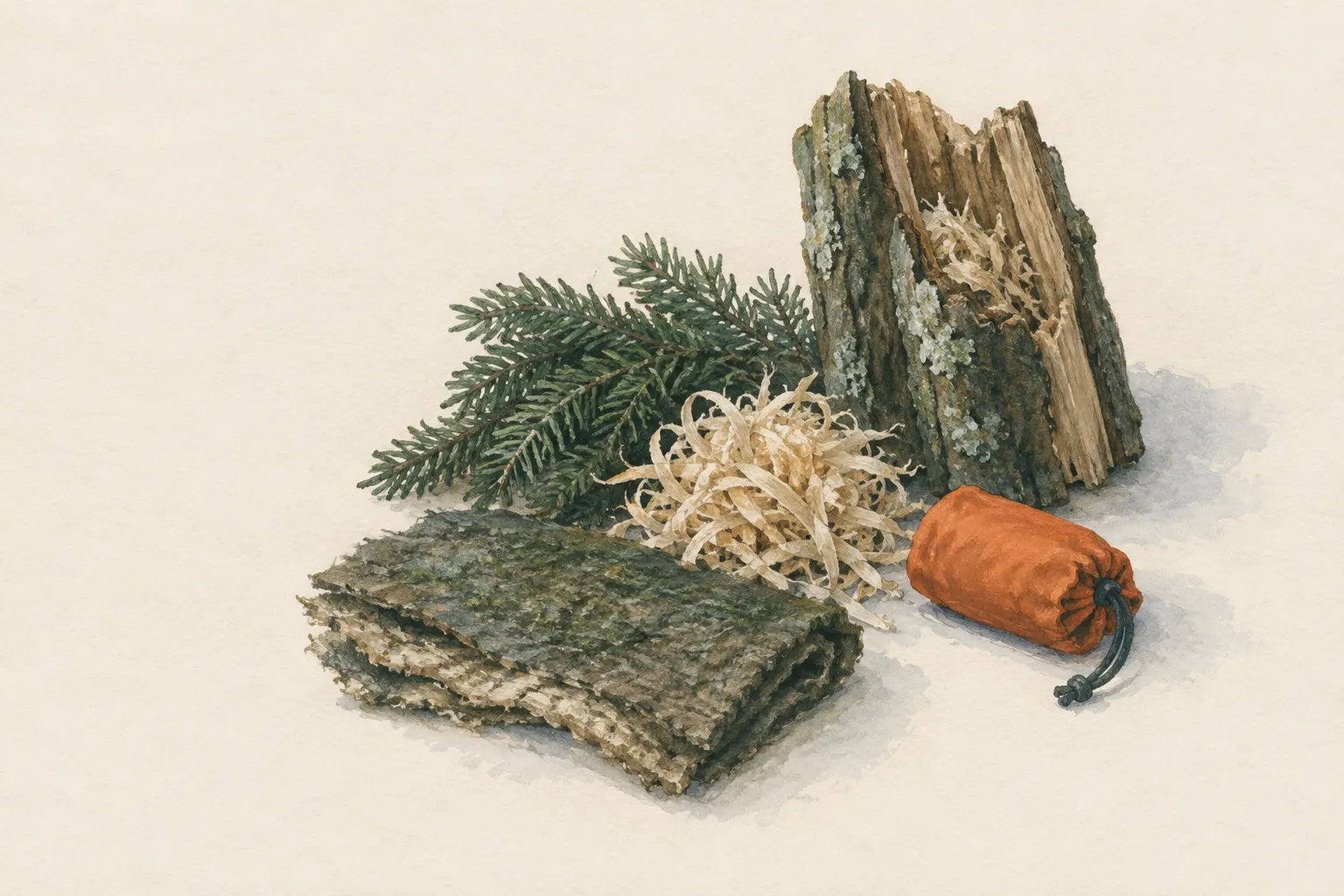
In wet conditions dry material is usually found inside wood, under conifers and in dead standing wood. Carried tinder, an insulating base against wet ground or snow and more preparation than usual decide success.
- 30–60 minutes or more
Explained simply
When it rains, almost everything outdoors is wet. But not quite: the inside of thick dead branches is often still dry – like a loaf of bread that has gone damp outside but is still dry inside. Thin, dead twigs still hanging on the tree, especially under dense conifers, are also usually drier than wood from the ground.
In wet weather you need much more fine material than usual and more patience. Carried tinder in a waterproof bag is worth its weight in gold then. You build the fire on a base of thick branches so it does not get wet from below.
Very important: if you are wet and cold, look after yourself first – dry clothing, shelter from wind and rain. And never make a fire inside a tent, not even in the rain. The poisonous gas carbon monoxide can kill you without you noticing.
How it works
Before wet wood can burn, the water in it has to evaporate. That costs a lot of heat – heat that is then missing for bringing the wood to ignition temperature. That is why a fire with wet wood hisses, smokes and goes out so easily. In wet conditions you therefore need more and finer starting material and a strong burst of heat before thicker wood follows.
Rain soaks wood from the outside in. In dead branches that are not rotten, the water often penetrates only the outer layer, and the core stays dry. If you split such a branch, you get at this dry wood. Rotten wood, on the other hand, soaks up water like a sponge.
The ground also cools and wets a fire from below. On wet ground or snow, water keeps evaporating under the embers, and on snow the fire can sink in. A platform of a single layer of thick, dead branches separates the fire from the ground.
What really matters
Carried tinder is the core: cotton wool with petroleum jelly or fire-lighter cubes, packed waterproof. Birch bark is commonly reported to burn even when slightly damp. It is best to carry ignition sources and tinder on your body as well, because everything in the pack can get wet.
Look for dry wood in the right places: dead, thin branches on standing trees, especially the lower dead twigs under dense conifers. Avoid wood lying on the ground. Split dead branches of thumb to wrist thickness and carve fine shavings or feather sticks from the dry core. Prepare much more fine material than in dry weather.
When lighting, block rain and wind with your body and pack and build the tinder under a small roof of kindling. Once the fire is burning, lay the next pieces of wood at the edge to pre-dry – with a gap so they do not catch uncontrolled – and add them only once the fire is burning strongly.
Fire on snow
On snow you need either a thick platform of pieces of wood or a spot you have shovelled clear down to the ground. Otherwise the fire melts a hole in the snow, sinks in and drowns in the meltwater.
Do not make a fire under snow-laden branches. The rising heat melts the snow, and it can fall down as a wet load and put the fire out. In the cold, hands and lighters also work less well – keep the lighter warm against your body and carve with extra care when your hands are cold and wet.
Safety: what to watch out for
Wet and cold together chill the body quickly. Do not spend your last energy on a fire that will not succeed. First change wet clothing, insulate yourself from the cold ground and find shelter from wind and rain. With signs of serious hypothermia, for example if someone becomes confused or stops shivering while still cold, call the local emergency number (112 in the EU).
Never make a fire inside a tent, under a tarp right next to the tent, in a shelter or a snow cave to escape the rain. Carbon monoxide is invisible, odourless and can be fatal. A tarp as a rain roof over the fire can also melt or catch fire: only high up, with a large gap and never directly above the flames – if in doubt, leave it out.
And however tempting it is: no flammable liquids such as petrol or spirit to help things along. Especially in the wet, when people get impatient, serious accidents happen this way. The local rules for making fires apply in the rain too.
How to practise it
Learn fire-making in dry weather first. Only once that works reliably, practise after a rainy day or in drizzle at a permitted fire pit, ideally near a warm, dry place to retreat to. Then a failed attempt is not a problem but a lesson.
While practising, notice how long everything takes: collecting, splitting, carving shavings. In persistent rain, experienced people often manage a fire and beginners often do not – and sometimes it is impossible even for the experienced. That is why fire is never planned as the only heat source. Clothing, insulation and shelter remain the foundation.
Step by step
Use carried tinder
Use waterproof-packed tinder (cotton wool with petroleum jelly, fire-lighter cubes) as the core. Birch bark is commonly reported to burn even when slightly damp.
- 1
Use carried tinder
Use waterproof-packed tinder (cotton wool with petroleum jelly, fire-lighter cubes) as the core. Birch bark is commonly reported to burn even when slightly damp.
- 2
Find dry wood
Dead, thin branches on standing trees – especially the lower dead twigs under dense conifers – are usually drier than wood from the ground. Avoid fallen wood lying on the ground.
- 3
Split and make feather sticks
Split dead branches of thumb to wrist thickness and carve fine shavings or feather sticks from the dry core.
Carve with extra care when your hands are cold and wet.
- 4
Build a base
On wet ground or snow, lay a platform of a single layer of thick dead branches so the fire is not quenched from below and does not sink into the snow.
- 5
Shield from rain and wind
While lighting, block rain and wind with your body and pack. Build the tinder under a small roof of kindling.
- 6
Pre-dry wood at the fire
Let the next pieces of wood dry at the edge of the fire – with a gap so they do not catch uncontrolled – and add them only once the fire is burning strongly.
Common mistakes
- Using wet wood from the ground
- Preparing too little fine material
- Building directly on snow or wet ground
- Adding thick wood too early
- Helping it along with petrol or spirit
- Making the fire inside a tent or shelter to escape the rain
Quick view
Materials
Tinder
Carried tinder in waterproof packaging
Carry in waterproof packaging.
Do not use liquid accelerants as tinder.
Lighter, matches or ferro rod
Observe local fire bans.
Knife (fixed or locking blade)
For splitting and feather sticks
Cut away from your body.
Rules on carrying knives differ by region – check local rules.
Waterproof case or bag
Suitable for
- Rain, fog, wet forest
- Fire on snow
- After prolonged wet weather
Not suitable for
- A fire under a tarp, at a tent or in a shelter
- Exhausted or seriously hypothermic people as the only measure – conserving body heat comes first
Prerequisites
- Basics of fire-making practised in dry weather
- Safe knife handling
Safety
- A tarp used as rain cover over the fire can melt or catch fire. Only high up, with a large gap and never directly above the flames; if in doubt, leave it out.
How it works
Water must evaporate before wood burns – which costs heat. A fire in wet conditions therefore needs more and finer starting material, a base separating it from wet ground, and a burst of heat before thicker wood follows. The inside of split dead branches is often dry even when the surface is wet.
Advantages
- Allows warmth and boiled water even in bad weather
Disadvantages
- Time- and energy-consuming
- Success not guaranteed
Deep knowledge
Background
Survival manuals recommend always carrying tinder and ignition sources waterproofed and also on your body, because gear in the pack can get wet. A fire in persistent rain often works for experienced people and often fails for beginners.
This is why fire should not be planned as the only heat source: clothing, insulation and shelter remain the foundation.
Variants
- Fire on snow
- A thick platform of wood or a spot shovelled clear down to the ground stops the fire sinking in. Do not make a fire under snow-laden branches: melting snow can fall and put the fire out.
Common mistakes
- Using wet wood from the ground
- Preparing too little fine material
- Building directly on snow or wet ground
- Adding thick wood too early
- Helping it along with petrol or spirit
- Making the fire inside a tent or shelter to escape the rain
Limits and risks
- Can be impossible in heavy rain or a soaked forest
- Requires practice
Material alternatives
Derived from material properties: a substitute must have all relevant properties. Observe the notes on the substitute.
- Tinder
- Dry firewood (Collect only where permitted.), Char cloth (charred cotton) (Store dry in a tin.), Finest-grade steel wool (Store separately from batteries – fire risk.), Fatwood (resin-rich wood) (Collect only dead wood where permitted.), Stove fuel (canister, liquid fuel, alcohol) (Store fuels apart from food and in original containers or bottles intended for them.), Petroleum jelly cotton balls (Use only pure cotton.)
- Lighter, matches or ferro rod
- Ferro rod (Practise before you need it.), Fire striker and hard stone (Carbon steel, not stainless.), Bow drill set (bow, spindle, hearth board, bearing block) (Use only dry wood.), Burning lens / magnifier (Never leave lying in the sun – fire risk.), Fire piston (Maintain the seal.)
- Waterproof case or bag
- Single-wall stainless steel bottle (Heat only single-wall bottles without paint/plastic; remove the lid before heating.), Double-wall insulated bottle (Never heat directly.), PET bottle (clear, max. 2 litres) (Do not heat or place in a fire.), Food-grade water container (Only use containers that never held chemicals or fuel.), Used chemical or fuel container (Never for drinking water or food – residues cannot be reliably removed.), Galvanised bucket (Do not heat: the zinc coating can release harmful fumes when heated.), Airtight food-grade storage container (Fill only when clean and completely dry; never use containers that previously held chemicals.), Wildlife-resistant food container (Where specific containers are required, use only approved models – check local rules.), Small metal tin with lid (Burn off coated or painted tins outdoors first.), Collapsible water container or bag (Protect from sharp objects.), Food-grade water bag (Use only for drinking water, never for chemicals or fuel.), Fermentation jar or crock (Use only food-grade containers of glass, food-safe glazed stoneware or food-grade plastic – no metal containers for acidic food.), Resealable food bags (Use only bags intended for food; do not use with boiling water unless the manufacturer explicitly allows it.)
Results come exclusively from structured entries. No improvised instructions are generated.
Sources
Headquarters, Department of the Army (USA) (2002): FM 3-05.70 Survival
Fire in wet conditions, platform on snow, keeping tinder dry
World Health Organization, Regional Office for Europe (2010): WHO guidelines for indoor air quality: selected pollutants (carbon monoxide chapter)
Carbon monoxide from combustion in enclosed spaces
Wilderness & Environmental Medicine (Wilderness Medical Society) (2019): Wilderness Medical Society Clinical Practice Guidelines for the Out-of-Hospital Evaluation and Treatment of Accidental Hypothermia: 2019 Update
Priority of preventing heat loss and getting help in hypothermia