Lighting with matches – including in wind and rain
Matches are simple and give an immediate open flame that can light somewhat coarser tinder. Their weaknesses are moisture, wind and their limited number. Storm matches and a waterproof case partly make up for this.
- Seconds, once tinder and wood are ready
Explained simply
A match is a small wooden stick with a head made of special substances. When you drag the head across the rough striker, friction makes it so hot that it bursts into flame. Then the wooden stick burns for a few seconds – and in those few seconds the flame must light your tinder.
So the rule is: prepare everything first, then strike the match. Flames like to travel upwards, just as hot air rises. That is why you hold the burning match tilted slightly downwards and light the tinder from below.
Important for safety: strike away from your body and keep hair, face and sleeves out of the flame. Matches do not belong in children's hands without supervision.
How it works
With today's common safety matches, the ignition chemicals are split: some are in the head, others in the striker on the box. Only when the two come together through friction does the head ignite. That is why they light only on their own striker – which makes them safer in luggage, but you depend on a dry striker.
The burning head sets the wooden stick alight. This flame is small and brief. It is enough for fine to medium-coarse tinder such as birch bark, paper or very thin twigs, but not for thicker wood. Compared with a ferro rod, a match has one advantage: it gives a real flame, not just sparks.
Flames and hot gases rise. If you hold the match upright, the flame burns away from the wood and soon goes out. If you tilt it slightly downwards, the flame travels along the wood and grows. In the same way, tinder is best lit from below so the flame draws into it.
What really matters
The most important part happens before striking: tinder loosely under a small teepee or stack of the finest kindling, further sizes within reach. Anyone who searches only afterwards uses up match after match.
Wind is the greatest enemy. Kneel with your back to the wind so your body, pack or hands form a shelter. Strike the match away from your body, cup it immediately in your hand and wait a moment until the wood itself is burning. Only then bring the flame to the windward underside of the tinder.
If the tinder is slightly damp, two matches struck together can give a bigger flame. But that costs twice the supply. It is better to improve the tinder: tease it finer, take drier material from the inside of split branches, or use carried tinder.
Gear and materials
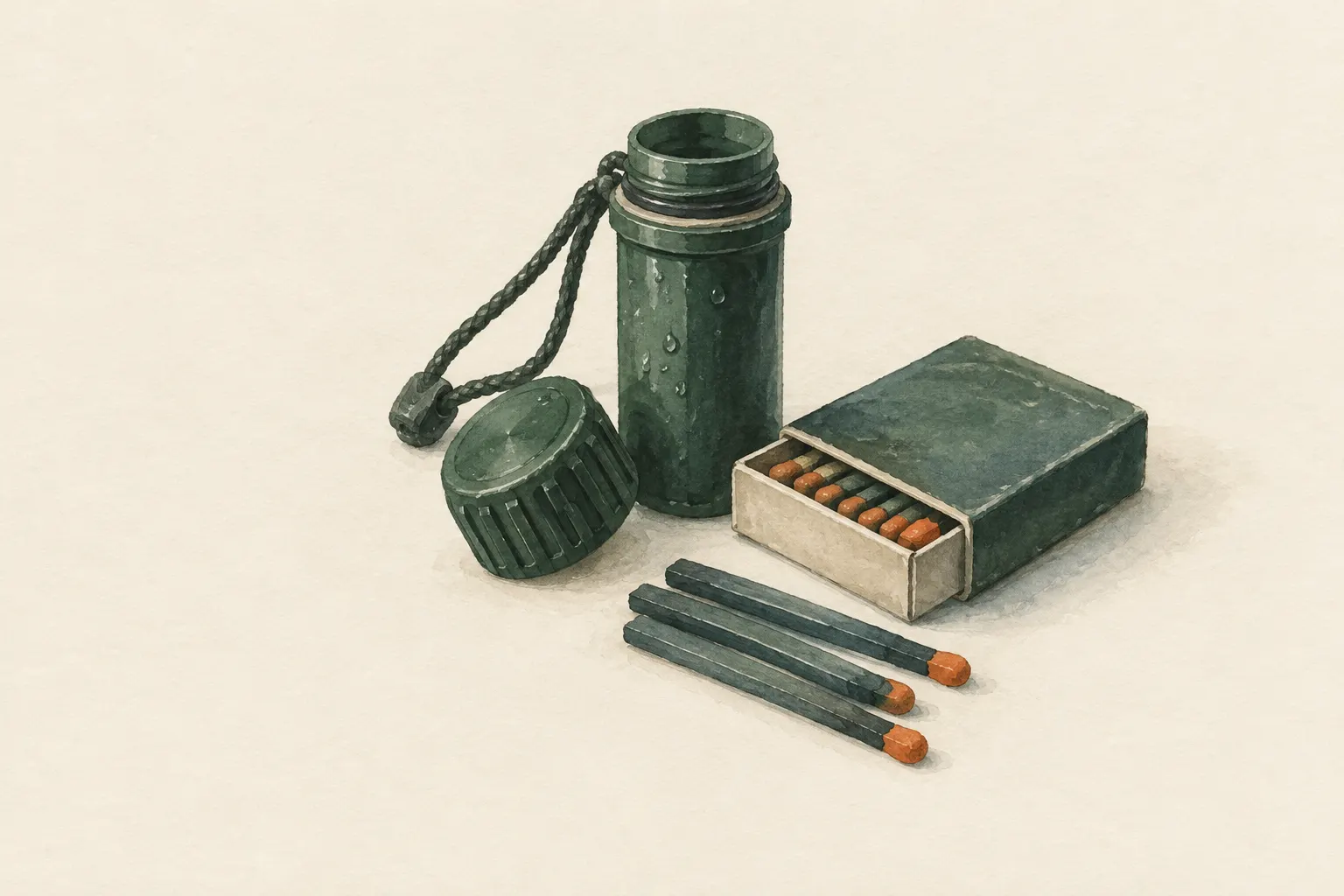
Ordinary matches are sensitive to moisture: a damp head no longer lights, and a wet striker becomes useless. So keep them in a waterproof case or a well-sealed bag and pack them away again immediately after each use. Loose in a trouser pocket they get damp and break.
Storm matches have a long head that, according to manufacturers, keeps burning in strong wind and in some cases after brief immersion in water. They usually need their own striker, which must also stay dry. Properties differ between products – check the manufacturer's information and test them before the trip.
Matches are counted: so many sticks, so many attempts. Survival manuals therefore recommend always backing them up with a second, independent ignition method, such as a lighter or a ferro rod, and stowing the two in different places.
Safety: what to watch out for
Always strike away from your body. Glowing particles of the head can fly off when striking, and the first flare is fierce. Keep face, hair and loose sleeves out of the flame. Storm matches burn especially fiercely and are hard to blow out: discard them only once they are definitely out, ideally straight into the fire.
Never use flammable liquids to help when the fire will not catch. Keep matches and lighters out of children's reach. And before lighting: check whether fires are allowed here and whether there is a current wildfire danger.
If you burn yourself, cool the spot immediately with cool, not ice-cold, running water. For large or deep burns, burns to the face or hands, and burns in children, call the local emergency number (112 in the EU).
How to practise it
First practise striking, shielding in a cupped hand and lighting from below on a calm day at a permitted fire pit. Count how many matches you need. The goal is a fire with a single match.
Then practise in a light wind: how do you position yourself? Where does your body give the best shelter? Once you master these moves, you can manage with few matches even in harder conditions.
Step by step
Lay everything out
Place tinder loosely under a small teepee or stack of the finest kindling, with further sizes within reach. Only then take a match.
- 1
Lay everything out
Place tinder loosely under a small teepee or stack of the finest kindling, with further sizes within reach. Only then take a match.
- 2
Block the wind
Kneel with your back to the wind so your body, pack or hands form a windbreak. The opening of the stack faces away from the wind or slightly into it so air can reach it without blowing the flame out.
- 3
Strike and shield
Strike the match away from your body, immediately cup it in your hand and tilt it slightly downwards until the wood is burning.
- 4
Light the tinder from below
Hold the flame to the windward underside of the tinder so it draws into the stack. Add air gently once the tinder is burning.
- 5
Pack the rest away dry
Put the remaining matches and striker straight back into a waterproof case or bag.
Common mistakes
- Striking a match before the tinder is ready
- Holding the flame to the top of the tinder
- Using a wet striker
- Carrying matches loose in a trouser pocket
- Taking one box as the only ignition source
Quick view
Materials
Lighter, matches or ferro rod
Matches, ideally storm matches, with striker
Observe local fire bans.
Tinder
Carry in waterproof packaging.
Do not use liquid accelerants as tinder.
Waterproof case or bag
Suitable for
- Everyday fire-making
- Beginners
- Coarser tinder such as birch bark or thin twigs
Not suitable for
- Long trips as the only ignition source
- Wet conditions without waterproof packaging
Prerequisites
- Tinder, kindling and fuel wood prepared
- Safe fire site
Safety
- Strike away from your body and keep your face, hair and sleeves out of the flame. Storm matches burn fiercely and are hard to blow out – discard them only once they are definitely out.
- Keep matches and lighters out of children's reach.
How it works
Friction ignites the match head, which sets the wooden stick alight. The flame lasts only seconds; in that time it must ignite the tinder. Flames climb upwards – a match tilted slightly downwards catches better.
Advantages
- Hardly any practice needed
- Open flame lights coarser tinder too
- Works reasonably well with cold hands
Disadvantages
- Limited number
- Sensitive to moisture (regular matches)
- Short burn time, vulnerable to wind
Deep knowledge
Background
Safety matches ignite only on their striker; that makes them safe in luggage but dependent on a dry striker. Some manufacturers offer waterproof or storm matches – their properties differ, so check the manufacturer's information and test before the trip.
Survival manuals regard matches as a proven ignition source that should be backed up by a second, independent method.
Variants
- Storm matches
- Storm matches have a long head that, according to manufacturers, keeps burning in strong wind and in some cases after brief immersion in water. They usually need their own striker – keep it dry.
- Two matches together
- With damp tinder, two matches struck together can give a bigger flame. Costs twice the supply.
Common mistakes
- Striking a match before the tinder is ready
- Holding the flame to the top of the tinder
- Using a wet striker
- Carrying matches loose in a trouser pocket
- Taking one box as the only ignition source
Limits and risks
- Only as many ignitions as matches
- Does not replace good tinder preparation
Material alternatives
Derived from material properties: a substitute must have all relevant properties. Observe the notes on the substitute.
- Lighter, matches or ferro rod
- Ferro rod (Practise before you need it.), Fire striker and hard stone (Carbon steel, not stainless.), Bow drill set (bow, spindle, hearth board, bearing block) (Use only dry wood.), Burning lens / magnifier (Never leave lying in the sun – fire risk.), Fire piston (Maintain the seal.)
- Tinder
- Dry firewood (Collect only where permitted.), Char cloth (charred cotton) (Store dry in a tin.), Finest-grade steel wool (Store separately from batteries – fire risk.), Fatwood (resin-rich wood) (Collect only dead wood where permitted.), Stove fuel (canister, liquid fuel, alcohol) (Store fuels apart from food and in original containers or bottles intended for them.), Petroleum jelly cotton balls (Use only pure cotton.)
- Waterproof case or bag
- Single-wall stainless steel bottle (Heat only single-wall bottles without paint/plastic; remove the lid before heating.), Double-wall insulated bottle (Never heat directly.), PET bottle (clear, max. 2 litres) (Do not heat or place in a fire.), Food-grade water container (Only use containers that never held chemicals or fuel.), Used chemical or fuel container (Never for drinking water or food – residues cannot be reliably removed.), Galvanised bucket (Do not heat: the zinc coating can release harmful fumes when heated.), Airtight food-grade storage container (Fill only when clean and completely dry; never use containers that previously held chemicals.), Wildlife-resistant food container (Where specific containers are required, use only approved models – check local rules.), Small metal tin with lid (Burn off coated or painted tins outdoors first.), Collapsible water container or bag (Protect from sharp objects.), Food-grade water bag (Use only for drinking water, never for chemicals or fuel.), Fermentation jar or crock (Use only food-grade containers of glass, food-safe glazed stoneware or food-grade plastic – no metal containers for acidic food.), Resealable food bags (Use only bags intended for food; do not use with boiling water unless the manufacturer explicitly allows it.)
Results come exclusively from structured entries. No improvised instructions are generated.
Sources
Headquarters, Department of the Army (USA) (2002): FM 3-05.70 Survival
Matches as an ignition source and keeping them dry
USDA Forest Service / Ad Council / National Association of State Foresters: Campfire Safety (Smokey Bear wildfire prevention campaign)
No flammable liquids for lighting