Fire triangle and fuels
A fire needs three things at the same time: fuel, heat and oxygen. Understanding the fire triangle lets you build a fire deliberately, keep it burning and extinguish it completely. What matters most is fuel in the right order: tinder, kindling, fuel wood – all of it dry.
- About 5 minutes to read
Explained simply
A fire needs three things at the same time: something that burns (fuel, for example wood), heat (for example the flame of a match) and air – or more exactly, the oxygen in it. Think of a stool with three legs. As long as all three legs are there, it stands. Take one leg away and it falls over – and the fire goes out.
That is also why wood does not simply start burning on its own. A thick branch needs a lot of heat before it burns. So you always start with very thin, dry material and add thicker wood step by step – like a staircase you climb one step at a time.
The most important safety point: never pour petrol, spirit or any other flammable liquid onto a fire. The vapours can flare up like an explosion and cause terrible burns. And only make a fire where it is allowed.
How it works
Wood does not really burn directly. When it gets hot enough, it breaks down and gives off flammable gases. The yellow flames you see are these gases burning together with oxygen from the air. This releases heat, which warms the next piece of wood, which in turn gives off gases. That is how the fire keeps itself going, as long as all three sides of the triangle are supplied.
Before wood can release these gases, it first has to heat up. If it is damp, much of the heat is spent evaporating the water first. That is why wet wood hisses, smokes heavily and burns poorly. Thin material heats up much faster than thick material because it has a large surface relative to its weight, where heat and air can reach it.
In the end, embers are left: almost pure charcoal that glows without big flames. Embers give off long, even heat. They are ideal for cooking, but they can also start a new fire hours later if they are not properly put out.
What really matters
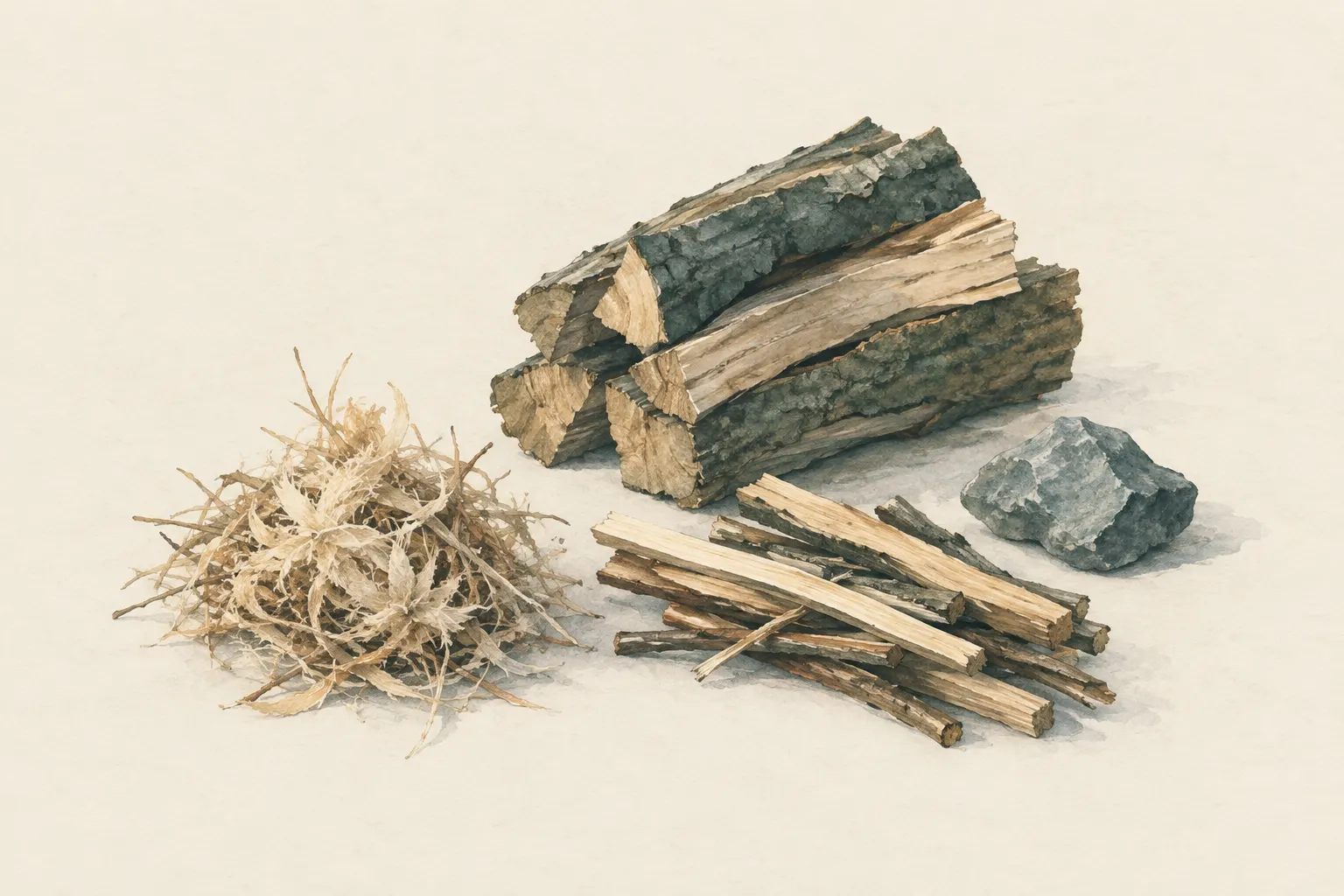
The most common reason a fire will not catch is not the match or the lighter but the material. It is too damp, too thick, or the in-between stages are missing. The proven order is: tinder (very fine, catches at once), then kindling in several sizes from matchstick-thin to thumb-thick, and only then fuel wood.
Air is just as important. A fire packed too tightly suffocates – even when there is enough wood. Lay the wood loosely so air can flow in from below. If a fire smokes heavily, that is often a sign of wood that is too damp or too little air.
The type of wood matters too, but less than dryness. Resinous softwood catches easily and burns fast and hot but can throw sparks. Denser hardwood burns more slowly and forms longer-lasting embers. So softwood is better for starting a fire, hardwood for cooking and warmth.
Putting fires out with the triangle
The fire triangle explains not only lighting but also extinguishing. Water removes heat from the fire. Sand or soil separate the embers from the air. Pulling pieces of wood apart takes away the fuel. Each of these removes one side of the triangle.
In practice, one measure alone is often not enough. Embers that were merely covered with soil can keep smouldering underneath for hours and flare up later. So for a campfire the rule is: drown it with plenty of water, stir, water again, and leave only when everything is cold.
Safety: what to watch out for
Flammable liquids such as petrol, spirit or barbecue lighter fluid are off-limits. They evaporate, and the vapours can ignite suddenly – often right where the person pouring is standing. Good preparation of tinder and kindling replaces any “accelerant”.
Do not burn plastic, rubber, painted, coated or treated wood, chipboard or rubbish. They release toxic smoke and residues that you breathe in and that stay behind in the ash.
Before you make any fire at all, check the local rules and the current wildfire danger. In many areas open fires in or near forests, in protected areas or during dry spells are prohibited. A fire ban always applies, including to a “small” fire. For a fire that is out of control, there is only one answer: get to safety and call the local emergency number (112 in the EU).
Good to know
The fire triangle is a simplified model. Real combustion is chemically more complicated, and fire-safety training sometimes extends the model with a fourth side, the chain reaction of combustion. For making fires outdoors, though, the three sides are quite enough to understand almost every problem.
A good exercise: when your fire is not burning properly, ask yourself in turn which side is missing. Is the material too thick or too wet (fuel)? Is the starting flame too small or too short (heat)? Is everything packed too tightly or lying on wet ground (air)? That way you usually find the cause quickly.
Step by step
Tinder
Very fine, dry material that catches from a spark or small flame: dry grass, birch bark, fine wood shavings, cotton, paper.
- 1
Tinder
Very fine, dry material that catches from a spark or small flame: dry grass, birch bark, fine wood shavings, cotton, paper.
- 2
Kindling
Thin dry twigs and splits from about matchstick to thumb thickness. It bridges the gap from the brief tinder flame to the fuel wood.
- 3
Fuel wood
Thicker dry wood, added only once the kindling is burning strongly. Dead standing or hanging wood is usually drier than wood from the ground.
- 4
Let air in
Stack fuel loosely so air can flow in from below. Wood packed too tightly or added too early smothers the fire.
Common mistakes
- Adding thick wood too early
- Preparing too little tinder and kindling
- Using damp wood from the ground
- Packing fuel so tightly that no air gets in
- Helping it along with flammable liquids
Quick view
Suitable for
- Understanding why a fire will not catch or goes out
- Choosing fuel
- Basis for extinguishing safely
Not suitable for
- Fighting building, vehicle or wildfires – that is the fire service's job
Safety
- Do not burn plastic, rubber, painted, coated or treated wood, chipboard or rubbish: they release toxic smoke and residues.
How it works
When heated, fuel releases flammable gases; these burn with oxygen from the air and supply the heat that ignites more fuel. If one of the three sides – fuel, heat or oxygen – is missing, the fire goes out. Thin, dry material reaches ignition temperature quickly; thick or damp wood needs a lot of heat because water must evaporate first.
Deep knowledge
Background
The fire triangle is a simplified model used both in fire-safety training and in survival manuals. It also explains extinguishing: water removes heat, soil or sand cut off oxygen, spreading the fire apart removes fuel.
The most common reason a fire fails is not the ignition method but insufficiently prepared, too damp or too thick material.
Variants
- Softwood and hardwood
- Resinous softwood ignites easily and burns fast and hot but can throw sparks. Denser hardwood burns more slowly and leaves longer-lasting embers. Softwood suits starting the fire, hardwood suits cooking and warmth.
Common mistakes
- Adding thick wood too early
- Preparing too little tinder and kindling
- Using damp wood from the ground
- Packing fuel so tightly that no air gets in
- Helping it along with flammable liquids
Limits and risks
- Simplified model; real combustion is more complex
- Does not replace fire-safety training
Sources
Headquarters, Department of the Army (USA) (2002): FM 3-05.70 Survival
Fire triangle and tinder, kindling and fuel
USDA Forest Service / Ad Council / National Association of State Foresters: Campfire Safety (Smokey Bear wildfire prevention campaign)
No flammable liquids; keep fires small and under control