Keyhole fire: separating flames and cooking coals
In a keyhole fire the fire site is shaped like a keyhole: the fire burns in the round part and produces coals, which are raked into the narrow extension for cooking. Wood keeps burning for warmth and light while cooking happens over even coals – with less soot and better heat control.
- Slightly more setup than a simple fire; coals take time
Explained simply
Imagine a fire site that looks like a keyhole from above: a large round part with a narrow strip attached. In the round part the fire burns with flames – that gives light and warmth. Into the narrow part you push glowing pieces of charcoal, the coals, with a stick, and you cook on them.
Why like this? Flames flicker, are sometimes hot and sometimes weak and blacken the pot with soot. Coals, on the other hand, radiate evenly like a hotplate. More coals mean more heat, fewer coals mean less – so you can adjust the heat.
Take care: coals often look grey and harmless but are very hot. Children and adults must not step over them or into them.
How it works
Wood burns in two phases. First it gives off gases that burn with bright, restless flames. After that, charcoal remains, which glows without big flames and radiates heat evenly. For cooking, the second phase is much better: the heat is steady, predictable and makes hardly any soot.
In a keyhole fire both phases run side by side. Wood is added continuously in the round burning area, and new coals keep forming there. You push these coals into the narrow cooking area as needed. If the pot needs more heat, you fetch more coals; if it only needs to keep warm, you take some away.
What really matters
The most important thing is patience. Coals take time to form. If you cook too early, you only have a few glowing bits and get impatient. Hardwood or simply enough fuel wood gives the best coals. So allow time before the food goes on the grate.
A stable pot support is just as important. A grate or flat, dry stones on each side of the narrow part carry the pot or pan. If something wobbles, boiling water can slop over. If possible, lay the narrow part across the wind so that smoke and sparks from the burning area do not drift over your cooking spot.
Do not use stones from streams or wet ground. Water can be trapped inside them, which turns to steam in the heat and can make the stone burst – with sharp, hot fragments.
When it makes sense – and when not
The keyhole fire suits groups and longer camps where people cook and warm themselves at the same fire for hours. Pan and grill dishes turn out much better over coals than over flames.
For quickly boiling water it is too cumbersome – a stove is much faster. It is unsuitable in dry and windy conditions, and it needs a larger fire site and more wood. Use only permitted, existing fire sites with mineral soil or a stone ring. In places where no traces should be left, do not create a new, large fire site.
Safety: what to watch out for
Coals in the cooking area are often hard to see in daylight because they are covered with grey ash. They are still very hot. Keep children away, do not step over the cooking area and wear sturdy shoes. Cool burns immediately with cool, not ice-cold, running water; for large or deep burns, burns to the face or hands and burns in children, call the local emergency number (112 in the EU).
At the end, both areas must be completely extinguished – not just the one that still has flames. Pour on plenty of water, stir, pour again and check with the back of your hand from a little distance whether any heat is still rising. Only when everything is cold may you leave. And as always, beforehand: check local rules and wildfire danger.
Good to know
The keyhole shape is widespread among scout and outdoor groups. Its basic idea applies to any fire, though: if you cook on coals rather than flames, you cook more calmly, more safely and with less soot on the pot.
You can use this at an ordinary round fire site too, by pushing some of the coals to the edge and cooking there while wood keeps burning in the middle.
Step by step
Lay out the shape
In a permitted fire site, mark out a round burning area and a narrow extension, ideally with the extension lying across the wind.
- 1
Lay out the shape
In a permitted fire site, mark out a round burning area and a narrow extension, ideally with the extension lying across the wind.
- 2
Fire in the round part
Build a fire in the round part and keep it going with hardwood or enough fuel wood until coals form.
- 3
Rake coals
Use a stick or shovel to rake coals into the narrow part. More coals = more heat.
- 4
Cook
Place a grate or pot over the narrow part, e.g. on flat, dry stones. Top up coals from the burning area.
- 5
Extinguish both areas
At the end, completely extinguish both the burning and coal areas: drown, stir, feel.
Common mistakes
- Cooking too early, before there are enough coals
- A wobbly pot support
- Extinguishing only the burning area
- Wet river stones as a border
Quick view
Materials
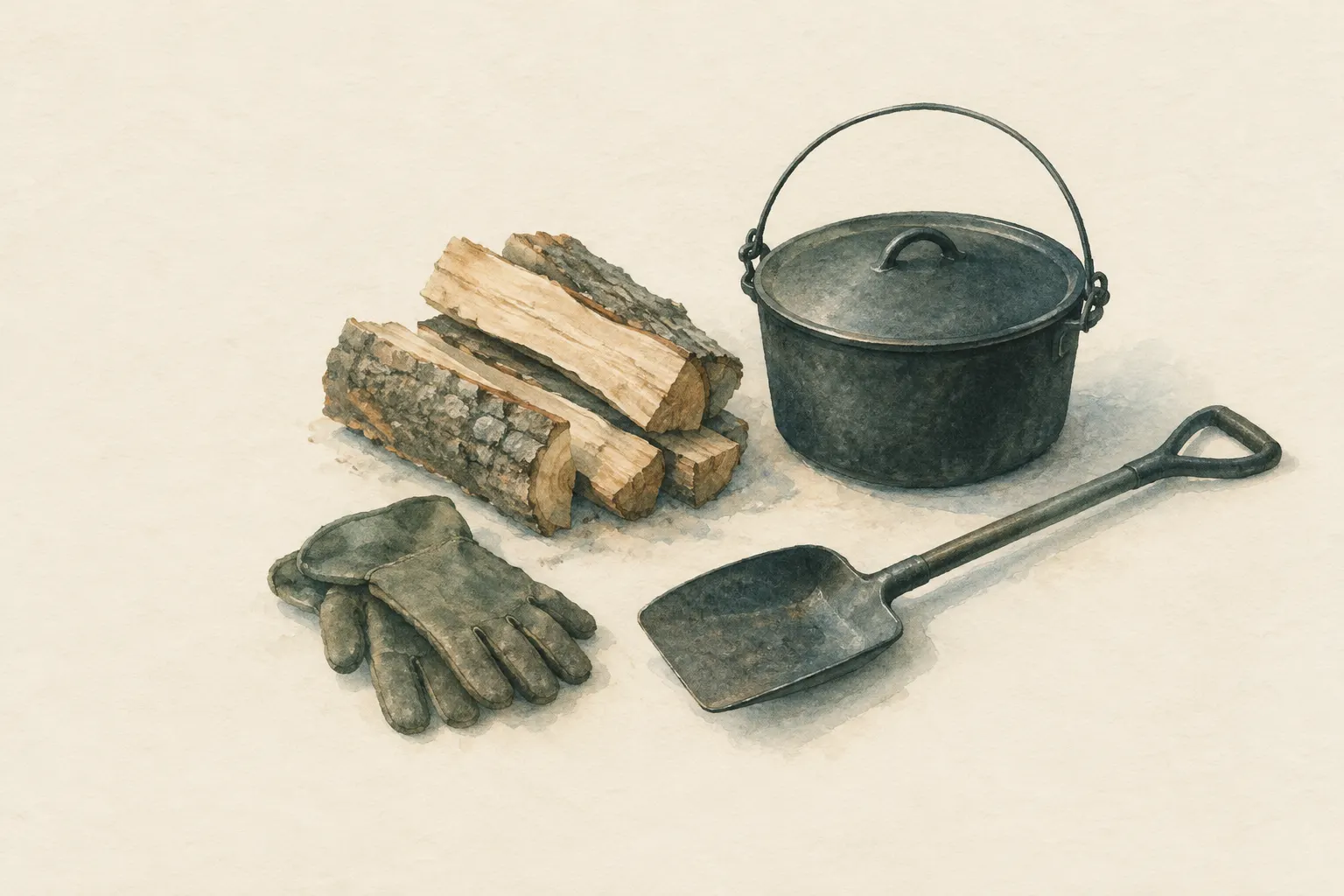
Dry firewood
Collect only where permitted.
Small shovel / folding spade
Or a stick for raking coals
Water for extinguishing (bucket, canister or pot)
Have several litres ready before lighting.
Suitable for
- Groups and longer camps
- Cooking and warming at the same time
- Pan and grill dishes
Not suitable for
- Quickly boiling water
- Dry and windy conditions
- Places without an existing fire site where no traces should be left
Prerequisites
- A permitted fire site on mineral soil or an existing stone ring
- Hardwood or enough fuel wood for coals
- A pot or grate that sits stably
Safety
- Do not use stones from streams or wet ground: trapped water can make them burst in the heat.
- Coals in the cooking area are hard to see but very hot. Keep children away and do not step over them.
- Cool burns immediately with cool, not ice-cold, running water. For large or deep burns, burns to the face or hands and burns in children, call the local emergency number (112 in the EU).
How it works
Flames give irregular, sooty heat; coals radiate evenly and can be regulated by quantity. Separating a burning zone and a coal zone combines both: new coals are produced continuously in the large part and metered out as needed in the narrow part.
Advantages
- Good heat control
- Warmth, light and a cooking spot at once
- Less soot on the pot
Disadvantages
- Needs more wood and time
- Larger fire site
Deep knowledge
Background
The keyhole shape is a common campfire layout among scouts and outdoor groups, especially for groups cooking over one fire for a long time.
The same principle – coals rather than flames for cooking – applies to any other fire: if you are patient, cooking over coals is calmer and safer.
Common mistakes
- Cooking too early, before there are enough coals
- A wobbly pot support
- Extinguishing only the burning area
- Wet river stones as a border
Limits and risks
- Only at permitted, sufficiently large fire sites
- Not a quick fire
Material alternatives
Derived from material properties: a substitute must have all relevant properties. Observe the notes on the substitute.
- Dry firewood
- Tinder (Carry in waterproof packaging.), Char cloth (charred cotton) (Store dry in a tin.), Finest-grade steel wool (Store separately from batteries – fire risk.), Fatwood (resin-rich wood) (Collect only dead wood where permitted.), Stove fuel (canister, liquid fuel, alcohol) (Store fuels apart from food and in original containers or bottles intended for them.), Petroleum jelly cotton balls (Use only pure cotton.)
Results come exclusively from structured entries. No improvised instructions are generated.
Sources
USDA Forest Service / Ad Council / National Association of State Foresters: Campfire Safety (Smokey Bear wildfire prevention campaign)
Safe fire site and complete extinguishing
Headquarters, Department of the Army (USA) (2002): FM 3-05.70 Survival
Cooking over a fire in survival situations