Stoves compared: gas, alcohol, solid fuel, liquid fuel
A stove is often a better choice than a campfire: faster, cleaner and easier to control. Gas canister stoves are the simplest, alcohol stoves quiet and basic, solid fuel light and robust, liquid-fuel stoves good in the cold but more maintenance-heavy. All belong outdoors – never in a tent or enclosed room. Fire bans can also apply to stoves.
- About 8 minutes to read
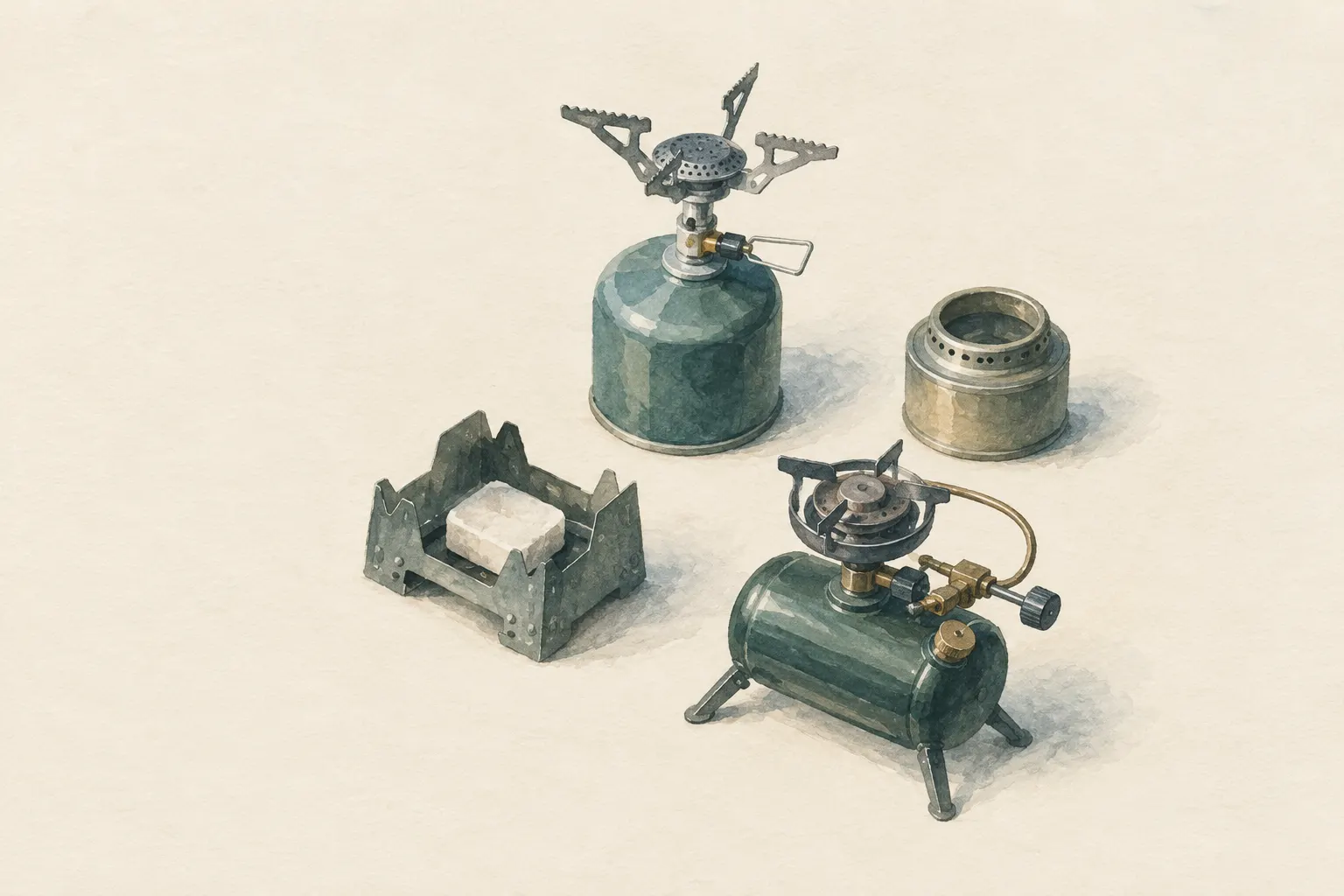
Explained simply
A stove is like a small cooker you can take with you. Instead of making a big campfire, a small, steady flame burns right under the pot. The water boils faster, you do not have to look for wood, and no black patch is left on the ground.
There are different kinds: some stoves burn gas from a small can (a canister), some burn methylated spirit (a liquid alcohol), some burn solid fuel tablets and some burn liquid fuel from a bottle. Each kind has strengths and weaknesses – just as a bike, a scooter and a skateboard all get you moving, but not equally well everywhere.
The most important thing: a stove always belongs outdoors. Even a small flame makes carbon monoxide, an invisible gas with no smell, which becomes dangerous inside a tent, car or home.
How it works
Every stove basically does the same thing: it brings fuel evenly to one spot, mixes it with air and lets it burn there in a small, controlled flame. In a gas stove, gas flows from the canister through a valve and a jet. In an alcohol stove, the liquid alcohol evaporates thanks to the heat of its own flame. Fuel tablets melt or turn to gas at their surface and burn there.
Liquid-fuel stoves work a little differently: the fuel is pushed under pressure through a tube that runs over the flame. There it gets hot and vaporises before it burns. For this to work, the tube must first be preheated (“primed”) – this is the step where you must follow the manufacturer's instructions exactly.
Because the flame is small and sits right under the pot, much less heat is lost than with an open fire. It is still combustion, though: exhaust gases are produced, including carbon monoxide. That is why a stove is a cooking device and never a heater.
The types at a glance
Gas canister stoves are the simplest: screw on, open the valve, light, regulate with the knob. Their weakness is cold. The gas in the canister vaporises less well at low temperatures, the flame gets weaker, and the canister cools down further while you cook. A canister kept body-warm inside your jacket works much better in frost.
Alcohol stoves are light, quiet and have hardly any parts that can break. However, they give less heat, are sensitive to wind, and their flame is almost invisible in daylight. Fuel tablets weigh little, do not leak and keep for a long time – but they are slow, smell and leave residue on the pot.
Liquid-fuel stoves are powerful and cope well even with severe cold. In return they need practice, regular maintenance and care when priming. Small wood stoves that burn twigs are a group of their own: they need no carried fuel, but they produce sparks and are often treated legally like an open fire.
Which stove makes sense when
For short summer trips and for the emergency supply at home, a gas canister stove is usually the most convenient choice because it works immediately and without practice. People travelling for a long time who want to save weight often choose alcohol and accept the lower output. Fuel tablets are good as a light backup fuel that can sit in an emergency kit for a long time.
In the cold, at high altitude or for groups who have to melt a lot of snow, liquid-fuel stoves show their strength. At high altitude, by the way, water boils at a lower temperature, so cooking food takes longer there even when the water is bubbling.
In areas with a campfire ban, a stove is often the permitted alternative – but not always. Some bans explicitly include open-flame stoves or wood stoves. So check the local rules before every trip.
Safety: what to watch out for
The biggest danger is invisible: carbon monoxide. It has no smell, you cannot see it, and at first it makes you tired or dizzy or gives you a headache – signs that are easily mistaken for exhaustion. So without exception: run stoves only outdoors, never in a tent, vestibule, car or home, not even “just for a moment”. If you suspect poisoning, get into fresh air at once and call the local emergency number (112 in the EU).
The second common danger is scalding from tipping pots. Place the stove on level, firm, non-flammable ground, shelter it from wind and keep children away. A windscreen helps a lot, but must not wrap around a gas canister so tightly that the canister heats up.
Refill or change canisters only when the stove is off and has cooled down, and well away from other flames. This is especially important with alcohol, because a flame that is still burning is easy to miss. Always store fuel separately, tightly closed and clearly labelled.
How to practise it
Read the instructions for your own stove before you need it outdoors – they take precedence over any general overview. Then try it out in the open, for example in the garden: how long does it take for a pot of water to boil? How does it behave in wind? How much fuel do you use for one meal?
Experience of your own like this is worth more than any table, because weather, pot and windscreen make a big difference. Make a rough note of how much fuel you need per day, and add a small reserve when packing for trips. That way you also know how long your supply lasts during a power cut at home.
Step by step
Gas canister stove
Simple, clean, easy to regulate. Weaknesses: loss of power in the cold, canister availability and disposal. Keep the canister body-warm in frost.
- 1
Gas canister stove
Simple, clean, easy to regulate. Weaknesses: loss of power in the cold, canister availability and disposal. Keep the canister body-warm in frost.
- 2
Alcohol stove
Light, quiet, almost no maintenance. Weaknesses: less heat, sensitive to wind, almost invisible flame, risk of spills.
- 3
Solid fuel
Fuel tablets are light, spill-proof and keep for a long time. Weaknesses: slow, smell and residue.
- 4
Liquid fuel
Liquid-fuel stoves are powerful and cope with cold. They need practice, maintenance and exact adherence to the manufacturer's instructions when priming.
- 5
Wood-burning stove
Small wood stoves use twigs as fuel. They produce sparks and are often treated legally like open fires – check local rules.
- 6
Operate safely
Outdoors, on a stable surface, with a windscreen, never unattended. Store fuel separately and sealed.
Common mistakes
- Running a stove inside a tent or vestibule
- Adding alcohol while the flame is still burning
- Enclosing the canister completely with a windscreen
- Using a stove for heating
Quick view
Materials
Stove
Never operate inside a tent, shelter or enclosed room – carbon monoxide and fire risk.
Metal pot (stainless steel, aluminium, titanium)
Hot – scalding risk.
Lighter, matches or ferro rod
Observe local fire bans.
Suitable for
- Cooking and boiling water on the move
- Areas with campfire bans, where stoves are allowed
- Power cuts – outdoors only
Not suitable for
- Heating a tent, vehicle or home
- Use indoors
Prerequisites
- Know your own stove's instructions
- A stable, non-flammable surface
Safety
- Tipping pots cause scalds. Set the stove up stably and out of the wind, keep children away. Do not wrap a windscreen so tightly around gas canisters that they overheat.
How it works
Stoves burn an evenly supplied fuel in a small, controlled flame right under the pot. This is more efficient and safer than an open fire but also produces carbon monoxide.
Advantages
- Faster and more controlled than fire
- Leaves almost no trace
- Often allowed even under campfire bans (check locally)
Disadvantages
- Fuel must be carried
- Not a heat source for people
- Carbon monoxide and burn hazard
Deep knowledge
Background
Leave No Trace principles recommend lightweight stoves for cooking because they leave fewer traces than fire pits.
Carbon monoxide poisoning from stoves and grills used in tents and enclosed rooms keeps occurring; health authorities explicitly warn against it.
Common mistakes
- Running a stove inside a tent or vestibule
- Adding alcohol while the flame is still burning
- Enclosing the canister completely with a windscreen
- Using a stove for heating
Limits and risks
- General overview, not a product review
- Manufacturer's instructions take precedence
Material alternatives
Derived from material properties: a substitute must have all relevant properties. Observe the notes on the substitute.
- Metal pot (stainless steel, aluminium, titanium)
- Single-wall stainless steel bottle (Heat only single-wall bottles without paint/plastic; remove the lid before heating.)
- Lighter, matches or ferro rod
- Ferro rod (Practise before you need it.), Fire striker and hard stone (Carbon steel, not stainless.), Bow drill set (bow, spindle, hearth board, bearing block) (Use only dry wood.), Burning lens / magnifier (Never leave lying in the sun – fire risk.), Fire piston (Maintain the seal.)
Results come exclusively from structured entries. No improvised instructions are generated.
Sources
Leave No Trace Center for Outdoor Ethics: The Seven Principles of Leave No Trace (Principle 5: Minimize Campfire Impacts)
Lightweight stoves instead of campfires for cooking
Centers for Disease Control and Prevention: Carbon Monoxide Poisoning – Prevention guidance
No fuel-burning appliances in enclosed rooms, tents or vehicles