Star fire
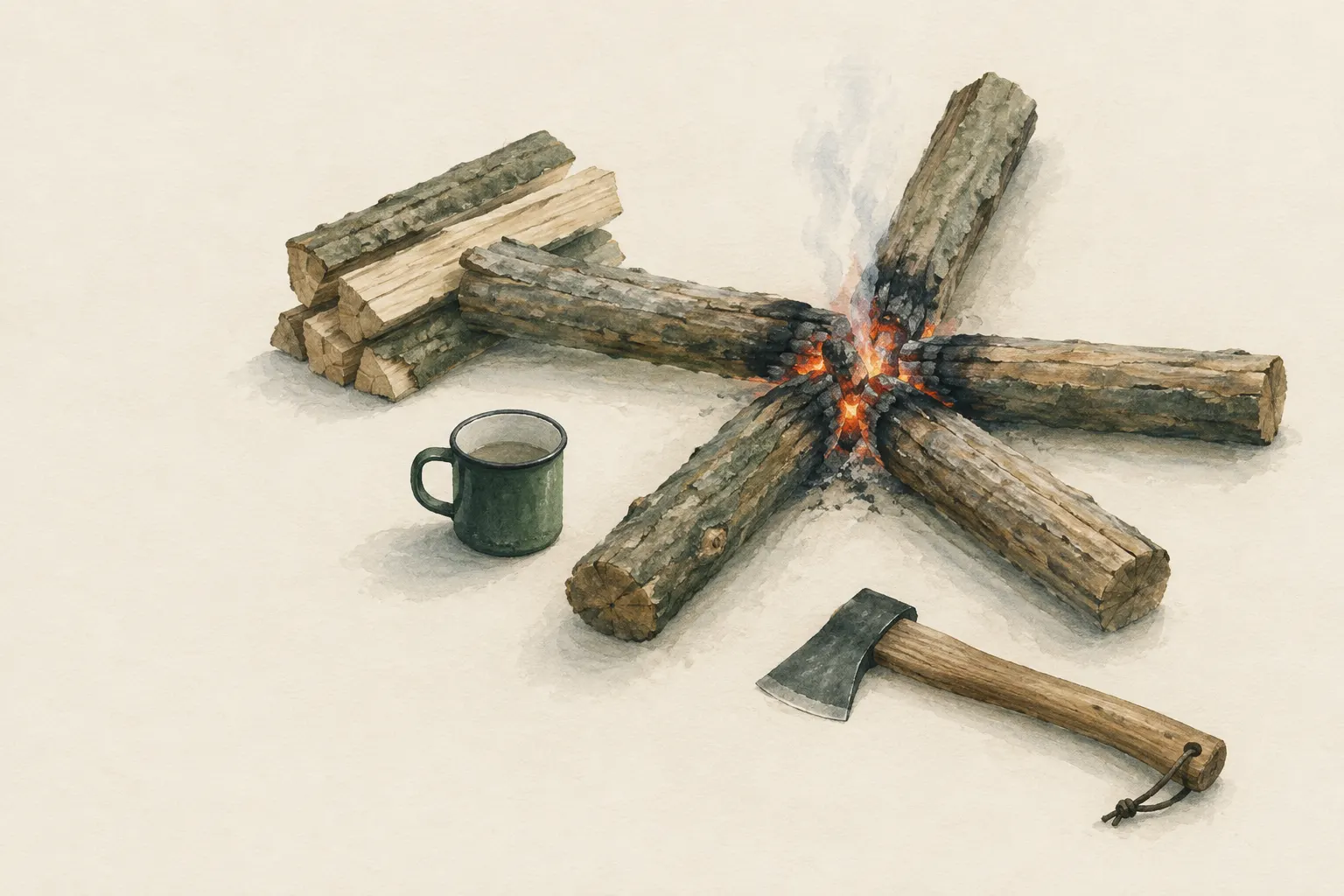
In the star fire, several long pieces of wood lie like the spokes of a wheel with their ends in the centre. Only the ends burn; you push the logs inwards as they burn down. This lets you regulate the fire's size finely and save wood without cutting everything up.
- Low; regular pushing in
Explained simply
Picture a bicycle wheel: the hub is in the middle and the spokes go outwards from there. For a star fire you lay three to five long pieces of wood exactly like that – one end in a small fire in the middle, the other end pointing outwards.
Only the ends in the middle burn. When they have burned away, you simply push the logs in a little further. If you want a bigger fire, you push them together. If you want a smaller one, you pull them apart. That way you save wood and do not have to saw up long logs.
Watch out: the protruding logs are trip hazards, especially in the dark. And never leave the fire burning on its own.
How it works
Wood only burns where it is hot enough. In the star fire, that is only the case in the middle, where the logs meet and heat each other. A little further out, the wood is too cool to burn. That is why the logs burn away slowly from the inside out rather than all at once.
That gives you a simple control knob: the closer together the ends lie, the more wood is hot and the bigger the fire becomes. If you pull them apart a little, the ends cool down and the fire gets smaller. The outer ends stay cool enough for a long time that you can use them as handles.
What really matters
Start with a small fire that already has a good core of embers – for example from a teepee. Only then lay the long logs in a star with their ends in it. Laid on a small flame, thick logs would be more likely to smother the fire.
Push the logs in only as far as the ends have burned away. If you push them in too far, the fire gets big and eats more wood than necessary. Dry, thick logs burn more evenly and for longer than thin or damp ones.
For cooking, you can rest a pot on the converging log ends or on stones beside them. Make sure it stands securely and cannot tip over when a log is pushed in.
When it makes sense – and when not
The star fire is a traditional cooking fire used in many parts of the world because it needs little wood. It is especially practical when you find only a few long pieces of deadwood and have no saw. It is also good for a small, calm fire that you want to keep at the same size for hours.
It does need space all round, however, because the logs stick out a long way. In cramped spots and between tents it is a poor choice. For a group that wants to warm up, the fire is usually too small, because it gives off only a little radiant heat.
Safety: what to watch out for
Check the local rules and wildfire danger before every fire; fire bans always apply. The long logs are trip hazards and can carry embers outwards if someone kicks them. Keep the area around all the logs clear, do not step over them and be especially careful in the dark. Children should know where the logs lie.
Hold a log for pushing in only by its outer, cool end. Even there it can be warm if the log has been burning for a long time – check carefully. Cool burns immediately with cool, not ice-cold, running water; for serious burns, call the local emergency number (112 in the EU).
To put the fire out, pull the logs apart and thoroughly extinguish both the embers in the middle and the smouldering log ends with water. A pulled-out log end can keep smouldering for a long time – never just leave it lying there.
Good to know
The star fire shows very nicely how to control a fire without adding new wood: purely through the distance between the pieces of fuel. The same principle is at work in many fire lays – wood that lies close together heats itself up.
If you have to leave the fire briefly, pulling the logs apart and hoping it goes out on its own is no solution. A fire is never left unattended – either someone stays with it, or it is put out completely.
Step by step
Small fire
Light a small fire with a good core of embers.
- 1
Small fire
Light a small fire with a good core of embers.
- 2
Lay the spokes
Lay three to five long logs in a star with their ends in the fire.
- 3
Feed in
Push the logs inwards as their ends burn away.
- 4
Reduce
To reduce the fire or before extinguishing, pull the logs outwards and extinguish the embers separately.
Common mistakes
- Pushing the logs in too far
- Leaving pulled-out ends smouldering
Quick view
Materials
Dry firewood
Several long, thick logs
Collect only where permitted.
Tinder
Carry in waterproof packaging.
Do not use liquid accelerants as tinder.
Suitable for
- An economical, long-lasting fire
- Long logs without a saw
- Regulating fire size
Not suitable for
- Cramped spots
- Unattended fire
Prerequisites
- A safe, permitted fire site with space all round
- A small fire already burning
Safety
- The protruding logs are trip hazards and can carry embers outwards. Keep the area clear and take special care in the dark.
- Cool burns immediately with cool, not ice-cold, running water. For large or deep burns, burns to the face or hands and burns in children, call the local emergency number (112 in the EU).
How it works
Only where the logs meet is there enough heat for combustion. Pushing them together makes the fire bigger; pulling them apart makes it smaller. The outer ends stay cool and act as handles.
Advantages
- Very economical with wood
- No need to cut long logs
- Easy to regulate
Disadvantages
- Needs space
- Trip hazard
- Rather small fire
Deep knowledge
Background
The star fire is a traditional cooking fire used in many parts of the world because it needs little wood.
It works well when only a few long pieces of deadwood are available.
Common mistakes
- Pushing the logs in too far
- Leaving pulled-out ends smouldering
Limits and risks
- Gives little radiant heat for groups
Material alternatives
Derived from material properties: a substitute must have all relevant properties. Observe the notes on the substitute.
- Dry firewood
- Tinder (Carry in waterproof packaging.), Char cloth (charred cotton) (Store dry in a tin.), Finest-grade steel wool (Store separately from batteries – fire risk.), Fatwood (resin-rich wood) (Collect only dead wood where permitted.), Stove fuel (canister, liquid fuel, alcohol) (Store fuels apart from food and in original containers or bottles intended for them.), Petroleum jelly cotton balls (Use only pure cotton.)
- Tinder
- Dry firewood (Collect only where permitted.), Char cloth (charred cotton) (Store dry in a tin.), Finest-grade steel wool (Store separately from batteries – fire risk.), Fatwood (resin-rich wood) (Collect only dead wood where permitted.), Stove fuel (canister, liquid fuel, alcohol) (Store fuels apart from food and in original containers or bottles intended for them.), Petroleum jelly cotton balls (Use only pure cotton.)
Results come exclusively from structured entries. No improvised instructions are generated.
Sources
Ray Mears – Hodder & Stoughton (2002): Bushcraft
Different fire forms for different purposes