Long fire and reflector wall for warmth
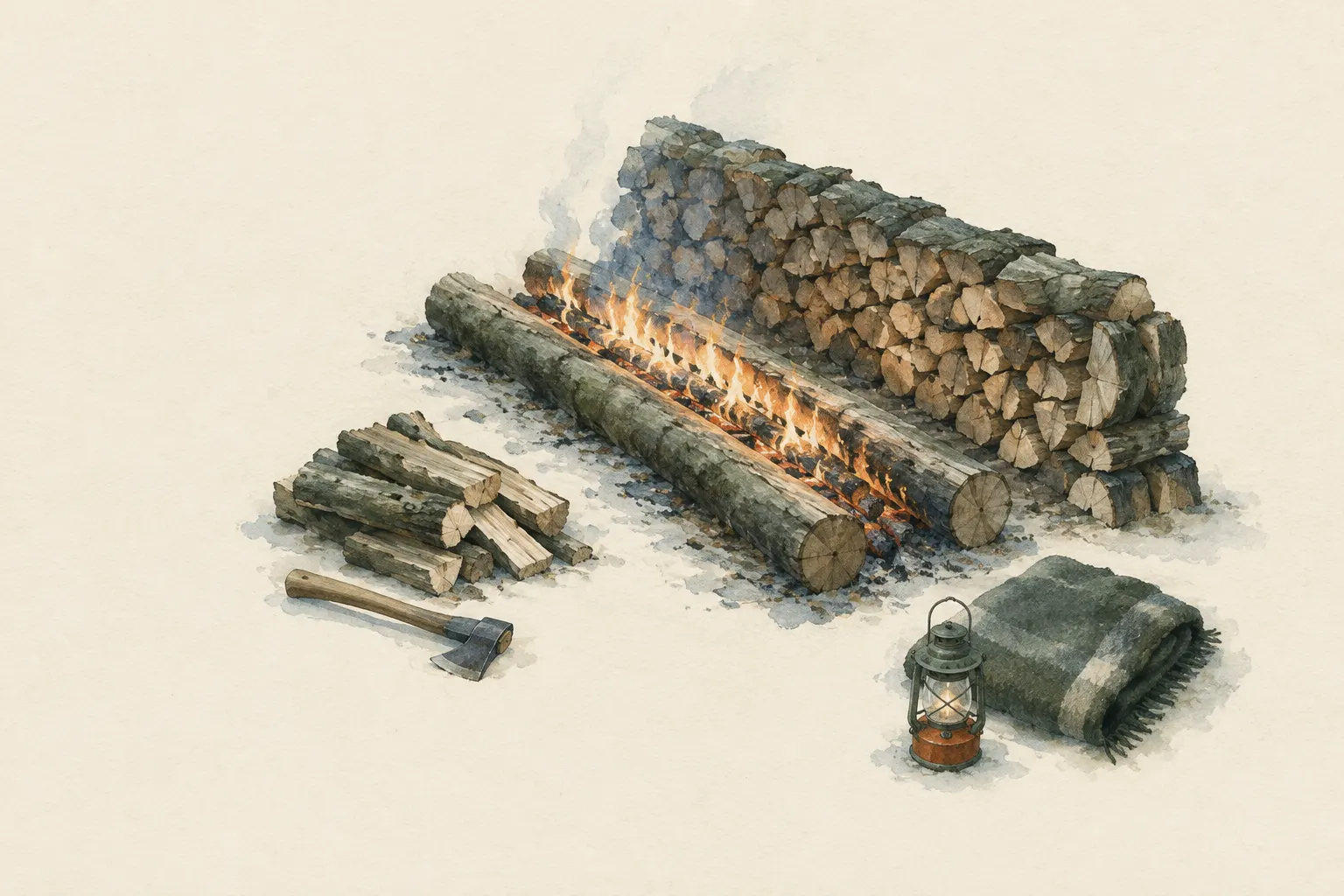
A long fire burns between two parallel logs and is about as long as a person lying down, so the whole body receives radiant heat. A wall of stacked logs or stones on the far side throws some of the heat back and blocks wind. Both need a lot of wood and constant supervision.
- An hour or more to build; very high wood demand for a night
Explained simply
When you sit by a campfire at night, your front is warm and your back is cold. An ordinary round fire warms only a small part of your body. So a long fire is as long as a person lying down. It burns between two long logs lying side by side and warms you from head to toe.
On the other side of the fire there can be a wall of stacked logs or dry stones. It blocks wind and throws some of the heat back. Its effect is smaller than many people think, though.
A fire like this needs a great deal of wood and has to be watched all night. Sparks can set sleeping bags and clothing alight. Warm clothing, a mat against the cold ground and shelter from wind matter more than any fire.
How it works
A fire warms you mainly through radiation – the same kind of heat you feel when the sun warms your face even though the air is cold. This heat travels in straight lines. Anything not facing the fire gets hardly any. A long fire as long as your body therefore radiates evenly onto the whole side of your body.
A reflector wall behind the fire first of all blocks the wind, which would otherwise carry heat away and swirl smoke and sparks around. It also warms up and radiates some of that heat back. That helps a little, but not as much as is often claimed. The bigger benefit is usually the wind protection.
The long fire is most effective in front of an open shelter, such as a sloping tarp roof whose open side faces the fire. Then the heat reaches you directly while the roof keeps off the rain.
What really matters
Wood, wood and more wood. A fire for a whole night consumes enormous amounts – much more than most people estimate. Gather before dark, and then gather the same again. Looking for wood in the dark is hard work and dangerous.
Choose an open spot with no overhanging branches, across the wind, so that the smoke does not blow into your shelter. Keep enough distance between the fire and your sleeping place: you want to feel the warmth, but no spark should reach you. Better a smaller, steady fire than a big one that throws sparks.
Build the reflector wall from logs stacked between driven-in stakes, or from dry stones. Do not use wet stones or stones from streams or lakes: they can crack when heated and throw fragments.
Safety: what to watch out for
A fire you sleep next to is always risky. Sparks can set sleeping bags, tarps and clothing alight; synthetic fibres melt and stick to the skin. So never leave the fire unattended. In a group, someone always keeps watch and adds wood while the others sleep; alone, a long fire overnight can hardly be run safely.
Never bring fire or embers into a tent, vehicle, snow shelter or enclosed room. Carbon monoxide can build up there – an invisible, odourless gas that can be fatal. The shelter in front of a long fire must be open towards the fire.
Check the local rules and wildfire danger before every fire; during a fire ban or drought, a long fire is out of the question. Keep extinguishing water ready and put the fire out completely in the morning. For burns, cool immediately with cool running water and call the local emergency number (112 in the EU) for serious burns.
When it makes sense – and when not
The long fire is a technique for genuine cold emergencies: an unplanned bivouac in the cold with an open shelter, plenty of deadwood nearby and a group that can take turns keeping watch. In North American and Scandinavian wilderness traditions it is a classic element; bushcraft authors such as Mors Kochanski have described it in connection with open shelters.
In many situations it is not the right choice: alone without anyone to take turns, in areas with little deadwood, under trees, in rain where it can hardly be kept going, or anywhere fire is not permitted. Clothing, insulation from the ground and shelter from wind remain the foundation. The fire is a supplement, not a replacement.
Step by step
Choose the site
Choose an open spot with no overhanging branches, parallel to the shelter and across the wind so smoke does not blow into the shelter.
- 1
Choose the site
Choose an open spot with no overhanging branches, parallel to the shelter and across the wind so smoke does not blow into the shelter.
- 2
Gather wood
Gather a great deal of fuel wood before dark – much more than estimated.
- 3
Lay the logs
Lay two body-length logs parallel with a gap between them and build a fire along the whole length in between.
- 4
Reflector wall
On the side away from the shelter, build a wall of logs stacked between stakes or of dry stones.
- 5
Keep watch
Take turns watching and adding wood. Check distances before sleeping and keep extinguishing water ready.
Common mistakes
- Too little wood for the night
- Fire too close to the shelter
- Reflector wall made of wet stream stones
- Sleeping alone without a watch
Quick view
Materials
Dry firewood
Long logs and large amounts of fuel wood
Collect only where permitted.
Folding saw
Fold or cover the blade after use; saw teeth are very sharp.
Water for extinguishing (bucket, canister or pot)
Have several litres ready before lighting.
Suitable for
- Emergency bivouac in the cold with an open shelter
- Groups who can take turns
Not suitable for
- Fire bans or drought
- Alone without someone to take turns
- Areas with little deadwood
- Under trees
Prerequisites
- Permission and a safe spot
- A great deal of deadwood
- A tool for cutting to length
- Supervision all night
Safety
- Wet stones or stones from water can crack when heated.
How it works
Outdoors, a person loses a lot of heat by radiation. A long, low fire gives radiant heat evenly along the whole body. A reflector wall blocks wind and radiates back part of the heat it absorbs; its effect is limited, however, and often overestimated.
Advantages
- Warms the whole body
- The reflector wall also blocks wind
Disadvantages
- Enormous wood demand
- Constant supervision needed
- High risk of fire and injury
Deep knowledge
Background
Long fires in front of open shelters are a classic element of North American and Scandinavian wilderness skills. Bushcraft authors such as Mors Kochanski have described them in connection with open shelters.
Protection through clothing, insulation from the ground and shelter from wind remains more important than the fire; the fire is a supplement.
Variants
- Rock face as reflector
- A dry rock face can act as a reflector. It must be stable; smoke and soot blacken the rock.
Common mistakes
- Too little wood for the night
- Fire too close to the shelter
- Reflector wall made of wet stream stones
- Sleeping alone without a watch
Limits and risks
- Not allowed everywhere
- Hard to keep going in rain
Material alternatives
Derived from material properties: a substitute must have all relevant properties. Observe the notes on the substitute.
- Dry firewood
- Tinder (Carry in waterproof packaging.), Char cloth (charred cotton) (Store dry in a tin.), Finest-grade steel wool (Store separately from batteries – fire risk.), Fatwood (resin-rich wood) (Collect only dead wood where permitted.), Stove fuel (canister, liquid fuel, alcohol) (Store fuels apart from food and in original containers or bottles intended for them.), Petroleum jelly cotton balls (Use only pure cotton.)
Results come exclusively from structured entries. No improvised instructions are generated.
Sources
Mors L. Kochanski – Lone Pine Publishing: Bushcraft: Outdoor Skills and Wilderness Survival
Long fires and warmth in front of open shelters
Headquarters, Department of the Army (USA) (2002): FM 3-05.70 Survival
Fire reflectors made of wood or stone