Banking a fire overnight
Banking means raking the embers together and covering them with ash so they smoulder slowly with little oxygen and can be revived in the morning. Outdoors this means an unattended fire – which is dangerous and prohibited in many places. It is safe only in a closed stove or under continuous supervision.
- A few minutes in the evening and morning
Explained simply
In the past, before matches existed, people did not want to relight the hearth fire every morning. So in the evening they raked the embers together and covered them with ash – like a warm blanket. Under the ash the embers get only a little air. They then keep burning very slowly and stay hot for many hours.
In the morning you brush off the ash, add thin wood and blow gently. Often the fire soon burns again.
But: outdoors this means a fire keeps smouldering all night without supervision. Wind can fan it back up and scatter sparks. That is dangerous and prohibited in many places. It is only safe in a closed stove or when someone stays awake the whole time.
How it works
Embers are burning wood without a flame. They need oxygen to keep glowing – the more air, the faster they burn up. A layer of ash works in two ways: it lets only a little air reach the embers, and it holds the heat in like an insulating blanket. The embers therefore burn very slowly.
A thick, dense log on the embers can also serve as a slow fuel reserve. It gradually chars under the ash and holds the heat. In the morning, ideally, a core of hot embers is left that quickly forms flames again with fresh tinder and air. There is no guarantee, though – sometimes the embers have gone out by morning.
When it makes sense – and when not
Today, banking embers makes sense mainly with wood stoves and ranges. There the embers burn in a closed firebox of metal or stone, and the air supply can be reduced according to the manufacturer's instructions. In a fixed camp with a fire watch, it can also save ignition sources and tinder.
Outdoors, the safe standard rule is different: the fire is put out completely before sleeping. An unattended campfire in the forest, in wind, drought or during a fire ban is out of the question. Where you are required to put fires out before sleeping, that applies without exception. And never bring embers into a tent, vehicle or a room without a stove.
What really matters
First you need a good, strong bed of embers. A few scattered, weak pieces of ember will not last until morning. Rake the embers and remaining wood tightly together in the centre of the fire site so they keep each other warm.
The layer of ash must be thick enough that no flames are visible any more. If it is too thin, the fire can flare up again, especially if the wind picks up. If, on the other hand, the embers are buried completely airtight, they suffocate. It takes some experience to find the right amount – so practise first under supervision and in a safe fire site.
In the morning, brush the ash off carefully without breaking up the embers. Put fine tinder and thin wood directly on the hottest spot and blow gently and evenly. Keep your face and hair a little to the side in case ash or sparks swirl up.
Safety: what to watch out for
A banked fire outdoors is an unattended fire. Wind can blow the ash away, fan the embers back up and carry sparks into dry grass – a wildfire can start this way in the middle of the night while everyone is asleep. So outdoors the rule is: either assign a watch that checks at short intervals and has extinguishing water ready, or put the fire out completely.
Embers give off carbon monoxide, an invisible, odourless gas that can be fatal. Embers, fires and stoves never belong in a tent, vehicle, snow shelter or enclosed room. Anyone running a wood stove overnight should have a working carbon monoxide alarm and use the stove according to the manufacturer's instructions.
Headache, dizziness, nausea or drowsiness near a fire or stove can be warning signs of carbon monoxide. Then get into fresh air immediately, take others with you and call the local emergency number (112 in the EU). Also check the local rules before every fire.
Good to know
Banking embers was everyday practice at hearths and fireplaces for centuries, when relighting a fire was hard work. To understand why, imagine how much effort it took to start a fire with flint and steel every morning.
For trips there are simpler solutions today: a lighter and matches stored in different places, plus some dry tinder in a waterproof bag. With these, a new fire is quickly made in the morning – without anything having to smoulder unattended during the night.
Step by step
Gather the embers
Rake embers and remaining wood together in the centre of the fire site.
- 1
Gather the embers
Rake embers and remaining wood together in the centre of the fire site.
- 2
Thick log
Optionally lay one thick, dense log on the embers.
- 3
Cover with ash
Cover embers and log with a layer of ash so no flames are visible.
- 4
Supervise
Outdoors, assign a watch or check at short intervals. Keep extinguishing water ready.
- 5
Revive in the morning
Carefully brush off the ash, place tinder and thin wood on the embers and blow gently.
Common mistakes
- Banking unattended in the forest
- Too thin a layer of ash – the fire flares up
- Embers near a tent or vehicle
Quick view
Materials
Dry firewood
One thick, dense log
Collect only where permitted.
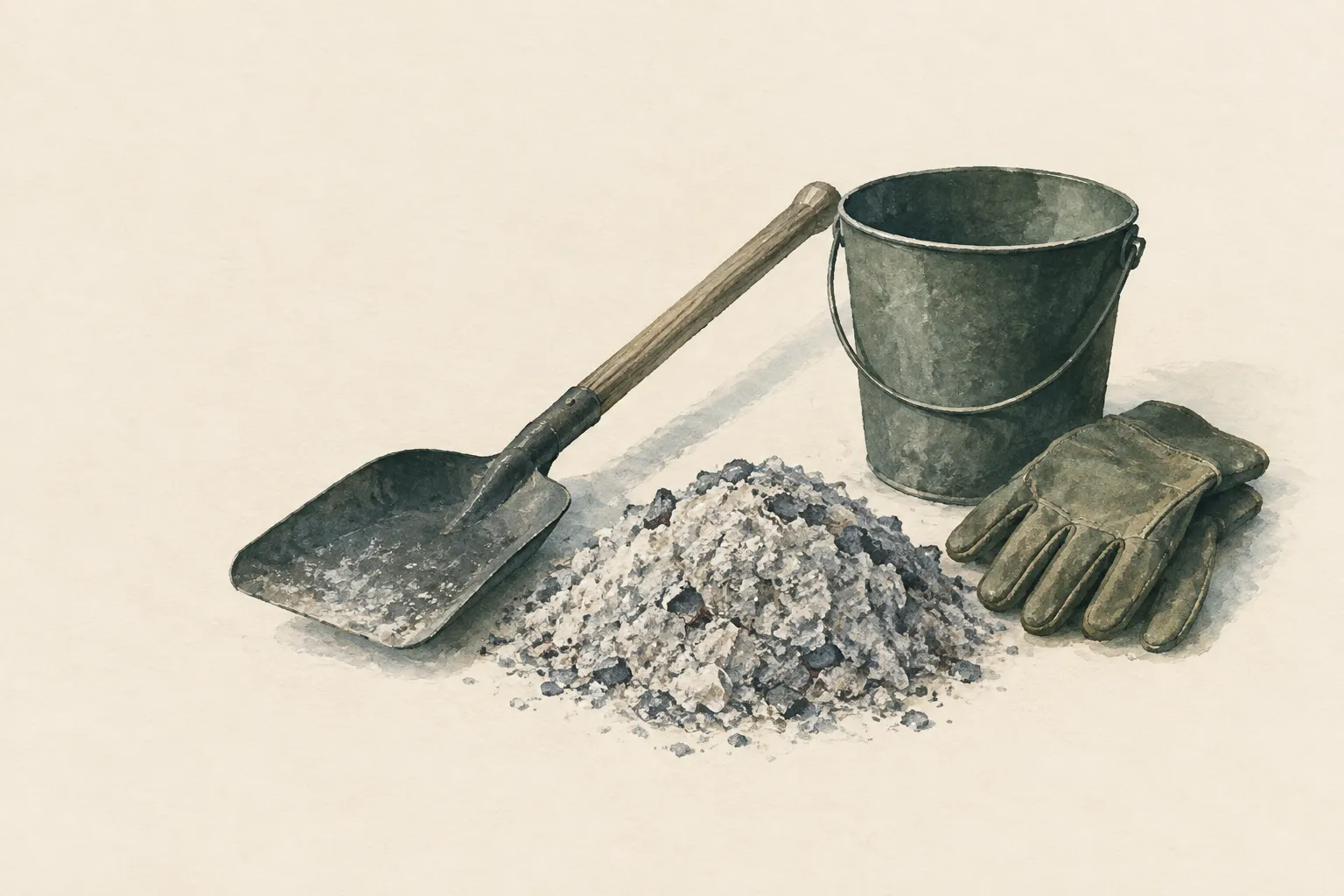
Small shovel / folding spade
Suitable for
- A fixed camp with a watch
- Wood stove or range
- Reviving in the morning without new ignition
Not suitable for
- Unattended campfire in the forest
- Wind, drought, fire bans
- Tent, vehicle, indoors without a stove
Prerequisites
- A safe fire site or closed stove
- A good bed of embers
- Clarity on whether a fire smouldering overnight is allowed
How it works
Ash insulates and limits the supply of oxygen. The embers therefore burn very slowly and stay hot for hours. In the morning it is enough to brush off the ash, add fine material and supply air.
Advantages
- Saves ignition sources and tinder
- Quick fire in the morning
Disadvantages
- Outdoors, an unattended fire
- Not permitted in many places
Deep knowledge
Background
Banking embers was everyday practice at hearths and fireplaces before matches were invented.
Today it is relevant mainly for wood stoves. Outdoors, putting the fire out completely before sleeping is the safe standard rule.
Variants
- In a wood stove
- In a wood stove the embers are raked together in a similar way and the air supply is reduced according to the manufacturer's instructions. A working carbon monoxide alarm is advisable.
Common mistakes
- Banking unattended in the forest
- Too thin a layer of ash – the fire flares up
- Embers near a tent or vehicle
Limits and risks
- No guarantee the embers last until morning
- Does not replace complete extinguishing
Material alternatives
Derived from material properties: a substitute must have all relevant properties. Observe the notes on the substitute.
- Dry firewood
- Tinder (Carry in waterproof packaging.), Char cloth (charred cotton) (Store dry in a tin.), Finest-grade steel wool (Store separately from batteries – fire risk.), Fatwood (resin-rich wood) (Collect only dead wood where permitted.), Stove fuel (canister, liquid fuel, alcohol) (Store fuels apart from food and in original containers or bottles intended for them.), Petroleum jelly cotton balls (Use only pure cotton.)
Results come exclusively from structured entries. No improvised instructions are generated.
Sources
USDA Forest Service / Ad Council / National Association of State Foresters: Campfire Safety (Smokey Bear wildfire prevention campaign)
Never leave a fire unattended
Centers for Disease Control and Prevention: Carbon Monoxide Poisoning – Prevention guidance
Carbon monoxide hazard from combustion indoors