Log cabin fire lay
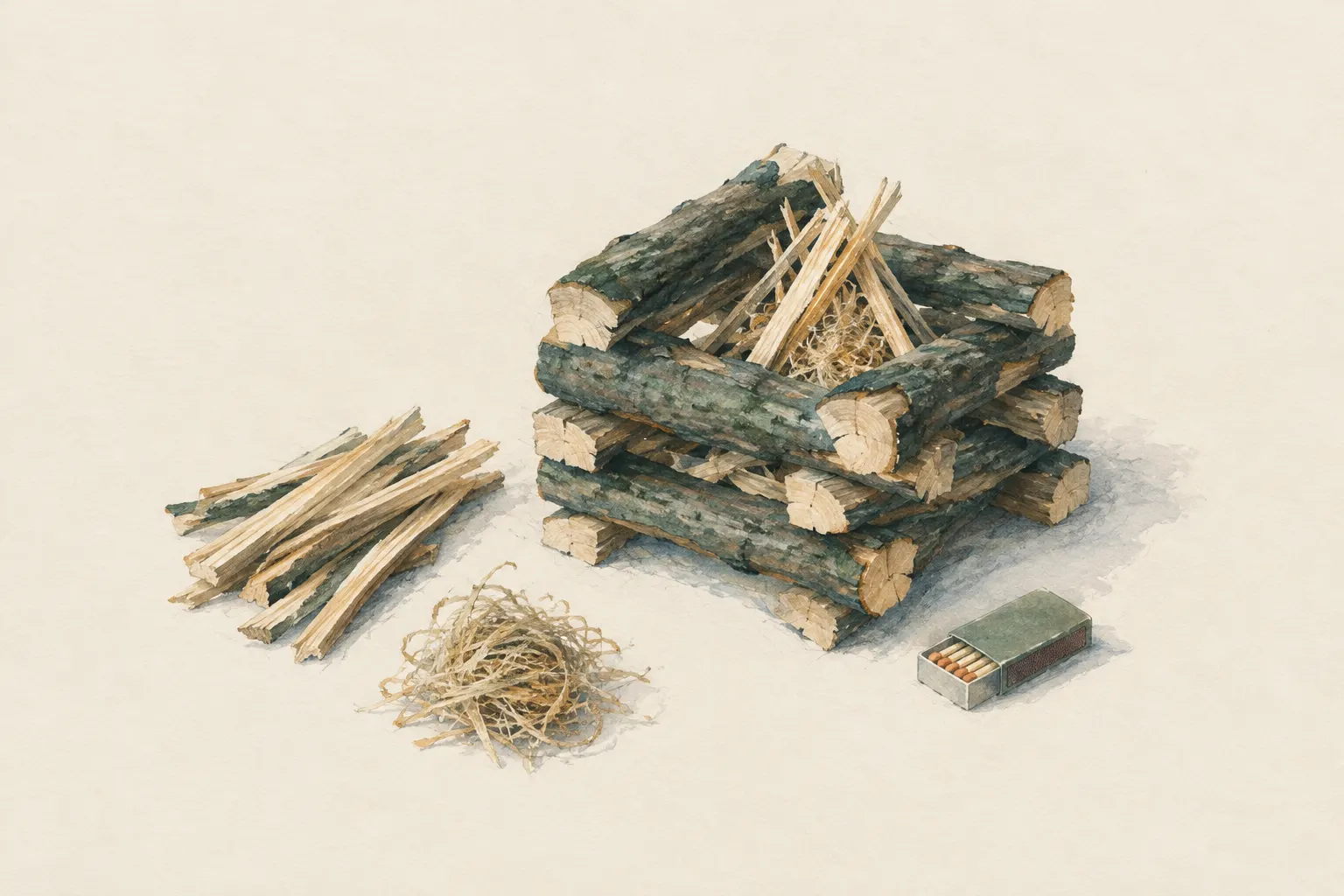
In the log cabin, sticks are stacked crosswise in layers like a log hut around a small teepee or tinder bundle. The fire burns evenly and stably and builds a good bed of embers – ideal for cooking.
- 10–15 minutes to build
Explained simply
For a log cabin fire, you stack sticks the way you build a log hut: two sticks parallel side by side, two crosswise on top, then two more in the first direction – layer by layer. In the middle goes a small teepee of tinder and thin wood, which you light first.
Air comes in from all sides through the gaps between the sticks. The fire burns evenly and calmly and finally settles into a flat bed of embers. Embers like that are very good for cooking.
As with every fire: only where it is allowed, never unattended, and keep water ready for putting it out.
How it works
The small teepee in the core makes for a quick start. Its flames rise and catch the log cabin sticks from the inside. Because the sticks lie crosswise, they support each other – the fire stays stable and does not suddenly fall over like a teepee.
The gaps between the layers are like many small windows. Air flows evenly through them to the fire from all sides. The fire burns from the inside out and from the top down. In the end a flat, evenly hot layer of embers remains that gives off heat for a long time.
What really matters
You need sticks that are as straight as possible. Crooked pieces wobble, roll away and make the stack tip over. The lower layers can be a little thicker, getting thinner towards the top. That way the rising flame first reaches the pieces that burn most easily.
The layers must not be too tight. There should be clear space between two sticks of the same layer, otherwise the fire gets too little air. Do not build the stack too big either – a knee-high tower is usually far too much for a cooking fire. A few layers are enough.
Leave a gap on the windward side so you can light the core. If you want a fire that burns longer by itself, you can lay a few thin sticks loosely across the top as a lid.
When it makes sense – and when not
The log cabin is the classic cooking fire. It produces an even bed of embers on which pots and pans stand steadily or on which you can place a grill. It also suits a calm evening fire because it burns in a stable, predictable way.
However, it needs more preparation than a teepee and a fair amount of straight sticks. If you are in a hurry or only have crooked branches, a simpler lay is better. In strong wind, the side facing the wind burns down faster – then you should site the fire out of the wind or straighten it more often.
Safety: what to watch out for
Check the local rules and current wildfire danger before every fire; fire bans always apply. Choose an existing fire site or a spot on bare ground, well away from tents, trees and dry grass. Never pour flammable liquids onto the fire.
When cooking you get close to the fire. Place pots so they cannot tip over, and touch hot handles only with a cloth or glove. Cool burns immediately with cool, not ice-cold, running water. For large or deep burns, burns to the face or hands and burns in children, call the local emergency number (112 in the EU).
A bed of embers often looks harmless but stays very hot for a long time. At the end, put it out thoroughly with plenty of water, stir and check that nothing is still warm.
Good to know
The log cabin lay is widespread in scouting and outdoor guides. It combines two advantages: the quick start of a small teepee and the stability of crossed layers.
A related idea is the top-down fire, in which the thick logs lie at the bottom and the fire is lit at the top. Both lays use crossed layers but differ in where the fire starts. It is worth trying both and comparing them.
Step by step
Build the core
Place a tinder bundle and a small teepee of thin kindling in the centre.
- 1
Build the core
Place a tinder bundle and a small teepee of thin kindling in the centre.
- 2
Stack layers
Two parallel sticks left and right, two crosswise on top – several layers like this, slightly thinner towards the top.
- 3
Optional top
For a longer-burning fire, lay thin sticks loosely across the top as a lid.
- 4
Light
Light the core through a gap on the windward side.
Common mistakes
- Layers too tight
- Crooked sticks that roll away
- Too large a stack
Quick view
Materials
Tinder
Carry in waterproof packaging.
Do not use liquid accelerants as tinder.
Dry firewood
Collect only where permitted.
Suitable for
- Cooking on embers
- A steady, stable fire
- Resting a pot on the stack
Not suitable for
- Very quick lighting
- Lack of straight sticks
Prerequisites
- A safe, permitted fire site
- Straight sticks in several thicknesses
Safety
- Cool burns immediately with cool, not ice-cold, running water. For large or deep burns, burns to the face or hands and burns in children, call the local emergency number (112 in the EU).
How it works
The gaps between the layers let in air from all sides while the crossed sticks stay stable. The fire burns from the inside out and settles into a flat, even bed of embers.
Advantages
- Stable and even
- Good ember bed for cooking
Disadvantages
- Needs straight sticks
- More work than a teepee
Deep knowledge
Background
The log cabin lay is widespread in scouting and outdoor guides.
It combines the quick start of a small teepee with the stability of crossed layers.
Common mistakes
- Layers too tight
- Crooked sticks that roll away
- Too large a stack
Limits and risks
- In strong wind one side burns down faster
Material alternatives
Derived from material properties: a substitute must have all relevant properties. Observe the notes on the substitute.
- Tinder
- Dry firewood (Collect only where permitted.), Char cloth (charred cotton) (Store dry in a tin.), Finest-grade steel wool (Store separately from batteries – fire risk.), Fatwood (resin-rich wood) (Collect only dead wood where permitted.), Stove fuel (canister, liquid fuel, alcohol) (Store fuels apart from food and in original containers or bottles intended for them.), Petroleum jelly cotton balls (Use only pure cotton.)
- Dry firewood
- Tinder (Carry in waterproof packaging.), Char cloth (charred cotton) (Store dry in a tin.), Finest-grade steel wool (Store separately from batteries – fire risk.), Fatwood (resin-rich wood) (Collect only dead wood where permitted.), Stove fuel (canister, liquid fuel, alcohol) (Store fuels apart from food and in original containers or bottles intended for them.), Petroleum jelly cotton balls (Use only pure cotton.)
Results come exclusively from structured entries. No improvised instructions are generated.
Sources
Headquarters, Department of the Army (USA) (2002): FM 3-05.70 Survival
Fire lays for building a fire