Teepee fire lay
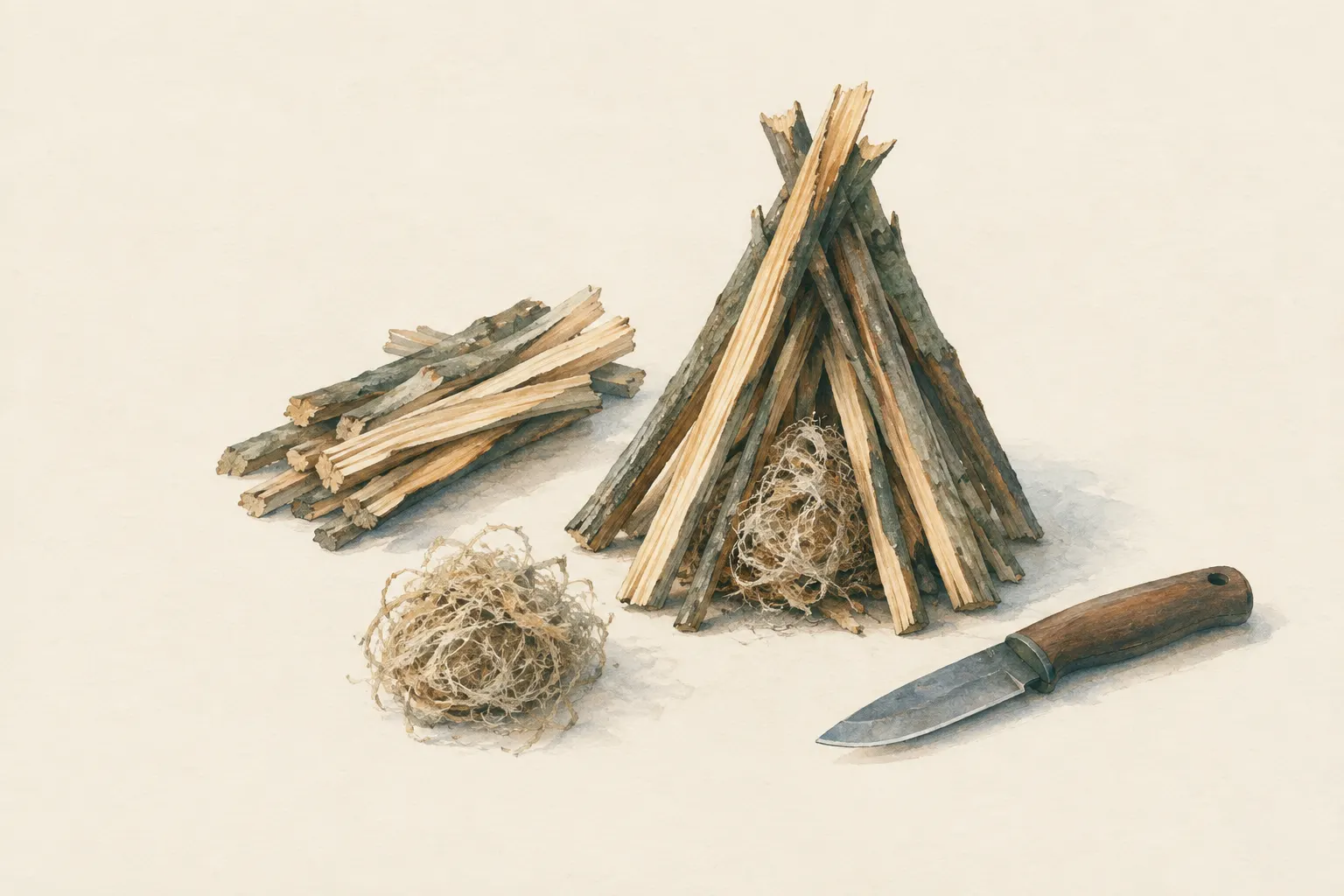
In the teepee, kindling stands in a cone around a tinder bundle. Flames rise inside and quickly catch all the wood. The teepee lights hot and fast and suits lighting and boiling water quickly, but it soon collapses.
- 5–10 minutes to build
Explained simply
For a teepee, you stand thin sticks at an angle around a tinder bundle so that they meet at the top – like the poles of a tipi tent or a cone. You light the bundle in the middle.
The cone works like a small chimney: hot air rises in the middle and fresh air flows in at the bottom. The flames climb up all the sticks at the same time. That is why the teepee lights quickly and hot – good for getting a fire going and for heating water fast.
After a while the teepee collapses. Embers and pieces of wood can roll to the side. So keep the area around the fire clear, and only make a fire where it is allowed.
How it works
A fire needs three things: fuel, heat and oxygen. The teepee provides all three at once. The sticks stand at an angle and point towards the flame. That way they are preheated evenly from bottom to top before they burn themselves.
At the same time, a chimney effect develops. Hot air is lighter than cold air and rises in the middle of the cone. This draws fresh air in at the bottom through the gaps between the sticks. So the fire supplies itself with oxygen – as long as the sticks are not packed too tightly.
What really matters
Sort your wood by thickness before lighting: tinder, matchstick-thin sticks, pencil-thick sticks and thumb-thick sticks. The thinnest go on the inside, the thicker ones outside. If you stand up thick logs straight away, you smother the small flame or it never reaches the wood.
Leave a small opening on the windward side so you can light the bundle from below. The wind then blows into the fire rather than blowing the flame away from your tinder. Stand the cone loosely enough that you can still see between the sticks.
Once the flames break out at the top, lean on more wood that is slightly thicker. Not too early and not too much at once – otherwise the teepee collapses before the new wood has caught.
When it makes sense – and when not
The teepee is ideal for beginners and whenever a fire needs to burn quickly. With its tall, concentrated flame it brings a pot of water to the boil fast. Many experienced people use a small teepee as a starter fire and later build a log cabin or star fire around it.
It is less suitable for a long-lasting fire: it burns through wood quickly and constantly needs feeding. In strong wind it is a poor choice, because the tall flames carry many sparks into the air. A low lay such as the lean-to is better then.
Safety: what to watch out for
Check the local rules and current wildfire danger before every fire. Fire bans always apply, even to small practice fires. Use existing fire sites where possible and keep water or soil ready for putting the fire out.
The teepee collapses as it burns. Burning pieces can roll off to the side. So clear dry leaves, grass and twigs from around the fire site and keep a sensible distance yourself. Never pour petrol, spirit or other flammable liquids onto the fire or the embers – the vapours can ignite explosively.
Never leave the fire unattended. When you are finished, put it out completely with plenty of water, stir the ashes and check with the back of your hand, at a safe distance, that no heat can be felt.
How to practise it
The teepee is the best way to start learning fire-making. Practise at a permitted fire site and set yourself a small goal: get the fire burning with a single match. For that you need to have gathered enough thin, dry material beforehand – usually more than you would think.
While practising, notice what happens when you build the cone tighter or looser. That way you learn for yourself how much air a fire needs. This knowledge will help you later with every other fire lay.
Step by step
Tinder bundle
Place the tinder bundle in the centre of the fire site.
- 1
Tinder bundle
Place the tinder bundle in the centre of the fire site.
- 2
Lean thin wood
Stand matchstick-thin sticks in a cone around the nest; leave an opening on the windward side for lighting.
- 3
Thicker sticks
Lean a second layer of pencil- to thumb-thick sticks on the outside, loose enough for air.
- 4
Light
Light the nest from below through the opening and lean on more wood once the flames climb.
Common mistakes
- Cone packed too tightly
- Opening on the wrong side
- Standing up thick logs straight away
Quick view
Materials
Tinder
Carry in waterproof packaging.
Do not use liquid accelerants as tinder.
Dry firewood
Collect only where permitted.
Suitable for
- Quick lighting
- A short, hot fire for boiling water
- Beginners
Not suitable for
- A long-lasting fire without refuelling
- Strong wind (flying sparks)
Prerequisites
- A safe, permitted fire site
- Tinder and kindling in several thicknesses
Safety
- The teepee collapses as it burns; embers and wood can roll sideways. Keep the area around the fire clear.
How it works
The cone forms a chimney: hot air rises in the middle and fresh air flows in at the bottom. All sticks lean towards the flame and are preheated evenly.
Advantages
- Lights quickly
- Hot, concentrated flame
Disadvantages
- Burns through wood quickly
- Collapses
- Tall flames, more flying sparks
Deep knowledge
Background
The teepee is the fire lay described most often in survival manuals and scouting guides.
In practice it is often used as a starter that later becomes a log cabin or star fire.
Common mistakes
- Cone packed too tightly
- Opening on the wrong side
- Standing up thick logs straight away
Limits and risks
- Short burn time without refuelling
Material alternatives
Derived from material properties: a substitute must have all relevant properties. Observe the notes on the substitute.
- Tinder
- Dry firewood (Collect only where permitted.), Char cloth (charred cotton) (Store dry in a tin.), Finest-grade steel wool (Store separately from batteries – fire risk.), Fatwood (resin-rich wood) (Collect only dead wood where permitted.), Stove fuel (canister, liquid fuel, alcohol) (Store fuels apart from food and in original containers or bottles intended for them.), Petroleum jelly cotton balls (Use only pure cotton.)
- Dry firewood
- Tinder (Carry in waterproof packaging.), Char cloth (charred cotton) (Store dry in a tin.), Finest-grade steel wool (Store separately from batteries – fire risk.), Fatwood (resin-rich wood) (Collect only dead wood where permitted.), Stove fuel (canister, liquid fuel, alcohol) (Store fuels apart from food and in original containers or bottles intended for them.), Petroleum jelly cotton balls (Use only pure cotton.)
Results come exclusively from structured entries. No improvised instructions are generated.
Sources
Headquarters, Department of the Army (USA) (2002): FM 3-05.70 Survival
Tepee as a fire lay