Lean-to fire lay
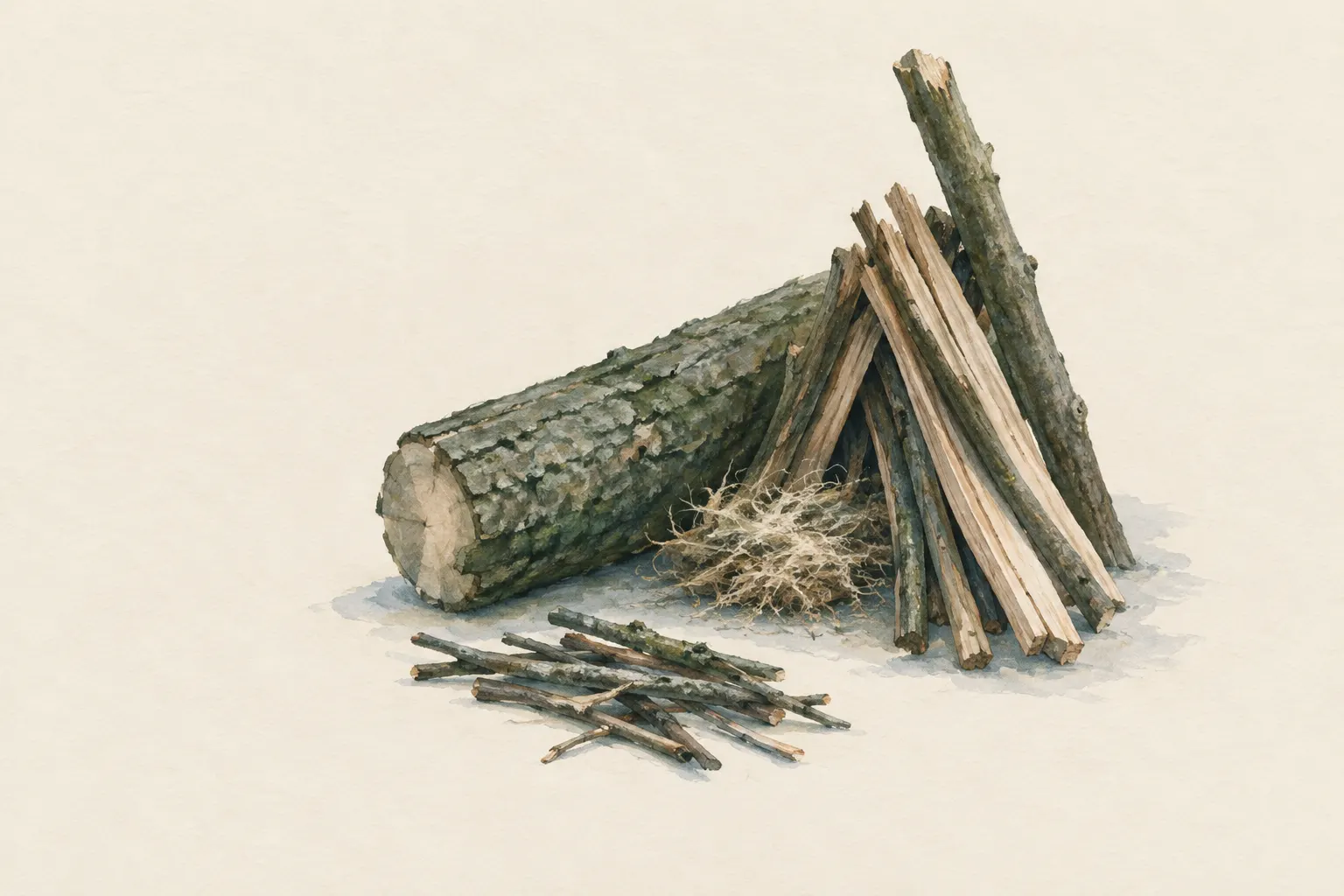
In the lean-to lay, the tinder bundle lies in the lee of a thick log or under a stick pushed into the ground at an angle, with kindling leaned against it. The lay shelters the young flame from wind.
- 5–10 minutes
Explained simply
A small, young flame is fragile – one gust of wind and it is out. So with the lean-to fire you build it a protective wall. That can be a thick log laid across the wind, or a stick pushed into the ground at an angle.
You place the tinder bundle in the shelter of this wall, right against it. Then you lean thin sticks at an angle over it against the thick log – like a small sloping roof. The flame is protected and can still grow upwards into the kindling.
The lean-to fire is fairly small. In a storm with lots of flying sparks the wall does not help either – then it is better not to make a fire at all. And as always: only where it is allowed.
How it works
Wind holds back a young fire in two ways: it cools the small flame and blows it away from the fuel. The thick log or slanted stick forms a wall behind which the air is calmer. There the tinder can catch fire undisturbed.
The kindling leaned against it lies at an angle over the tinder. The rising flame reaches it from below without the kindling pressing down on the bundle and smothering the flame. Later the thick windbreak log often catches too and holds the embers together.
What really matters
The wall has to be on the right side – that is, between the wind and the tinder. Check the wind direction before you build: hold up a moistened finger or watch grass, leaves or smoke. A stick pushed in at an angle points its tip into the wind; the bundle lies beneath it on the side away from the wind.
The bundle must lie right against the wall, not a hand's width in front of it. Otherwise the wind still reaches it around the edge. First lean very thin wood against the wall, then slightly thicker wood on top, and leave a small opening on the open side through which you can light it.
After that, add wood gradually. Once the fire is burning well, you can turn it into another form, for example a log cabin fire for cooking.
When it makes sense – and when not
The lean-to is ideal when a light to moderate wind is blowing and you need a small fire for cooking or warming water. It needs little material: one thick piece of wood and some kindling are enough.
But it does not replace a well-chosen, sheltered spot. If the wind shifts, the wall loses its effect. For a large fire for warmth the lay is too small. And in a storm or great dryness, sparks fly far – then the risk of a wildfire is too high, no matter how good the windbreak is.
Safety: what to watch out for
Wind is always a warning sign when making fire. Check the local rules and current wildfire danger before every fire; during a fire ban or in strong wind, no fire is made. Clear dry leaves and grass from the surroundings, especially on the downwind side, where sparks are carried.
Never pour petrol, spirit or other flammable liquids onto the fire, even if it is hard to light in the wind – the vapours can ignite explosively and the wind can push the flames towards you. Keep water ready for putting it out and never leave the fire alone.
Good to know
The lean-to is a classic fire lay from military survival manuals. It combines well with other ideas: a backpack, a rock or your own body can serve as an extra windbreak while you light the fire.
A good rule of thumb: first the site, then the lay. A hollow, a large rock or dense bushes some distance away often protect better against wind than any wooden wall. The lean-to is the fine-tuning at a spot that is already well chosen.
Step by step
Windbreak
Lay a thick log across the wind or push a stick into the ground at an angle, with its tip pointing into the wind.
- 1
Windbreak
Lay a thick log across the wind or push a stick into the ground at an angle, with its tip pointing into the wind.
- 2
Place the tinder
Place the tinder bundle in the lee, right against the log or under the stick.
- 3
Lean the kindling
Lean thin kindling at an angle over the nest against the log or stick, thicker pieces on top.
- 4
Light
Light from the open side and add wood gradually.
Common mistakes
- Windbreak on the wrong side
- Nest too far from the windbreak
Quick view
Materials
Tinder
Carry in waterproof packaging.
Do not use liquid accelerants as tinder.
Dry firewood
Collect only where permitted.
Suitable for
- Lighting in a light wind
- Small cooking fires
Not suitable for
- Storms and flying sparks
- Large fires for warmth
Prerequisites
- A safe, permitted fire site
- A thicker log or a sturdy stick
How it works
The thick log or slanted stick forms a wall against the wind; the kindling leaned against it lies at an angle over the flame and is caught by it without smothering it.
Advantages
- Shields the young flame from wind
- Possible with little material
Disadvantages
- Rather small fire
- Less effective when the wind shifts
Deep knowledge
Background
The lean-to is a classic fire lay from military survival manuals.
The thick windbreak log often catches later and helps hold the embers together.
Common mistakes
- Windbreak on the wrong side
- Nest too far from the windbreak
Limits and risks
- No substitute for a sheltered spot
Material alternatives
Derived from material properties: a substitute must have all relevant properties. Observe the notes on the substitute.
- Tinder
- Dry firewood (Collect only where permitted.), Char cloth (charred cotton) (Store dry in a tin.), Finest-grade steel wool (Store separately from batteries – fire risk.), Fatwood (resin-rich wood) (Collect only dead wood where permitted.), Stove fuel (canister, liquid fuel, alcohol) (Store fuels apart from food and in original containers or bottles intended for them.), Petroleum jelly cotton balls (Use only pure cotton.)
- Dry firewood
- Tinder (Carry in waterproof packaging.), Char cloth (charred cotton) (Store dry in a tin.), Finest-grade steel wool (Store separately from batteries – fire risk.), Fatwood (resin-rich wood) (Collect only dead wood where permitted.), Stove fuel (canister, liquid fuel, alcohol) (Store fuels apart from food and in original containers or bottles intended for them.), Petroleum jelly cotton balls (Use only pure cotton.)
Results come exclusively from structured entries. No improvised instructions are generated.
Sources
Headquarters, Department of the Army (USA) (2002): FM 3-05.70 Survival
Lean-to fire lay