Reducing smoke and where to sit
Smoke is a sign of incomplete combustion and contains fine particles, carbon monoxide and irritants. A fire smokes mainly with damp, fresh or overly thick wood, when air is lacking, and when rubbish is burned. Dry, split wood, a small, hot fire, good airflow and a seat across the wind reduce exposure – for the group and for neighbours.
- Little extra effort in wood choice and lay
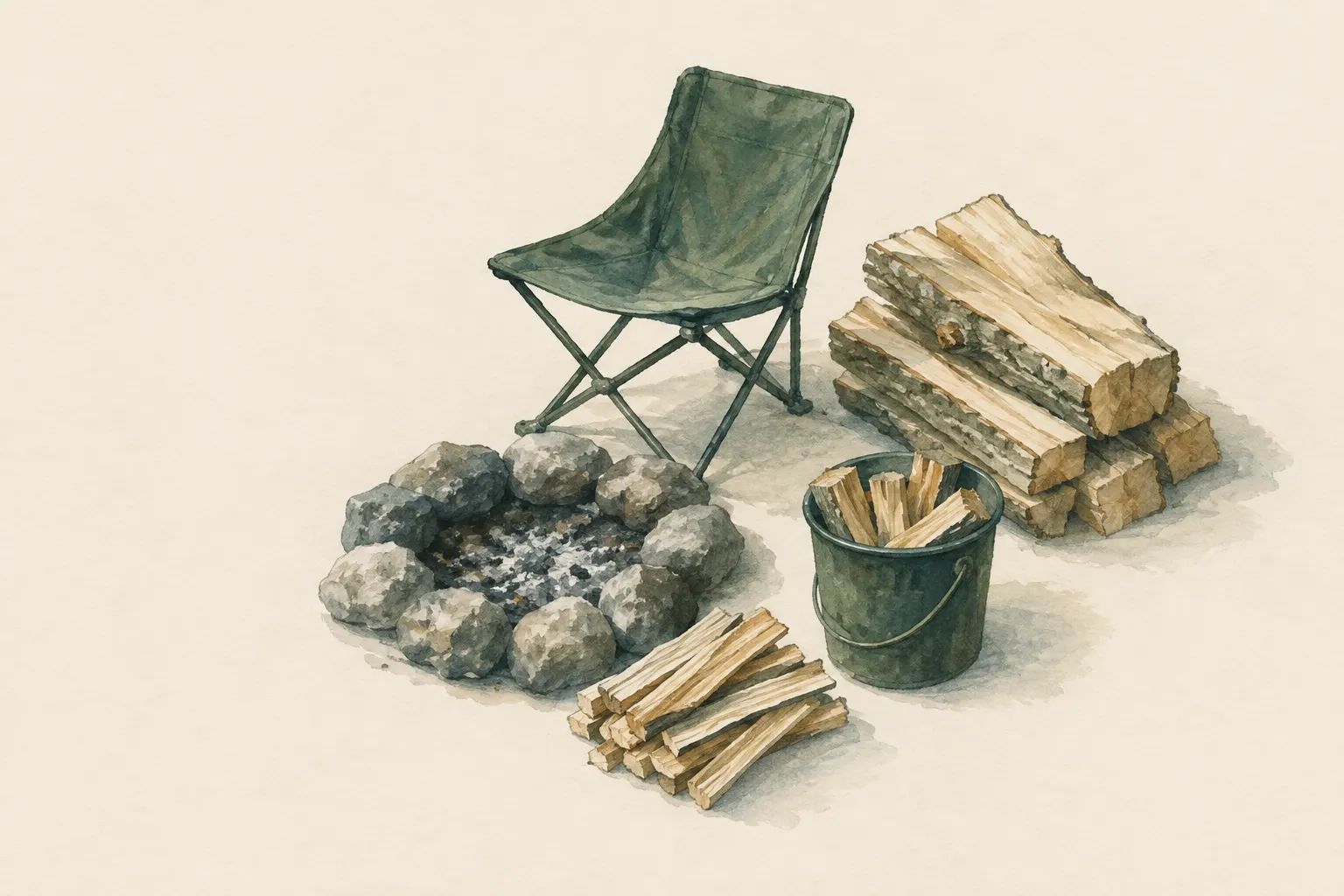
Explained simply
Smoke forms when a fire is not burning properly. When wood is heated, it gives off gases. If these get enough air and heat, they burn almost completely, and you see hardly any smoke. But if the wood is wet or the fire gets too little air, the gases rise unburned as smoke.
Smoke is not only annoying, it is also unhealthy. It contains tiny dust particles that get deep into the lungs, and carbon monoxide, an invisible gas. So it is good to avoid smoke: with dry wood, a small, hot fire and the right seat – not where the wind blows the smoke.
And very important: embers or fire never belong in a tent, a car or an enclosed room.
How it works
Wood does not burn directly. When heated, it gives off combustible gases, and it is these gases that burn in the flames. If there is enough oxygen and the temperature stays high enough, they burn almost completely into invisible exhaust gases. If either is missing, part of the gases escape unburned and cool down – visible smoke forms.
Wet wood is the most common reason. The water inside must evaporate first, and that takes a lot of heat. The fire stays cooler, and the steam mixes with unburned gases to form dense, whitish-grey smoke. The second reason is a lack of air: a large, tightly stacked pile of wood smothers itself. Green leaves, rubbish and plastics make it even worse.
Where the smoke goes is decided by the wind. In calm weather, smoke collects in hollows. During a so-called inversion – cold air lying near the ground beneath warmer air – it cannot rise and hangs over the surroundings like a lid.
What really matters
Use only dry, seasoned and split wood. A simple clue: if the wood hisses or foams at the ends when it is in the fire, it is too wet. Split wood dries better and catches fire more easily than round pieces with bark.
A small fire with good draught burns cleaner than a large, smothered stack. Add wood bit by bit instead of throwing a lot on at once, and leave air between the pieces. Never use leaves or greenery to “damp down” flames – that creates a great deal of smoke.
Sit across the wind direction, not in the smoke plume. If the wind shifts, you move. Children and sensitive people sit on the windward side, i.e. where the wind comes from.
Safety: what to watch out for
Smoke strains the airways as well as the heart and circulation. People with asthma, lung or heart disease, pregnant women, older people and children should avoid smoke exposure. Anyone who develops severe breathing difficulty needs help: call the local emergency number (112 in the EU).
Never burn rubbish, plastics or painted, coated or treated wood. This produces toxic gases that you cannot always smell. A campfire is not a rubbish bin.
The most treacherous danger is carbon monoxide. It is invisible, odourless and can be fatal. Outdoors it disperses; in tents, vehicles and enclosed rooms it builds up – even from embers that hardly smoke any more. So never bring a pot of embers into a tent for warmth. And as always: check local rules and wildfire danger beforehand.
Typical situations
In residential areas, the smoke decides a lot about whether a garden fire is pleasant for everyone. Watch the wind direction, open windows and the neighbours' washing on the line. If the smoke is a nuisance, make the fire smaller or put it out. That is not only polite but also avoids trouble.
There is no completely smoke-free wood fire. A stove produces much less smoke and is a good alternative if it is only about cooking. For a signal fire, by contrast, smoke is made deliberately so that you are seen – that is a separate case with its own rules.
Step by step
Dry wood
Use only dry, seasoned, split wood. If the wood hisses or foams at the ends, it is too wet.
- 1
Dry wood
Use only dry, seasoned, split wood. If the wood hisses or foams at the ends, it is too wet.
- 2
Small and hot
A small fire with good draught burns cleaner than a large, smothered stack. Add wood bit by bit rather than a lot at once.
- 3
Sit right
Sit across the wind direction, not downwind. Move when the wind shifts; seat children and sensitive people on the windward side.
- 4
Consider neighbours
In residential areas, consider wind direction, open windows and laundry, and reduce or put out the fire if it causes a nuisance.
Common mistakes
- Fresh or wet wood
- Too much wood at once
- Leaves and greenery to damp down flames
- Burning rubbish
- Sitting downwind
Quick view
Materials
Dry firewood
Dry, split, untreated
Collect only where permitted.
Suitable for
- Campfires and garden fires
- Groups with children or sensitive people
- Residential areas
Not suitable for
- Indoors, tents, vehicles (never an open fire there)
Prerequisites
- Dry firewood
- A permitted outdoor fire site
Safety
- Smoke strains the airways and cardiovascular system. People with asthma, lung or heart disease, pregnant women, older people and children should avoid smoke exposure. In case of breathing difficulty, call the local emergency number (112 in the EU).
How it works
When heated, wood releases combustible gases; if they burn completely with enough oxygen and heat, little visible smoke is produced. Water in the wood cools the fire, a lack of air lets gases escape unburned – both produce smoke. Smoke follows the wind and collects in hollows in calm weather.
Advantages
- Healthier for everyone at the fire
- Less trouble with neighbours
- More efficient wood use
Disadvantages
- Needs dry wood, which is not always available
Deep knowledge
Background
Health authorities point out that smoke from wood fires contains fine particles that penetrate deep into the lungs. During wildfires, people are therefore advised to avoid smoke as far as possible.
For signal fires, by contrast, smoke is produced deliberately – that is a separate use case with its own rules.
Common mistakes
- Fresh or wet wood
- Too much wood at once
- Leaves and greenery to damp down flames
- Burning rubbish
- Sitting downwind
Limits and risks
- There is no completely smoke-free wood fire
- In temperature inversions, smoke stays near the ground
Material alternatives
Derived from material properties: a substitute must have all relevant properties. Observe the notes on the substitute.
- Dry firewood
- Tinder (Carry in waterproof packaging.), Char cloth (charred cotton) (Store dry in a tin.), Finest-grade steel wool (Store separately from batteries – fire risk.), Fatwood (resin-rich wood) (Collect only dead wood where permitted.), Stove fuel (canister, liquid fuel, alcohol) (Store fuels apart from food and in original containers or bottles intended for them.), Petroleum jelly cotton balls (Use only pure cotton.)
Results come exclusively from structured entries. No improvised instructions are generated.
Sources
U.S. Environmental Protection Agency (EPA) with partner agencies: Wildfire Smoke: A Guide for Public Health Officials
Health risks from fine particles in smoke and sensitive groups
Centers for Disease Control and Prevention: Carbon Monoxide Poisoning – Prevention guidance
Carbon monoxide from combustion in enclosed spaces