Wildfire smoke: keeping clean air at home
Smoke from wildfires can travel hundreds of kilometres and contains fine particles that strain the airways and circulation. At home it helps to follow official air-quality information, close windows and doors, set up a 'clean air room' with a HEPA air cleaner, avoid creating extra pollutants and avoid exertion outdoors. Sensitive people need particular protection.
- 30–60 minutes to set up
Explained simply
When a forest burns, smoke rises and the wind can carry it very far – sometimes hundreds of kilometres. That is why the air can be smoky even where there is no fire to be seen anywhere. Floating in the smoke are tiny particles, much smaller than a grain of sand or a hair. They are so small that they get deep into the lungs and can cause coughing, stinging eyes or breathing problems.
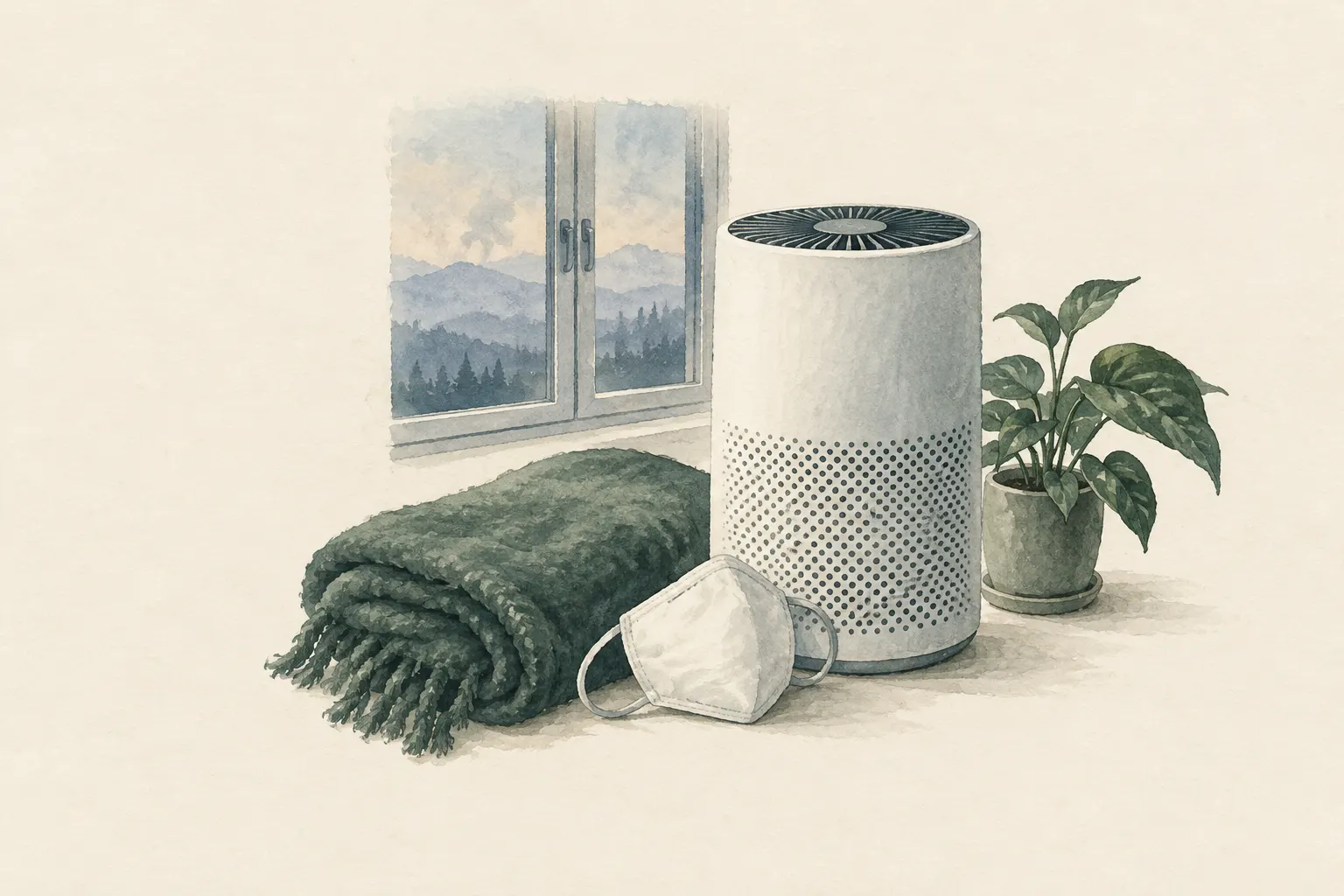
At home you can protect yourself well. Close windows and doors, just as you open an umbrella in the rain. Best of all, set up a 'clean air room': a room where everyone fits and where an air cleaner with a HEPA filter runs. A HEPA filter is a very fine sieve that catches even tiny smoke particles. Do not light candles or a fire in the fireplace during this time, because that makes the indoor air even worse.
The most important point: if someone struggles to breathe, has chest pain or becomes dizzy, get medical help or call the local emergency number (112 in the EU). And if it gets too hot indoors, a cool public place with filtered air is better than an overheated room.
What makes smoke so harmful
Wildfire smoke is a mix of gases and particles. What concerns experts most are the very fine particles, often called fine particulate matter or PM2.5 – particles smaller than 2.5 thousandths of a millimetre. Because they are so tiny, the nose and throat hardly filter them out, and they get deep into the lungs. There they can irritate the airways and also strain the heart and circulation.
Children, older people, pregnant people and people with asthma, other lung conditions or heart disease are especially sensitive. It is important for them to follow their medical plan and keep the medication they need at home. But healthy people also often notice smoke through irritated eyes, a scratchy throat or coughing.
You cannot reliably tell from the sky whether the air is polluted at the moment. A sky that is 'only slightly hazy' can still contain a lot of fine particles. So follow the official air-quality readings and health advice from the authorities and plan your day accordingly.
How a clean air room works
A closed building keeps part of the smoke out, but never all of it – something always gets in through gaps, doors and vents. An air cleaner with a HEPA filter draws in the room air, sends it through a very dense fibre mat and blows it out again cleaned. Fine particles get caught in the filter.
The smaller the room, the more often the device can clean all the air in it per hour. That is why a single room gets clean faster than the whole home. Choose a room where everyone fits, with as few windows as possible, keep the door and windows closed and let the air cleaner run continuously. It matters that the device suits the room size; manufacturers state an air delivery rate for this.
If the building has a ventilation system, it can often be set to recirculate or the outside air supply can be reduced. Use filters as the manufacturer specifies. This entry gives no build instructions for home-made air filters.
No extra pollutants
What use is the best filter if you create smoke indoors yourself? Candles, incense, cigarettes and fireplace fires also give off fine particles. Frying at high heat also produces particles; on smoky days it is better to cook gently or with a lid. Vacuuming without a HEPA filter stirs fine dust back up.
A common mistake is using candles or scented sprays against the smoke smell. They only mask the odour and make the air worse. Be careful too with air cleaners that produce ozone: ozone itself irritates the airways. Devices that give off ozone are therefore not the right choice.
Safety: masks, heat and warning signs
Cloth masks and simple surgical masks barely stop fine smoke particles. Particle-filtering respirators of the FFP2 or N95 classes can protect, but only if they fit tightly – a beard, the wrong size or a loose edge lets air flow past. They are not intended for small children. The most effective step anyway is to spend less time outside: move sport and heavy work indoors or postpone them, because when you exert yourself you breathe in much more air.
Smoke and heat often come together. With windows closed, a home can heat up dangerously, and heat is particularly risky for older and ill people. If it gets too hot indoors, go to a cooled public place with filtered air; some municipalities open such spaces during heavy smoke – check local advice.
With breathing difficulty, chest pain, severe coughing or dizziness, get medical help or call the local emergency number (112 in the EU). If the fire is in the immediate vicinity, it is no longer about clean air but about evacuation: then follow the authorities' instructions at once.
Typical situations
In the car, close the windows and set the ventilation to recirculate. On long drives, briefly let in fresh air at intervals so that it does not get stuffy and the driver does not get drowsy.
Think of others too: older neighbours, people with chronic illness and people living alone sometimes have no air cleaner or do not know about the advice. A call or a short visit can help a lot. As wildfire seasons lengthen, such smoke episodes also occur in regions that are not themselves burning – so a clean air room is a preparation that can pay off more than once.
Step by step
Monitor air quality
Follow official air-quality readings and health advice from the authorities and plan activities accordingly.
- 1
Monitor air quality
Follow official air-quality readings and health advice from the authorities and plan activities accordingly.
- 2
Close the building
Close windows and doors. Set ventilation systems to recirculate or reduce outside air where possible; use filters as the manufacturer specifies.
- 3
Set up a clean air room
Choose a room where everyone fits, ideally with few windows. Run a suitably sized HEPA air cleaner continuously.
- 4
No extra pollutants
No candles, no smoking, no fireplace, avoid frying where possible, do not vacuum without a HEPA filter.
- 5
Avoid exertion outdoors
Move sport and heavy work indoors or postpone it. Anyone who has to go out wears a tight-fitting FFP2/N95 respirator.
- 6
Check on others
Check in on older people, those with chronic illness and people living alone; keep medication in stock.
Common mistakes
- Relying on cloth masks
- Using ozone-producing air cleaners
- Lighting candles against the smoke smell
- Keeping everything sealed in heat until it becomes dangerously warm
- Jogging outside because the sky is 'only slightly hazy'
Quick view
Materials
Portable air cleaner with HEPA filter
Devices that produce ozone (ionisers, 'ozone generators') are not a suitable choice.
Change filters as the manufacturer specifies; more often in heavy smoke.
Particle-filtering respirator (FFP2/N95)
Only effective with a tight fit
Only protects with a tight fit; beards and the wrong size reduce effectiveness.
Filters particles, not gases – no protection against chemical vapours or carbon monoxide.
Medication supply
Agree any stock of prescription medication with a doctor or pharmacist; observe storage instructions and expiry dates.
Suitable for
- Smoke from distant or nearby wildfires
- Households with children, older, pregnant or chronically ill people
Not suitable for
- Fire in the immediate vicinity – then follow evacuation instructions
- Protection against gases such as carbon monoxide
Prerequisites
- Access to official air-quality data
- A room that can be closed well
Safety
- Closed windows in hot weather can lead to dangerous overheating. If it gets too hot indoors, go to a cooled public place with filtered air.
- Cloth and simple surgical masks barely stop fine smoke particles. Particle-filtering respirators (FFP2/N95) protect only with a tight fit and are not intended for small children.
How it works
The main hazard in smoke is very fine particles that reach deep into the lungs. Buildings keep part of them out, especially when they are closed and the indoor air is filtered. A small room with a suitably sized HEPA air cleaner reaches clean air faster than the whole home.
Advantages
- Clearly better indoor air
- Works during smoke lasting several days
- Protects particularly sensitive people
Disadvantages
- Air cleaners cost money and need power
- Can be difficult in hot weather
Deep knowledge
Background
The guide 'Wildfire Smoke: A Guide for Public Health Officials' by the US Environmental Protection Agency and partner agencies describes the health effects of smoke, clean air rooms, HEPA air cleaners and the limited benefit of masks.
As wildfire seasons lengthen, smoke episodes also occur in regions that are not themselves burning.
Variants
- In the car
- Close windows and set ventilation to recirculate; on long drives briefly let in fresh air at intervals so it does not become stuffy.
- Public clean air spaces
- Some municipalities open filtered, cooled spaces during heavy smoke – check local advice.
Common mistakes
- Relying on cloth masks
- Using ozone-producing air cleaners
- Lighting candles against the smoke smell
- Keeping everything sealed in heat until it becomes dangerously warm
- Jogging outside because the sky is 'only slightly hazy'
Limits and risks
- No medical advice
- No build instructions for air filters
Sources
U.S. Environmental Protection Agency (EPA) with partner agencies: Wildfire Smoke: A Guide for Public Health Officials
Health effects of smoke, clean air room, HEPA air cleaners, limits of masks
Ready.gov – U.S. Federal Emergency Management Agency (FEMA): Wildfires
Behaviour in wildfire smoke