Dried and preserved food: basics and limits
Drying, salting, acidifying and canning make food last by depriving microorganisms of water or favourable conditions. For an emergency stock, commercially produced dried and tinned goods are the safest choice. Home preserving requires tested instructions – especially canning, where mistakes can lead to life-threatening botulism. This entry explains principles and storage, but no canning procedures.
- Reading and sorting the stock: about 30 minutes
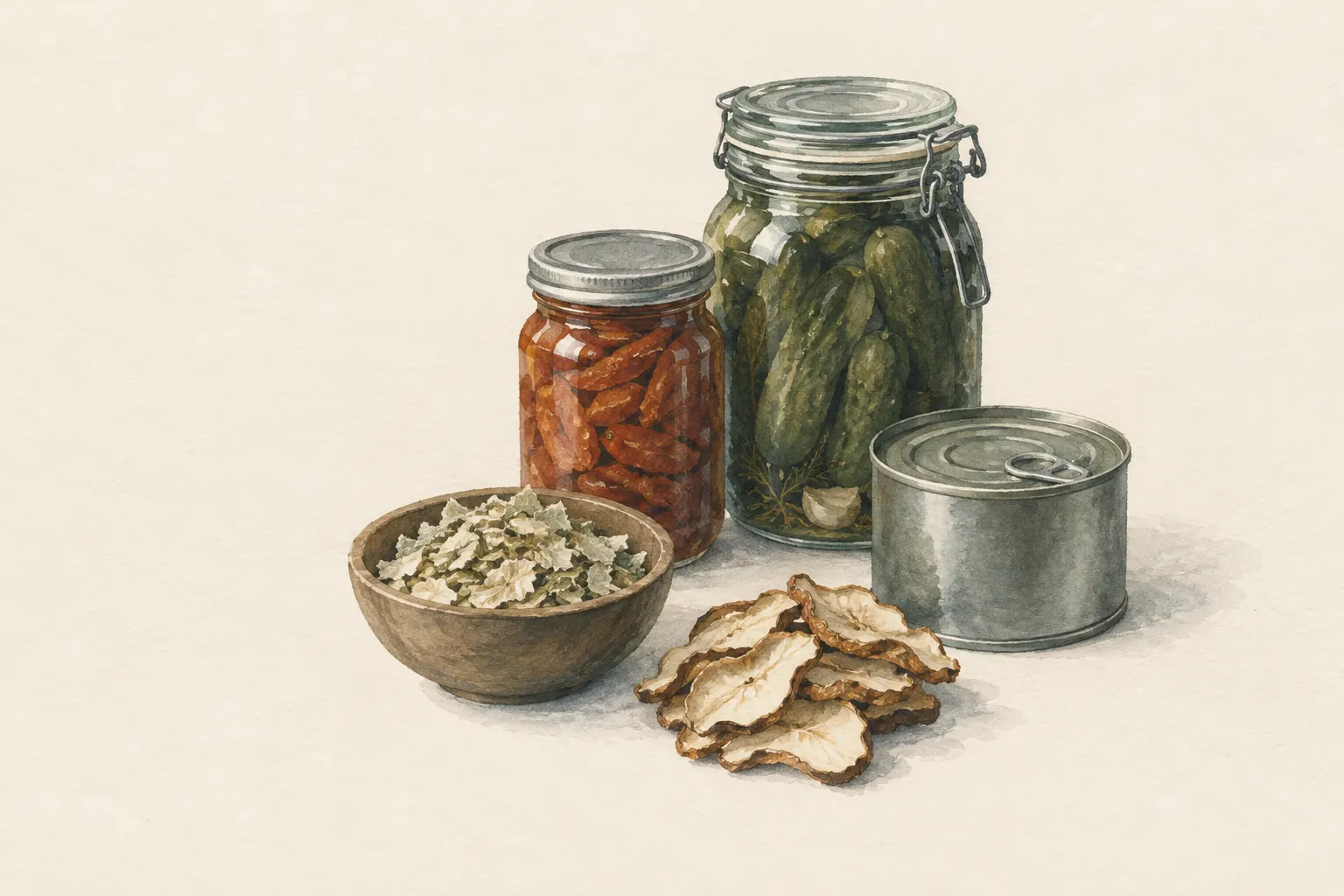
Explained simply
Food spoils because tiny living things “eat along”: bacteria, yeasts and moulds. These tiny creatures mainly need water, warmth and food. Take one of those away and food lasts longer. Drying takes away their water – that is why raisins keep much longer than grapes.
There are other tricks too: salt and sugar bind the water so that the germs cannot get at it. Acid, as in pickled cucumbers, slows them down. Heat kills them, and an airtight jar or tin stops new ones getting in.
Important: when canning at home a mistake can be very dangerous, because a strong poison can then form that you can neither see nor taste. So bought preserves and well-sealed dry goods are the safest choice for a stock.
How it works
Microorganisms need water, nutrients, a suitable temperature and usually surroundings that are not too acidic. Every preservation method takes away at least one of these conditions. Drying removes the water. Salt and sugar bind it so strongly that germs cannot use it – they even draw water out of their cells. Acid inhibits the growth of many spoilage organisms.
Heat kills germs, and an airtight seal prevents new ones from getting in. In tins and jars both work together. Cold in a fridge or freezer only slows germs down; it usually does not kill them – which is why thawed food spoils quickly again.
Danger arises when a method only works partially. The bacterium Clostridium botulinum forms very resistant spores. In an airtight jar that is not acidic enough and has not been heated enough, they can survive, germinate and produce a potent nerve toxin. The lack of oxygen in the jar, which keeps other germs away, actually suits this bacterium.
What really matters
For an emergency stock, commercially produced preserves and dry goods are the safest choice: tins, jars, dried fruit, pasta, rice, oats, pulses, milk powder. They are made by tested processes and labelled with a date.
Dry food must stay dry. Store dry goods airtight, cool and dark. Even moisture from the room air can be enough to make dried food go soft, mouldy or attract pests. Label decanted goods with contents and date.
Dried food has a catch: it often needs water and energy before you can eat it. Rice, pasta and pulses have to be cooked, lentils and beans usually for longer. So always include food that can be eaten without water and without cooking.
Safety: what to watch out for
Botulinum toxin is one of the most potent known poisons and changes neither smell nor taste. The main risk comes from incorrectly canned low-acid foods such as vegetables, meat or fish, but also from home-made garlic or herb oils kept at room temperature. Preserve only according to tested instructions from official bodies and never taste suspect jars.
Jars with a domed lid, leaking seal, gas bubbles, cloudy liquid or an unusual smell are disposed of so that nobody – not even animals – can eat from them. Dried food that has become damp, mouldy or musty also goes.
If signs of paralysis, double vision, difficulty swallowing or speaking appear after eating, call the local emergency number (112 in the EU) immediately. This is an emergency, not something to wait out.
When it makes sense – and when not
Drying at home is a good start for fruit and culinary herbs if you follow tested instructions. Lacto-fermented vegetables such as sauerkraut are preserved by acid and need no heat, but they also need hygiene and proven recipes. Drying meat requires an additional heat treatment and is not a beginner's method.
Canning is a craft for calm times, with time, equipment and current, tested instructions. In the middle of an emergency, without experience and a reliable heat source, improvised preserving is not a good idea. This entry deliberately gives no canning, smoking or curing instructions; regional authority recommendations take precedence.
Good to know
Preserving is one of humanity's oldest cultural techniques. Modern food research has shown, however, that some traditional methods are not reliably safe – especially when canning low-acid foods. That is why specialist bodies such as the US National Center for Home Food Preservation publish tested procedures.
Botulism is rare but life-threatening. The simplest precaution for a household is: bought preserves and well-stored dry goods for the stock, home-made preserves only from tested instructions, and when in doubt, throw it out.
Step by step
Prefer commercial preserves
For the emergency stock choose commercially produced tins, jars, dried fruit, pasta, rice, oats, pulses and milk powder. They are tested and labelled.
- 1
Prefer commercial preserves
For the emergency stock choose commercially produced tins, jars, dried fruit, pasta, rice, oats, pulses and milk powder. They are tested and labelled.
- 2
Store dry goods correctly
Keep dry food dry: airtight, cool, dark. Moisture makes dried food go mouldy and attracts pests.
- 3
Home drying only with tested instructions
If you dry fruit or herbs yourself, follow tested instructions from official bodies (e.g. consumer or food safety agencies). Drying meat requires special heat treatment and is not a beginner's method.
- 4
Canning: only by official guidance
This entry deliberately gives no canning instructions. Anyone who wants to can food uses current, tested procedures from a food safety authority or specialist body and follows times, temperatures and equipment exactly.
Do not improvise recipes from forums or memory.
- 5
Inspect before eating
Do not taste jars with a domed lid, leaking seal, gas bubbles, cloudy liquid or an unusual smell; dispose of them so that nobody – not even animals – can eat them.
Common mistakes
- Canning vegetables or meat by feel
- Keeping garlic or herb oil at room temperature
- Storing dried food in bags that are not airtight
- Tasting suspect jars "just a little"
- Using old, untested recipes
Quick view
Materials
Airtight food-grade storage container
Store dried food only completely dry and airtight
Fill only when clean and completely dry; never use containers that previously held chemicals.
Labels and permanent marker
Suitable for
- Choosing shelf-stable food for the stock
- Storing dry goods safely
- Understanding why preservation works
Not suitable for
- Canning vegetables, meat or fish without tested instructions and suitable equipment
- Improvised preservation in an emergency without experience
Prerequisites
- Basic food hygiene rules
- Access to tested, official instructions if preserving at home
Safety
- Discard dried food that has become damp, mouldy or musty.
How it works
Microorganisms need water, nutrients, suitable temperatures and usually conditions that are not too acidic. Drying removes water, salt and sugar bind it, acid inhibits growth, heat kills germs and an airtight seal prevents recontamination. Danger arises when a method only works partially: in an airtight jar that is not acidic enough or not heated enough, spores of Clostridium botulinum can survive and produce toxin.
Advantages
- Dry goods are light, compact and keep for a long time
- Commercial preserves are safe and labelled
Disadvantages
- Dried food often needs water and energy to prepare
- Home preserving requires knowledge, equipment and care
Deep knowledge
Background
Preservation is one of the oldest cultural techniques. Modern food safety research has shown that some traditional methods are not reliably safe – especially when canning low-acid foods. Specialist bodies such as the US National Center for Home Food Preservation therefore publish tested procedures.
Botulism is rare but life-threatening. For an emergency stock, the simplest protection is to rely on bought preserves and well-stored dry goods and to make home preserves only according to tested instructions.
Variants
- Fermentation
- Lacto-fermented vegetables (e.g. sauerkraut) are preserved by acid. Hygiene rules and proven recipes apply here too; mould or a putrid smell means: discard.
Common mistakes
- Canning vegetables or meat by feel
- Keeping garlic or herb oil at room temperature
- Storing dried food in bags that are not airtight
- Tasting suspect jars "just a little"
- Using old, untested recipes
Limits and risks
- No canning, smoking or curing instructions
- No statements on the shelf life of home-preserved food
- Regional authority recommendations take precedence
Material alternatives
Derived from material properties: a substitute must have all relevant properties. Observe the notes on the substitute.
- Airtight food-grade storage container
- Single-wall stainless steel bottle (Heat only single-wall bottles without paint/plastic; remove the lid before heating.), Double-wall insulated bottle (Never heat directly.), PET bottle (clear, max. 2 litres) (Do not heat or place in a fire.), Food-grade water container (Only use containers that never held chemicals or fuel.), Collapsible water container or bag (Protect from sharp objects.), Food-grade water bag (Use only for drinking water, never for chemicals or fuel.), Fermentation jar or crock (Use only food-grade containers of glass, food-safe glazed stoneware or food-grade plastic – no metal containers for acidic food.), Resealable food bags (Use only bags intended for food; do not use with boiling water unless the manufacturer explicitly allows it.)
Results come exclusively from structured entries. No improvised instructions are generated.
Sources
University of Georgia / National Center for Home Food Preservation (USA): National Center for Home Food Preservation – tested guidance on drying and preserving food
Tested procedures for drying and preserving; botulism risk when canning low-acid foods
World Health Organization (WHO) (2006): Five Keys to Safer Food Manual
Basic rules of food hygiene