Rotating and storing an emergency food stock
A stock is only as good as its condition. With the "first in, first out" principle, clear labelling and a cool, dry, dark storage place it stays edible instead of becoming waste. Damaged, bulging or leaking cans do not belong in the stock.
- 1–2 hours to set up; then a few minutes per check
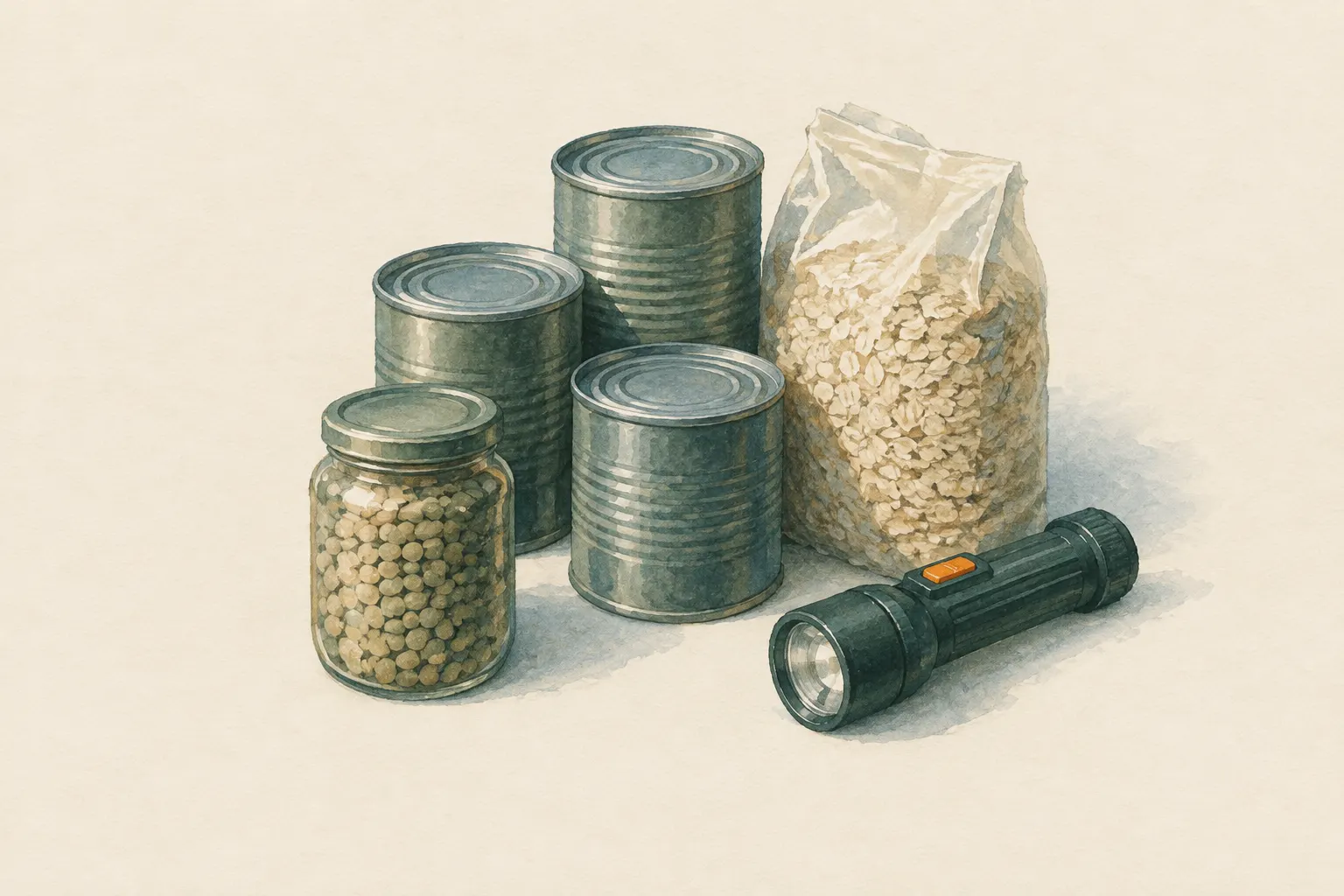
Explained simply
Imagine a queue at the supermarket checkout: whoever was there first is served first. A good stock works exactly the same way. What you bought first, you eat first. New tins and packets go to the back, the old ones to the front. This is called “first in, first out”.
Food ages over time, even when it is closed. Fat can go rancid, vitamins are lost, packaging can start to leak. A cool, dry and dark place slows this down, just as a fridge keeps milk fresh for longer.
One rule is especially important: a can that is bulging, leaking or dented at the seam is not tasted but thrown away. It could contain dangerous germs that you can neither see nor smell.
How it works
Food changes through oxygen, heat, light and moisture. Oxygen and light make fats go rancid, heat speeds up almost all chemical changes, moisture makes dry goods clump and go mouldy. A cool, dry, dark storage place slows all these processes at once.
Rotation solves a second problem: forgetting. A stock that is bought once and then not looked at for years is often expired, damaged or full of things nobody wants to eat any more when it is needed. If instead you build the stock into everyday life, the oldest items are constantly used up and replaced by new ones. This creates a “living stock”.
Part of this is storing food the household eats anyway. Then using it up happens by itself: you cook with the pasta from the stock and buy new pasta, which goes in at the back.
What really matters
The storage place decides a lot. Good options are a cupboard in a room with even temperature or a dry pantry. Unfavourable are damp cellars, hot attics, places near heaters or cookers and spots next to chemicals or fuels. Do not put boxes directly on a cold, damp floor, because condensation can form there.
Labelling saves time and mistakes. Write the expiry date large and clearly on the outside of the pack; for decanted goods also what is inside and when you filled it. A simple list on the inside of the cupboard door with product, quantity and date shows you at a glance what should be used soon.
Learn the difference between date labels as it applies in the EU: the best-before date is a quality promise from the manufacturer. The use-by date concerns highly perishable food and is a safety limit that should not be exceeded. Other regions have other rules.
Safety: what to watch out for
Cans that are bulging, leaking, badly rusted or dented at the seam do not belong in the stock. The same applies if the contents foam, spurt or smell unusual when opened. Such signs can indicate dangerous spoilage organisms. Do not taste any of it, not even “just a little” – throw it away.
Dry goods with pests, mould or a musty smell are also discarded. Scraping off mould is not enough, because mould threads and some mould toxins can spread invisibly through the food. Food that has come into contact with floodwater is considered contaminated; follow the authorities' advice.
How to practise it
Set fixed check dates that are easy to remember – for example whenever the clocks change in spring and autumn. Then take a quarter of an hour: look at dates, check cans for dents and rust, packets for holes, update the list.
Whatever expires soon goes into the meal plan for the next few weeks. If it is too much, food in perfect condition can also be donated in good time. When shopping the rule is: new items to the back or bottom, older ones to the front or top. After a few rounds this becomes a habit that hardly takes any time.
Transfer opened dry goods such as rice, flour or pasta into clean, dry, airtight containers. This protects against moisture and pantry pests and makes it easier to keep track.
Good to know
Both Germany's BBK and FEMA/Ready.gov in the USA recommend building the stock from familiar food and renewing it regularly. How long a particular product keeps is printed on the packaging; this entry deliberately gives no storage times.
A nice side effect: a rotating stock reduces food waste and also helps in everyday life, for example when you are ill or unexpected visitors arrive. The stock is then not a special store for disasters but simply a well-organised kitchen.
Step by step
Choose a storage place
Cool, dry, dark and easy to reach, away from heaters, cookers, chemicals and fuels. Do not place directly on a cold, damp floor.
- 1
Choose a storage place
Cool, dry, dark and easy to reach, away from heaters, cookers, chemicals and fuels. Do not place directly on a cold, damp floor.
- 2
Label
Write the expiry date clearly on the outside; for decanted goods also the product and date filled. A simple list on a sheet of paper helps keep an overview.
- 3
First in, first out
Put new items at the back or bottom, bring older ones to the front. When cooking day to day, always take from the stock first and then restock.
- 4
Secure opened goods
Transfer opened dry goods into clean, dry, airtight containers. This protects against moisture and pantry pests.
- 5
Check regularly
At fixed intervals (e.g. when the clocks change) check dates, cans and packaging. Plan whatever expires soon into the next meals or donate it while it is still in perfect condition.
Do not taste from damaged cans – discard them.
Common mistakes
- Buying a stock once and forgetting it for years
- Putting new items in front of old ones
- Storing in a damp cellar or hot attic
- Using dented or bulging cans anyway
- Leaving opened packs standing open
Quick view
Materials
Non-perishable food
Prefer food that can be eaten without cooking; consider allergies and dietary needs; do not forget a can opener.
Airtight food-grade storage container
For opened dry goods such as rice, flour, pasta
Fill only when clean and completely dry; never use containers that previously held chemicals.
Labels and permanent marker
Write purchase and expiry dates where they are easy to see
Manual can opener
Electric can openers do not work during a power outage.
Suitable for
- Any household stock
- Stocks in a holiday home, hut or camper
- Shared stocks, e.g. in a club
Not suitable for
- Storage next to chemicals, fuels or in damp cellars
- Stocks that are rarely accessible and never checked
Prerequisites
- A storage place that is cool, dry and dark
- Willingness to use the stock as part of everyday cooking
Safety
- Discard dry goods with pest infestation, mould or a musty smell. Do not simply scrape mould off.
- Food that has come into contact with floodwater is considered contaminated. Follow the authorities' advice on disposal.
- A best-before date is a quality guarantee; a use-by date concerns the safety of highly perishable food and should not be exceeded.
How it works
Stocks age: fats go rancid, vitamins decline, packaging leaks, pests find their way in. Rotation means building the stock into everyday life – the oldest items are used first and replaced by new ones. Cool, dry and dark conditions slow ageing; airtight containers protect against moisture and pests.
Advantages
- Hardly any food waste
- Stock stays fresh and familiar
- Little effort in everyday life
Disadvantages
- Requires discipline and fixed check dates
- Needs space for an orderly storage place
Deep knowledge
Background
Germany's BBK and FEMA/Ready.gov consistently recommend building stocks from food the household eats anyway and regularly using and replacing it. This creates a "living stock" instead of a forgotten store.
The US Department of Agriculture (USDA FSIS) advises against using food from damaged cans or food that has come into contact with floodwater. The exact meaning of date labels is regulated regionally; in the EU a distinction is made between best-before and use-by dates.
Variants
- A list instead of searching
- An inventory list on the inside of the cupboard door (product, quantity, expiry date) saves time and shows immediately what needs replacing.
Common mistakes
- Buying a stock once and forgetting it for years
- Putting new items in front of old ones
- Storing in a damp cellar or hot attic
- Using dented or bulging cans anyway
- Leaving opened packs standing open
Limits and risks
- No statements on the maximum storage life of individual products – follow the manufacturer's information
- Rules on date labelling differ by region
Material alternatives
Derived from material properties: a substitute must have all relevant properties. Observe the notes on the substitute.
- Airtight food-grade storage container
- Single-wall stainless steel bottle (Heat only single-wall bottles without paint/plastic; remove the lid before heating.), Double-wall insulated bottle (Never heat directly.), PET bottle (clear, max. 2 litres) (Do not heat or place in a fire.), Food-grade water container (Only use containers that never held chemicals or fuel.), Collapsible water container or bag (Protect from sharp objects.), Food-grade water bag (Use only for drinking water, never for chemicals or fuel.), Fermentation jar or crock (Use only food-grade containers of glass, food-safe glazed stoneware or food-grade plastic – no metal containers for acidic food.), Resealable food bags (Use only bags intended for food; do not use with boiling water unless the manufacturer explicitly allows it.)
Results come exclusively from structured entries. No improvised instructions are generated.
Sources
Bundesamt für Bevölkerungsschutz und Katastrophenhilfe (BBK), Deutschland: Ratgeber für Notfallvorsorge und richtiges Handeln in Notsituationen
Stock of familiar food, regularly used and renewed
Ready.gov – U.S. Federal Emergency Management Agency (FEMA): Build A Kit
Store the food supply cool and dry and renew it regularly
United States Department of Agriculture – Food Safety and Inspection Service (USDA FSIS): Keeping Food Safe During an Emergency
Do not use damaged cans or food after contact with floodwater