Calories and protein in an emergency: the basics
In an emergency water comes first, then enough energy. If you roughly understand where calories come from, how much protein a person needs and why needs depend on age, activity and cold, you can plan a stock sensibly and use scarce food wisely. Exact diet plans are not needed for this.
- About 30 minutes to work through your own stock
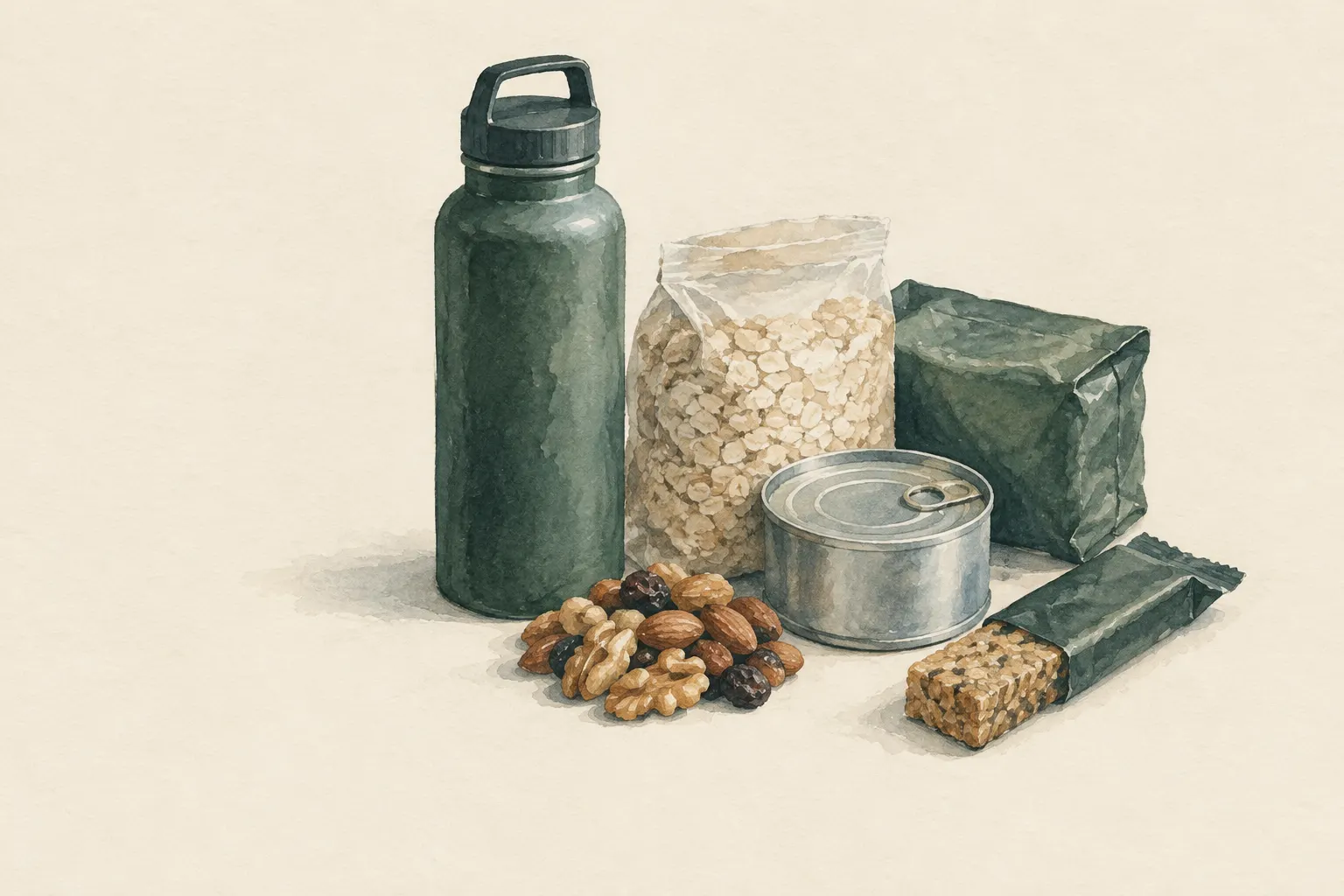
Explained simply
Your body is a bit like a stove that never quite goes out. To stay warm and to let you think, walk and carry things, it needs fuel – and that fuel is your food. The amount of energy in a food is measured in kilocalories, or kcal for short. The number is printed on almost every package.
There are three big sources of energy: carbohydrates (for example in bread, rice, pasta), fat (in oil, nuts, cheese) and protein (in beans, lentils, fish, meat, milk). Per gram, fat provides roughly twice as much energy as the other two. Protein is mainly building material: your body uses it to repair muscles and other parts.
The most important point first: water matters even more than food. A person can last much longer without food than without drinking. And if water is short, you should not eat a lot of salty or very high-protein food, because your body needs extra water to deal with it.
How it works
During digestion the body breaks food down into small building blocks and “burns” them slowly in the cells – without a flame, but with a similar result: energy is released, part of it as heat. As a common approximation, carbohydrates and protein provide about 4 kcal per gram and fat about 9 kcal per gram. That is why nuts, oil or hard cheese are so valuable when space and weight are limited.
A large part of the energy is used even at rest: for the heartbeat, breathing, the brain and body heat. On top of that comes everything you do – walking, carrying, shovelling snow. In the cold the body also has to heat itself, for example by shivering. So needs depend strongly on body size, age, activity and temperature.
Protein is different from the other two: the body uses it mainly to maintain muscle, skin, blood and immune defences. If more is eaten than needed, it is broken down, and the waste products have to be excreted through the kidneys with water. That is why a lot of protein is unhelpful when water is short.
What really matters
For planning you do not need an exact calculation, just a rough overview. Following the Sphere Handbook, humanitarian organisations plan with an average of 2,100 kcal per person per day for a whole population. That is an average: a small child needs less, a tall adult who does hard work or is cold needs considerably more.
For protein, WHO, FAO and UNU give a safe intake for healthy adults of around 0.8 g per kilogram of body weight per day. An adult weighing 70 kg would therefore need about 56 g a day. This amount is easy to reach with pulses, tinned fish or meat, nuts, milk powder or long-life dairy products.
At least as important as the numbers is the question: will the food actually be eaten? Under stress and uncertainty many people eat less, especially when food tastes unfamiliar. A stock of familiar food that everyone likes and tolerates is therefore worth more than a theoretically perfect stock that stays untouched.
How to roughly work out your stock
Take a package and find the “kcal per 100 g” figure on the label. Multiply it by the weight of the package in grams and divide by 100 – that is the energy of the whole package. A 500 g pack with 350 kcal per 100 g, for example, contains 1,750 kcal.
Add up the main parts of your stock this way and divide the total by the rough daily needs of all the people. The result is roughly the number of days the stock will last. This figure is a guide, not a promise – but it shows at once whether you are covered for three days or for two weeks.
Then check the mix: is there enough protein? Is there shelf-stable fruit and vegetables, for example from jars, tins or dried? Is there something that can be eaten without cooking? And is there enough water for everyone according to your authority's recommendation?
Safety: what to watch out for
Infants, young children, pregnant and breastfeeding people, older people and the chronically ill – for example with diabetes or kidney disease – have their own needs. The averages do not apply to them. Agree their stock and emergency diet with a doctor, midwife or dietitian while everything is calm.
Allergies and intolerances do not disappear in an emergency. Popular stock staples such as nuts or peanut butter are among the common allergens. If someone in the household is affected, deliberately plan alternatives and clearly label dangerous foods.
When water is short, do not eat large amounts of high-protein or very salty food, because both increase fluid needs. When food is short, saving energy – resting, staying warm, drinking enough – helps more than hard work. This entry does not replace nutritional advice and makes no statements about longer fasting.
Good to know
The reference values come from international expert reports by FAO, WHO and UNU. They describe averages for large groups and include safety margins – they are not calculated for individual people. For a household the principle is entirely sufficient.
A common misconception is that an emergency stock must consist mainly of special food. In fact, authorities recommend food you eat anyway, in somewhat larger quantities. Once you have roughly worked through your stock, you know where the gaps are – and can close them calmly on your next shopping trip.
Step by step
Secure water first
A person can last much longer without food than without water. Plan the water stock before the food stock, following your authority's recommendations.
- 1
Secure water first
A person can last much longer without food than without water. Plan the water stock before the food stock, following your authority's recommendations.
- 2
Roughly estimate needs
Note who needs to be fed. An average figure per person per day is enough for overall planning; children usually need less, adults doing hard physical work and people in the cold need more.
- 3
Add up the nutrition values
The energy per pack is on the label (kcal per 100 g times pack weight). Add up roughly how many person-days your stock covers.
- 4
Include protein sources
Pulses, tinned fish and meat, nuts, milk powder or long-life dairy provide protein. WHO/FAO/UNU give a safe intake for healthy adults of around 0.8 g of protein per kilogram of body weight per day.
- 5
Variety and habit
Store food everyone likes and tolerates, with carbohydrates, fat, protein and fruit and vegetables in a shelf-stable form. Unfamiliar food often leads people to eat too little in stressful situations.
- 6
Save energy
If food is scarce, reduce physical exertion, stay warm and drink enough. This noticeably lowers needs.
Common mistakes
- Counting only calories and forgetting water
- Storing a lot of salty or high-protein food but little water
- Storing food nobody eats
- Overlooking the special needs of children, older and sick people
- Doing heavy physical work when food is scarce instead of saving energy
Quick view
Materials
Non-perishable food
Use the nutrition labels on the packaging
Prefer food that can be eaten without cooking; consider allergies and dietary needs; do not forget a can opener.
Suitable for
- Planning an emergency stock
- Estimating how long a stock will last
- Choosing food for a backpack or go bag
Not suitable for
- Feeding infants, pregnant or breastfeeding people or sick people without professional advice
- Medical nutrition therapy or weight-loss plans
Prerequisites
- Being able to read nutrition labels on packaging
- An overview of the people in the household or group
Safety
- Infants, young children, pregnant and breastfeeding people, older and chronically ill people (e.g. with diabetes or kidney disease) have special needs. Agree their stock and emergency diet with a doctor, midwife or dietitian.
- Without enough drinking water, do not eat large amounts of high-protein or very salty food – both increase fluid needs.
- Allergies and intolerances still apply in an emergency. Energy-dense stock staples such as nuts or peanut butter are common allergens.
How it works
The body gets energy from carbohydrates, fat and protein. As a common approximation, carbohydrates and protein provide about 4 kcal per gram and fat about 9 kcal per gram – which is why fatty foods are especially energy-dense for little weight and space. Protein is mainly needed to maintain muscle and tissue. Energy needs rise with body size, physical work and cold; they fall at rest. For humanitarian planning the Sphere Handbook gives a planning figure of 2,100 kcal per person per day as an average for a population.
Advantages
- Helps to plan stocks realistically
- Simple rules of thumb are enough
- Prevents one-sided stocks
Disadvantages
- Individual needs differ greatly from the average
- Does not replace nutritional advice
Deep knowledge
Background
The reference values for energy and protein needs come from international expert reports by FAO, WHO and UNU. They describe population averages and safety margins, not exact values for individuals. The Sphere Handbook translates such values into planning figures for humanitarian operations.
For a household the principle is enough: sufficient water, enough energy from familiar food, a protein source and as much variety as the stock allows. Anyone who wants to plan in more detail should follow their own authority's recommendations.
Variants
- Backpack and go bag
- Where weight matters, energy-dense food that can be eaten without cooking makes sense: nuts, dried fruit, cereal bars, hard cheese, crispbread. Mind allergies.
Common mistakes
- Counting only calories and forgetting water
- Storing a lot of salty or high-protein food but little water
- Storing food nobody eats
- Overlooking the special needs of children, older and sick people
- Doing heavy physical work when food is scarce instead of saving energy
Limits and risks
- Only averages and reference values, no individual calculation
- No dietary advice for illness, pregnancy or infants
- No statements about fasting or starvation over longer periods
Sources
Sphere Association (2018): The Sphere Handbook: Humanitarian Charter and Minimum Standards in Humanitarian Response
Planning figure of 2,100 kcal per person per day in humanitarian response
Food and Agriculture Organization of the United Nations (FAO) (2004): Human energy requirements – Report of a Joint FAO/WHO/UNU Expert Consultation
Energy needs depend on body size, age and physical activity
World Health Organization / FAO / United Nations University (2007): Protein and amino acid requirements in human nutrition (WHO Technical Report Series 935)
Safe protein intake for adults, around 0.8 g per kg body weight per day