Food hygiene and storage without a fridge
Without refrigeration, bacteria multiply quickly in perishable food – often without any smell or visible sign. Ensuring clean hands and surfaces, separating raw and cooked food, preparing only what will be eaten straight away and not leaving leftovers standing for hours greatly reduces the risk of food poisoning.
- Ongoing, hardly any extra effort
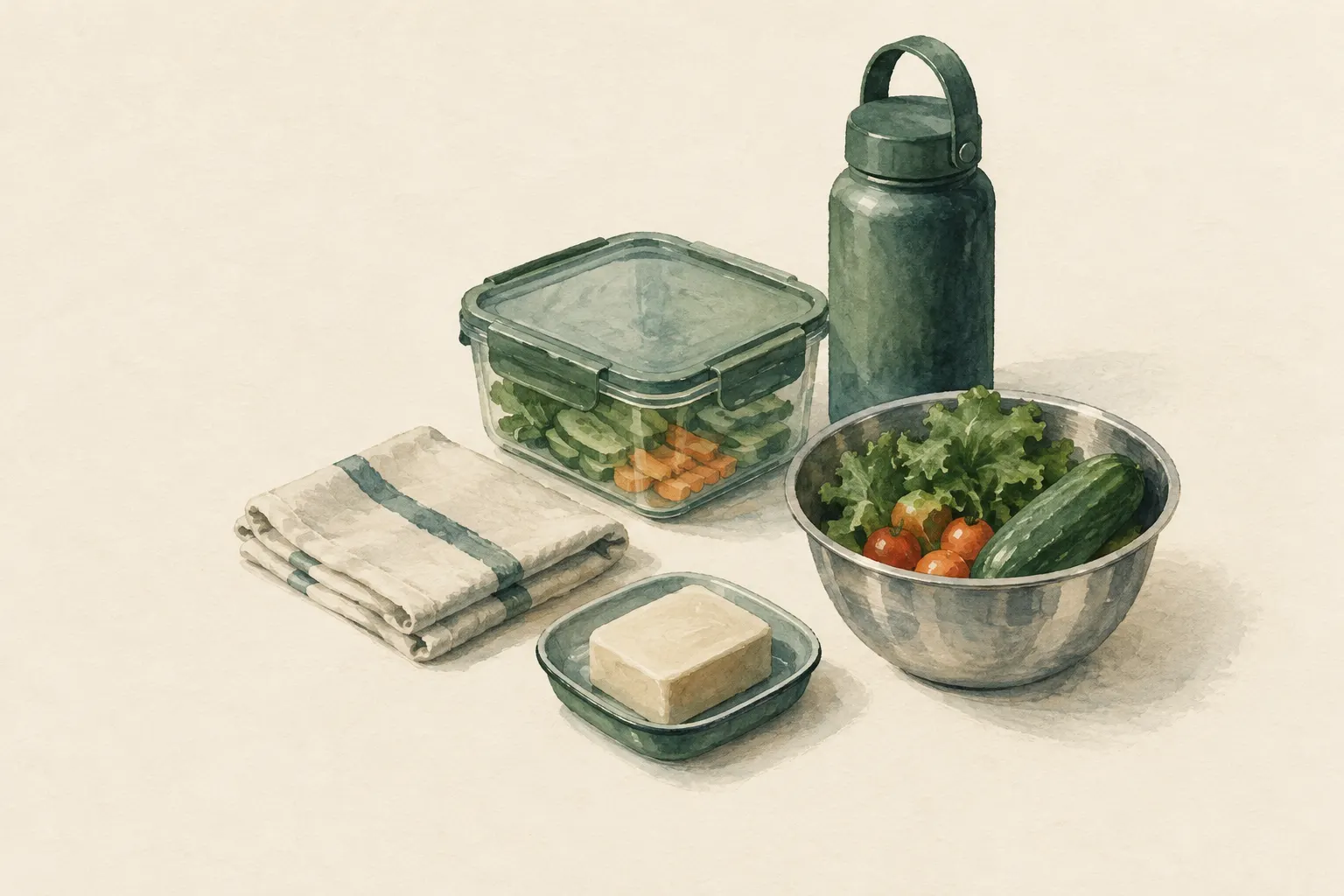
Explained simply
Bacteria are tiny living things that you cannot see. They are almost everywhere, including on food. In the cold of a fridge they hardly grow. When it gets warmer they multiply – one becomes two, two become four, and so on. After a few hours there can be so many that they make you ill.
The tricky part: you often cannot smell or see it. A sausage or some leftover rice can look perfectly normal and still make you sick. So without a fridge you do not rely on your nose but on simple rules: clean hands, keep raw and cooked food apart, cook only as much as will be eaten straight away.
The most important rule of thumb: do not leave perishable food unrefrigerated for more than about two hours, and only about one hour in great heat. When in doubt, throw it out – do not taste it.
How it works
Bacteria multiply by dividing. Under favourable conditions – moisture, nutrients and warmth – this happens very fast, and the number does not grow steadily but keeps doubling. The US food safety agency USDA calls the range between about 4 °C and 60 °C (40–140 °F) the “danger zone”. Below it most germs hardly grow; well above it they are killed.
A fridge keeps food below this zone. Without it, perishable food at room temperature sits right in the danger zone. That is why time limits apply: according to USDA guidance, no more than about two hours unrefrigerated, and no more than one hour above about 32 °C / 90 °F.
Some bacteria also produce toxins that are not destroyed even by boiling the food later. So a leftover that has stood warm for too long does not become safe again by heating. That is why prevention is so much more important than “rescuing” food afterwards.
What really matters
WHO summarises safe food hygiene in five keys: keep clean, separate raw and cooked, cook thoroughly, keep food at safe temperatures, and use safe water and raw materials. Without a fridge the fourth key largely falls away. So you have to follow the other four all the more consistently.
The order of use is crucial: first what spoils fastest – fresh meat, fish, dairy, cooked leftovers. Then fruit and vegetables, and finally unopened tins and dry goods, which need no refrigeration anyway. Cook small amounts, eat them straight away and use up opened cans completely if possible.
Keep food covered in the coolest place available, protected from sun, insects and animals. A cool box with ice or ice packs can bridge a while, but only for a limited time – open it rarely, close it again at once and keep an eye on the temperature.
Safety: what to watch out for
Smelling and looking are not a reliable test. Many pathogens that cause food poisoning change neither smell nor taste. Anything that has been unrefrigerated for too long is thrown out – even if it still looks fine. Leaving leftovers out overnight and eating them the next day is one of the most common mistakes.
Young children, pregnant, older and immunocompromised people become particularly ill. With persistent vomiting, bloody diarrhoea, high fever or signs of dehydration, get medical help or call the local emergency number (112 in the EU). This entry contains no treatment guidance.
For handwashing, dishes and raw fruit use only safe water. If tap water is not safe, boil it or disinfect it following your authority's advice. Skipping handwashing because water is scarce saves in the wrong place.
Typical situations
During a power outage at home: open the fridge and freezer as rarely as possible, use the food from the fridge first, then frozen food while it is still safe, and only then the shelf-stable stock. How long chilled food stays safe is described in the entry on the fridge during a power outage.
When camping or staying in a hut, plan from the start with little fresh food: perishables on the first day, then tins, bread, pasta, dried fruit. Store food sealed; where there are local rules to protect against wildlife, such as bear boxes, follow them.
In emergency shelters or group catering every risk is multiplied, because many people eat the same food. Here it is especially worthwhile to cook a few simple dishes fresh, serve them immediately and keep nothing.
Step by step
Keep hands and surfaces clean
Wash hands thoroughly with soap before preparing food, after handling raw food and after using the toilet. Keep work surfaces and dishes clean.
- 1
Keep hands and surfaces clean
Wash hands thoroughly with soap before preparing food, after handling raw food and after using the toilet. Keep work surfaces and dishes clean.
- 2
Order of use
Use perishable food first, then shelf-stable food. Unopened tins and dry goods need no refrigeration.
- 3
Separate raw and cooked
Use separate boards and knives for raw meat or fish, or clean them thoroughly in between. Do not put cooked food on surfaces where raw food has been.
- 4
Prepare only what will be eaten
Cook small amounts and eat them straight away. Use up opened cans completely if possible.
- 5
Store cool and covered
Store food covered in the coolest place available, protected from sun, insects and animals. A cool box with ice only bridges a limited time; keep an eye on the temperature.
- 6
Treat leftovers strictly
Do not keep leftovers without refrigeration. Discard anything that has been unrefrigerated for longer than the times given.
Smell and appearance are not a reliable test.
Common mistakes
- Checking by smell whether something is still fine
- Leaving leftovers out overnight and eating them the next day
- Using the same board for raw meat and bread
- Skipping handwashing because water is scarce
- Opening a cool box and leaving it open
Quick view
Materials
Soap / detergent
For hands and dishes
Rinse drinking-water containers thoroughly after cleaning.
Airtight food-grade storage container
Fill only when clean and completely dry; never use containers that previously held chemicals.
Insulated cool box
With ice or ice packs, only for a short time
Keeps cold only for a limited time; without ice packs or ice it is not a fridge.
Metal pot (stainless steel, aluminium, titanium)
Hot – scalding risk.
Suitable for
- Power outages
- Camping and hut stays
- Emergency shelters and group catering
Not suitable for
- Storing raw meat, fish, dairy or cooked leftovers for long periods without refrigeration
Prerequisites
- Safe water for handwashing and rinsing
- A clean work surface
Safety
- Young children, pregnant, older and immunocompromised people become particularly ill from spoiled food. With persistent vomiting, bloody diarrhoea, high fever or signs of dehydration, get medical help or call the local emergency number (112 in the EU).
- Use only safe water for washing hands, dishes and raw fruit; when in doubt, boil or disinfect it.
How it works
WHO summarises safe food hygiene in five keys: keep clean, separate raw and cooked, cook thoroughly, keep food at safe temperatures, and use safe water and raw materials. Without a fridge the fourth key largely falls away – so the others must be followed all the more consistently. USDA calls the range between about 4 °C and 60 °C (40–140 °F) the "danger zone" in which bacteria multiply especially fast.
Advantages
- Simple, well-established rules
- Works immediately and without equipment
- Protects the whole group
Disadvantages
- Inevitably leads to some food loss
- Needs water for hygiene
Deep knowledge
Background
WHO's "Five Keys to Safer Food" is training material used worldwide to prevent foodborne illness. USDA FSIS additionally gives specific time and temperature rules for emergencies such as power outages.
Many pathogens that cause food poisoning change neither smell nor taste. That is why all official guidance relies on prevention through hygiene, temperature and time – not on the sniff test.
Variants
- When camping
- Store food sealed and outside the tent where local rules require protection from wildlife (e.g. bear boxes) – check local rules.
Common mistakes
- Checking by smell whether something is still fine
- Leaving leftovers out overnight and eating them the next day
- Using the same board for raw meat and bread
- Skipping handwashing because water is scarce
- Opening a cool box and leaving it open
Limits and risks
- No treatment guidance for food poisoning
- Time figures are USDA guidance – follow national authority advice
Material alternatives
Derived from material properties: a substitute must have all relevant properties. Observe the notes on the substitute.
- Airtight food-grade storage container
- Single-wall stainless steel bottle (Heat only single-wall bottles without paint/plastic; remove the lid before heating.), Double-wall insulated bottle (Never heat directly.), PET bottle (clear, max. 2 litres) (Do not heat or place in a fire.), Food-grade water container (Only use containers that never held chemicals or fuel.), Collapsible water container or bag (Protect from sharp objects.), Food-grade water bag (Use only for drinking water, never for chemicals or fuel.), Fermentation jar or crock (Use only food-grade containers of glass, food-safe glazed stoneware or food-grade plastic – no metal containers for acidic food.), Resealable food bags (Use only bags intended for food; do not use with boiling water unless the manufacturer explicitly allows it.)
- Insulated cool box
- Sleeping pad, Dry leaves, grass or conifer boughs (Collect only where allowed; no protected plants. Check for ticks and insects.), Backpack, Dry spare clothing (Carry it in waterproof packaging – wet clothing barely insulates.), Wool blanket / duvet (Keep away from candles, stoves and heaters.), Sleeping bag (Do not store compressed long-term; do not pack away damp.), Newspaper and cardboard (Flammable – keep away from candles, stoves, heaters and embers.), Insulated cooking box (hay box, thermal cooker) (Never put open flame or embers inside – only the hot, closed pot.)
- Metal pot (stainless steel, aluminium, titanium)
- Single-wall stainless steel bottle (Heat only single-wall bottles without paint/plastic; remove the lid before heating.)
Results come exclusively from structured entries. No improvised instructions are generated.
Sources
World Health Organization (WHO) (2006): Five Keys to Safer Food Manual
Five keys: clean, separate, cook thoroughly, safe temperatures, safe water and raw materials
United States Department of Agriculture – Food Safety and Inspection Service (USDA FSIS): Keeping Food Safe During an Emergency
Danger zone 40–140 °F, two-hour / one-hour rule, "when in doubt, throw it out"