Improvised carrying: a bag from a shirt, a blanket roll
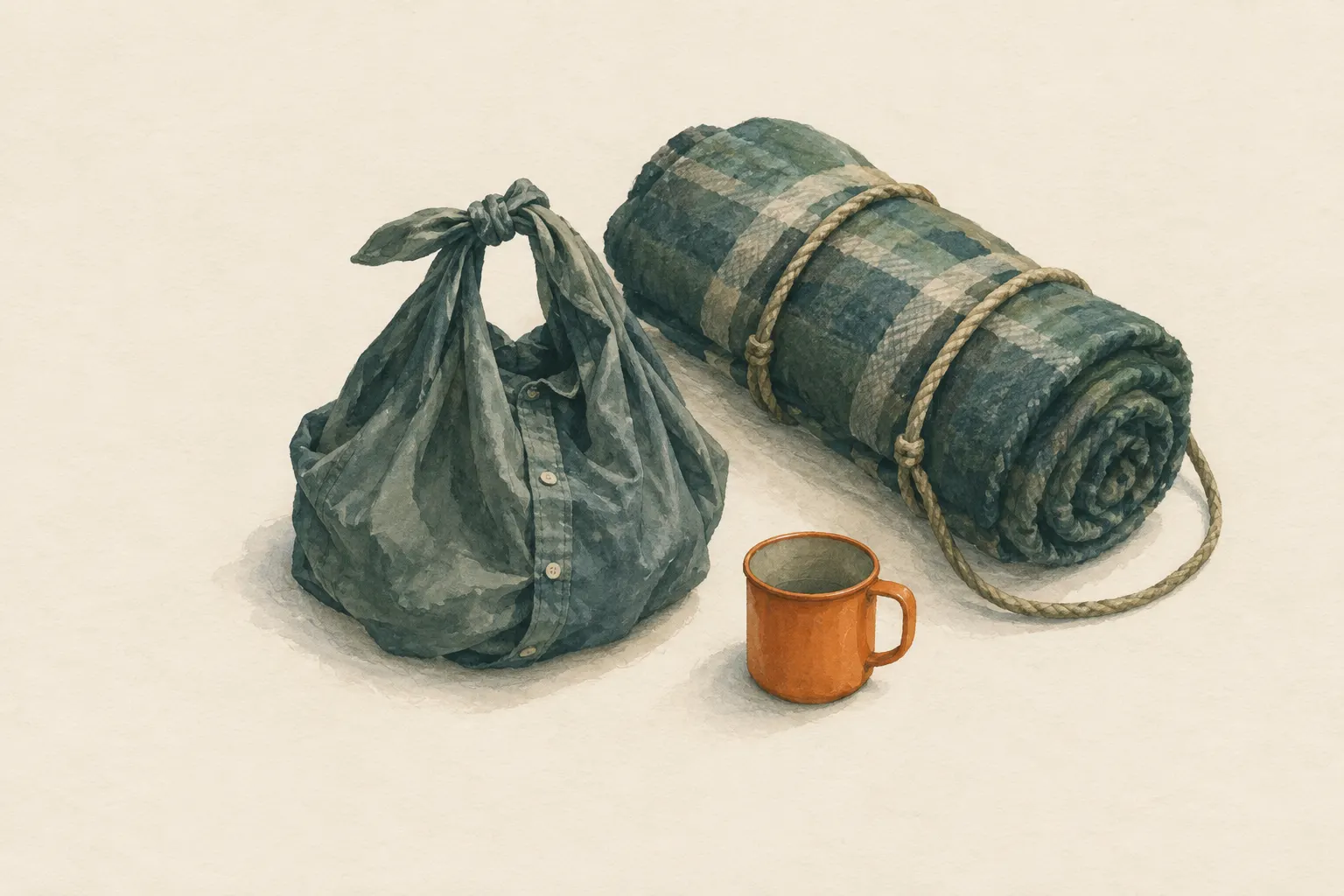
If a backpack is missing or broken, things can be carried with everyday items: a T-shirt or shirt becomes a bag by tying the sleeves and hem, a blanket or tarp becomes a roll over the shoulder with two cords. This carries light to medium loads over short distances – for heavy loads and long distances a proper backpack remains irreplaceable.
- 5–10 minutes
Explained simply
What do you do if you have to carry lots of things but have no bag? Look at a T-shirt: it is almost a bag already. At the bottom there is a big opening, at the top the neck hole, at the sides two sleeves. Tie the bottom opening shut and the base is closed. Fill it through the neck hole and knot the sleeves together, and you have a handle.
A blanket or tarp works another way: lay your things along one edge, roll everything up tightly like a sleeping bag, tie both ends and hang the roll diagonally over your shoulder with a cord. That way the weight is spread across your back.
Two important rules: do not use a garment you need right now to keep warm. And never put cords around your neck – always over one shoulder and across your chest.
How it works
Every container needs two things: a closed bottom so nothing falls out, and a way to grip or sling it. A shirt or T-shirt almost brings both with it. The tied hem becomes the bottom, the sleeves become handles and the neck hole is the opening for filling.
The blanket roll works on a different principle. Rolling tightly encloses the items so they cannot shift. Carried diagonally across the upper body, the weight sits close to you and is spread over a long stretch – much like a backpack, only simpler. Loads close to the body are easier to carry because they pull you less off balance.
The classic cloth bundle is even older: a large square cloth is folded around the contents and opposite corners are knotted. A reef knot (also called a square knot) suits this well because it lies flat and can be undone again.
What really matters
Less is more: fabric is not made for heavy loads. An overloaded T-shirt tears at the seams or at the hem knot. Rather split the weight into two bundles or carry heavy things in your hands. Hard and sharp items go inside so they neither poke through the fabric nor press into your back.
With the blanket roll, tightness decides everything: loosely rolled blankets sag and swing with every step. Roll as tightly as you can, fold in the ends and tie them off well. After packing, walk a few steps and retie if anything slips.
Thin cords dig into the shoulder. Put a folded cloth, gloves or a hat underneath as padding. On longer distances switch shoulders so your muscles can recover.
When it makes sense – and when not
Improvised carrying helps over short distances with light to medium loads: when a bag has torn, when you need to take extra things along in an evacuation, or when you collect wood, cones or small items around camp. One advantage: afterwards the bundle turns back into clothing or a blanket.
For heavy loads and long distances it is not a good solution. Without a hip belt and padded straps the weight presses on a few points, and that quickly becomes painful. For an evacuation, a prepared go-bag is always better than any improvisation.
This technique is explicitly not meant for carrying injured people. Injured people are only moved if they are in immediate danger where they are. Otherwise: call the local emergency number (112 in the EU), stay with the person and wait for help.
Safety: what to watch out for
In the cold, warmth comes first. A jumper used as a bag no longer keeps you warm. Even cool, windy or wet conditions can chill you, without any frost. So only use clothing you really can spare right now for bags, or a cloth, a sheet or a pillowcase.
Cords never go around the neck. If a bundle catches on something or someone falls, a cord around the neck can become dangerous. Always run carrying straps over one shoulder and across the upper body so they can be slipped off quickly if needed. Take particular care with children.
Look after your back as well: lift bundles with your knees, not with a rounded back, and rather carry twice than once too heavily.
Good to know
The blanket roll over the shoulder is a very old way of carrying. Soldiers, travelling workers and travellers carried their belongings this way long before modern backpacks were common. Military survival manuals also describe improvised carrying systems made from a blanket or tarp.
Try it once at home: turn an old T-shirt into a bag and a blanket into a roll, and carry them around the flat or the garden. You will quickly notice how much fits into a bundle, which knots hold and where it pinches. Then in a real situation you will not have to think.
Step by step
Shirt: close the hem
Lay the T-shirt flat. Tie the bottom hem closed – either with cord or by gathering the fabric into two corners and knotting them.
- 1
Shirt: close the hem
Lay the T-shirt flat. Tie the bottom hem closed – either with cord or by gathering the fabric into two corners and knotting them.
- 2
Shirt: sleeves as handle
Fill the bag through the neck opening and tie the two sleeves together to form a handle.
- 3
Blanket roll: lay out
Spread the blanket or tarp flat, distribute items evenly along one long edge, hard edges facing inwards.
- 4
Blanket roll: roll and tie
Roll tightly, fold in the ends and tie off both ends with cord. Join the ends with another cord and carry it diagonally across the chest.
- 5
Check the load
Walk a few steps and retie. Do not let anything heavy or sharp press against your body.
Common mistakes
- Overloading – the fabric tears
- Sharp objects facing outwards
- Sacrificing warm clothing
- Cords digging into the shoulder
Quick view
Materials
Cotton cloth / T-shirt
T-shirt, shirt or large cloth
Removes coarse particles only – no disinfection.
Wool blanket / duvet
Keep away from candles, stoves and heaters.
Tarp
Paracord
Not a climbing or safety rope.
Suitable for
- Short distances with light loads
- Evacuation when bags are missing
- Collecting material around camp
Not suitable for
- Heavy loads over long distances
- Carrying injured people
Prerequisites
- A few simple knots, e.g. the reef knot
- A garment or cloth you do not currently need for warmth
Safety
- Do not use a garment for carrying that you need for warmth. In the cold, warmth comes first.
- Do not put cords around your neck. Run carrying straps over the shoulder and across the chest.
How it works
A bag needs a closed bottom and a way to grip or sling it. A shirt almost has both already: tie the hem and the bottom is closed; the sleeves become handles. A roll of blanket or tarp spreads the weight along the back and can be carried diagonally over the shoulder with cord.
Advantages
- No special material needed
- Quick to make
- Can be turned back into clothing or a blanket
Disadvantages
- Uncomfortable over longer distances
- Limited load
- Not waterproof
Deep knowledge
Background
The manual FM 3-05.70 describes improvised carrying systems, including the roll made from a blanket or tarp. Such solutions have long been known and proven, but are only suitable for limited loads.
In an evacuation, a prepared go-bag is the better solution. Improvisation helps when luggage is lost or additional items must be taken along.
Variants
- Cloth bundle
- Fold a large square cloth diagonally over the contents and knot the opposite corners – the classic bundle.
- Padding
- Put a folded cloth or gloves under cords on the shoulder as padding.
Common mistakes
- Overloading – the fabric tears
- Sharp objects facing outwards
- Sacrificing warm clothing
- Cords digging into the shoulder
Limits and risks
- No guidance on transporting injured people
- Unsuitable for heavy loads
Material alternatives
Derived from material properties: a substitute must have all relevant properties. Observe the notes on the substitute.
- Wool blanket / duvet
- Sleeping pad, Dry leaves, grass or conifer boughs (Collect only where allowed; no protected plants. Check for ticks and insects.), Backpack, Dry spare clothing (Carry it in waterproof packaging – wet clothing barely insulates.), Insulated cool box (Keeps cold only for a limited time; without ice packs or ice it is not a fridge.), Sleeping bag (Do not store compressed long-term; do not pack away damp.), Newspaper and cardboard (Flammable – keep away from candles, stoves, heaters and embers.), Insulated cooking box (hay box, thermal cooker) (Never put open flame or embers inside – only the hot, closed pot.)
- Tarp
- Plastic sheet / large bin bag (Tears easily; never pull over the head (suffocation risk).), Emergency blanket (Tears easily once punctured; short-term shelter only.), Document folder (waterproof) (Store securely – contains sensitive personal data.), Rain poncho (When used as a shelter, it no longer protects your body from rain.), Bivy bag (Never fully close off the face.), Tent (Do not cook or heat inside the tent (fire and carbon monoxide danger).), Heavy-duty bin bag (large) (Suffocation risk: never pull plastic bags over the head or face and keep them away from small children.), Group shelter bag (Airtight – ventilate regularly.)
- Paracord
- Rope (Never use unknown or damaged rope for life-safety purposes.)
Results come exclusively from structured entries. No improvised instructions are generated.
Sources
Headquarters, Department of the Army (USA) (2002): FM 3-05.70 Survival
Improvised carrying systems, including a roll made from a blanket or tarp