How thunderstorms form
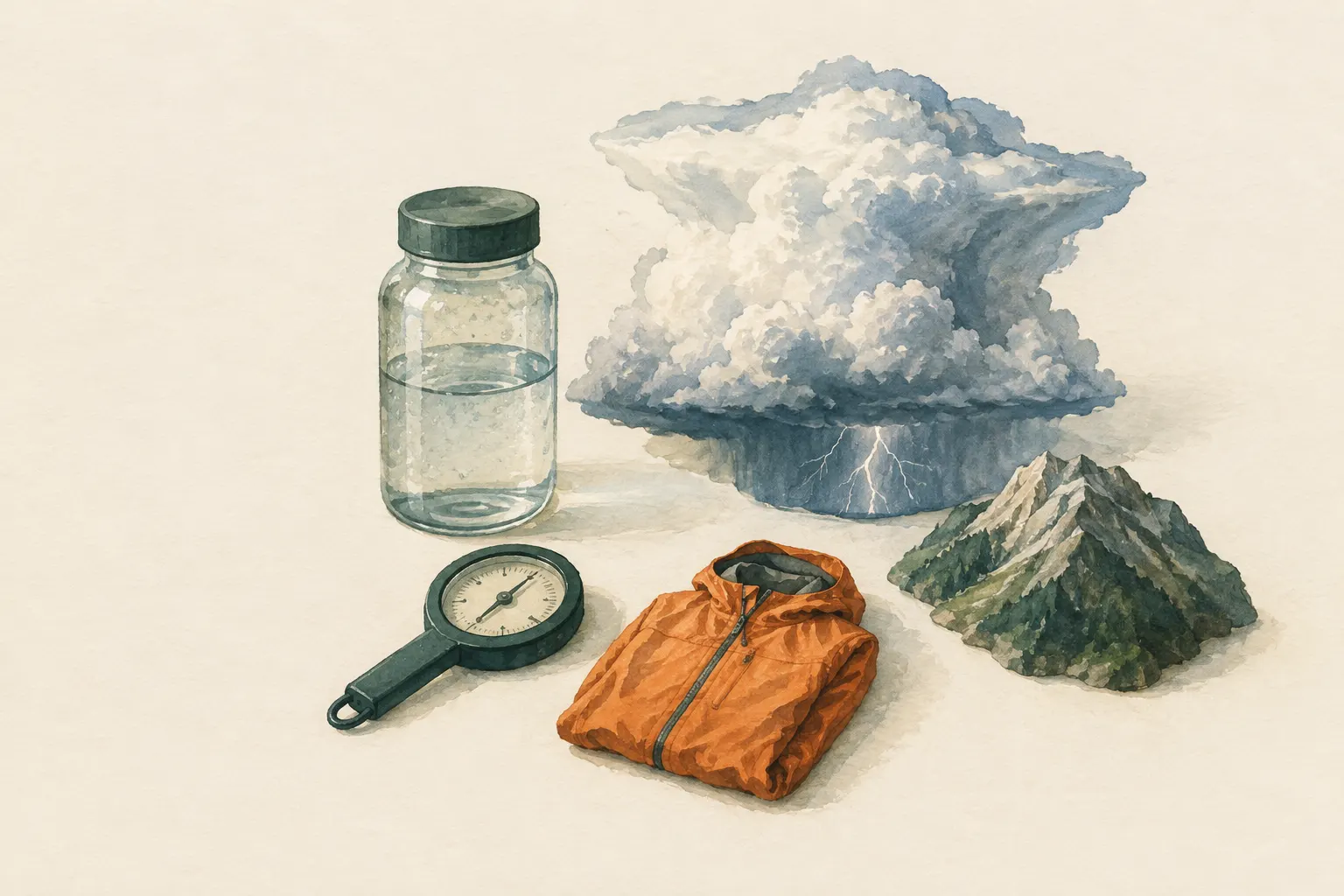
Thunderstorms need three ingredients: moist air, an unstable atmosphere in which rising air keeps rising, and a trigger such as solar heating, mountains or a cold front. In the towering storm cloud, collisions between ice and graupel particles separate electrical charges – lightning equalises them. Understanding this helps you recognise typical thunderstorm situations earlier and explains why shelter must be sought in good time.
- 10 minutes to read
Explained simply
A thunderstorm is like a giant cooking pot in the sky. Warm, moist air rises, like bubbles in a pot. Up high it gets cold, and the water vapour turns into clouds. If the air can keep rising, the cloud grows as tall as a tower, until ice forms right at the top. A thunderstorm needs three things: moist air, air that keeps wanting to go up, and a push – for example sun heating the ground, a mountain or a cold front.
Inside the cloud, ice grains whirl wildly around and crash into each other. This charges them with electricity – a little like rubbing a balloon on your hair, only unimaginably stronger. When the voltage gets too big, a lightning bolt jumps. The lightning makes the air extremely hot in a split second, and it expands with a bang: that is thunder.
The most important point: if you can hear thunder, lightning can reach you. Go straight into a substantial building or a car with a metal roof and closed windows – and stay there until about 30 minutes after the last thunder.
How it works
Warm, moist air is lighter than the air around it and rises. As it does, it cools and its water vapour condenses into cloud droplets. Condensation releases heat – the same heat that was needed earlier for evaporation. This heat keeps the rising air warmer than its surroundings and drives it further upwards. If the atmosphere is “unstable”, meaning cold enough higher up by comparison, the rising continues on and on.
This is how a heaped cloud grows into a thundercloud, the cumulonimbus. It reaches far into heights where it is icy cold. At the top, where it cannot rise any further, it often spreads out sideways and forms the typical top that looks like an anvil. Inside the cloud, strong updraughts and downdraughts sit side by side.
In this turmoil, small ice crystals and soft ice pellets, called graupel, collide. This separates electrical charges: lighter particles with one charge are carried upwards, heavier ones with the other charge stay lower down. A huge voltage builds up. When it is large enough, it is discharged as lightning – within the cloud, between clouds or to the ground.
Lightning and thunder
A lightning bolt heats the air in its channel to tens of thousands of degrees in a tiny instant. The air expands abruptly and creates a pressure wave that we hear as thunder. Close to the strike it sounds like a sharp crack; further away it is a long rumble, because sound from different parts of the lightning channel takes different times to reach you.
Light reaches you practically instantly, sound takes about three seconds per kilometre. If you count the seconds between flash and thunder and divide by three, you get roughly the distance in kilometres. That is a nice estimate – but not a measure of safety. Lightning can strike well ahead of the rain area and even behind a departing storm. If you can hear thunder, you are within reach.
Typical situations
Heat thunderstorms form on hot, humid summer days. The sun heats the ground through the day, the air rises ever more strongly, and the thunderstorm risk is usually greatest in the afternoon or early evening. In the mountains, sunlit slopes strengthen the rising air. A warning sign is heaped clouds that already grow upwards quickly with sharp edges in the morning.
Frontal thunderstorms form when a cold front quickly lifts warm, moist air. They can occur at any time of day and sometimes form entire lines of storms. A thunderstorm typically goes through three stages: growth with a billowing cloud, maturity with precipitation, gusts, lightning and possibly hail, and finally dissipation.
Shortly before a thunderstorm, cool gusts can often be felt. This is cold air from the cloud's downdraught spreading out along the ground. A sudden drop in temperature and freshening, gusty wind mean the storm is close.
Safety: what to watch out for
There is no truly safe place outdoors in a thunderstorm. Safe places are substantial, enclosed buildings and hard-topped metal vehicles with the windows closed. Tents, open-sided shelters and isolated trees offer no protection – an isolated tree is in fact a particularly dangerous spot. Do not wait until it rains; move as soon as you hear thunder or see a storm approaching, and stay inside until about 30 minutes after the last thunder.
Thunderstorms can trigger flash floods, even in valleys where no rain is falling, because the water comes from further up. Avoid stream beds, gorges and underpasses, and never walk or drive through flooded roads. If someone has been struck by lightning, call the local emergency number (112 in the EU) immediately; the person carries no electrical charge and can be touched safely. Detailed rules of behaviour are in the entry on lightning safety outdoors.
How to practise it
On summer days, watch the sky deliberately: when do the first heaped clouds grow, how fast do they tower up, and what does it look like an hour later? Compare your observation with the forecast and the weather service's rain radar. This gives you a feel for how quickly a harmless cloud can develop into a thunderstorm.
Plan summer trips so that exposed places such as summits and ridges are behind you as early in the day as possible, and decide in advance where you would find shelter in an emergency. Anyone who starts early and keeps to a fixed turnaround time has to make difficult decisions under pressure less often when storms come.
Quick view
Suitable for
- Trip planning in summer and in the mountains
- Understanding thunderstorm warnings
Not suitable for
- A substitute for severe-weather warnings
- Deciding to stay outside when thunder can be heard
Prerequisites
- A basic understanding of weather fronts helps
Safety
- In the mountains, heat thunderstorms often form in the afternoon. Start trips early and set turnaround times.
How it works
Moist, warm air rises, cools, and its water vapour condenses. This releases heat that drives the air further upwards. If the atmosphere is unstable, the cloud grows upwards until it reaches icy layers – a cumulonimbus cloud with the typical anvil-shaped top. In the cloud, ice crystals and graupel collide in strong updraughts and downdraughts, separating charges. When the voltage becomes large enough it discharges as lightning – within the cloud, between clouds or to the ground. Lightning heats the air abruptly; it expands explosively, and we hear that as thunder. Light arrives practically instantly, sound takes about three seconds per kilometre. A thunderstorm typically goes through a growth stage (towering cumulus), a mature stage (precipitation, gusts, lightning, possibly hail) and a dissipating stage. Cold fronts can trigger entire lines of thunderstorms.
Advantages
- Explains why thunderstorms often occur in the afternoon
- Helps to interpret warning signs early
Disadvantages
- Thunderstorms remain hard to predict exactly despite this knowledge
- Simplified account of charge separation
Deep knowledge
Background
The US National Weather Service explains thunderstorm formation in its learning resource “JetStream” and stresses in its lightning-safety guidance that there is no safe place outdoors in a thunderstorm and that you should seek shelter when thunder can be heard. Germany's Deutscher Wetterdienst describes the terms in its weather glossary.
Practical rules of behaviour in thunderstorms are in the entry on lightning safety outdoors. This entry provides the background to why those rules are so conservative.
Variants
- Signs in the sky
- Towering, sharply outlined cumulus clouds growing rapidly in the morning, a darkening sky, freshening gusty wind and a sudden drop in temperature are warning signs.
Common mistakes
- Waiting until it rains before retreating
- Concluding from the flash-to-thunder interval that you are still safe
- Sheltering under isolated trees
- Moving on immediately after the last flash
Limits and risks
- No detailed behaviour guidance – see the lightning-safety entry
- No details on regional thunderstorm frequency
Sources
U.S. National Weather Service (NOAA): JetStream – An Online School for Weather
Formation and life cycle of thunderstorms
NOAA National Weather Service (USA): Lightning Safety
No safe place outdoors; seek shelter when thunder is heard; wait 30 minutes after the last thunder
Deutscher Wetterdienst (DWD): Wetter- und Klimalexikon
Terms thunderstorm, cumulonimbus