Composting in the garden
Kitchen and garden waste turns into nutrient-rich compost within a few months. This works with a mix of moist, nitrogen-rich ("green") and dry, carbon-rich ("brown") materials, enough air and moisture. Meat, fish, dairy and cooked food do not belong on an open home compost – they attract rats.
- A few minutes a week, occasional turning
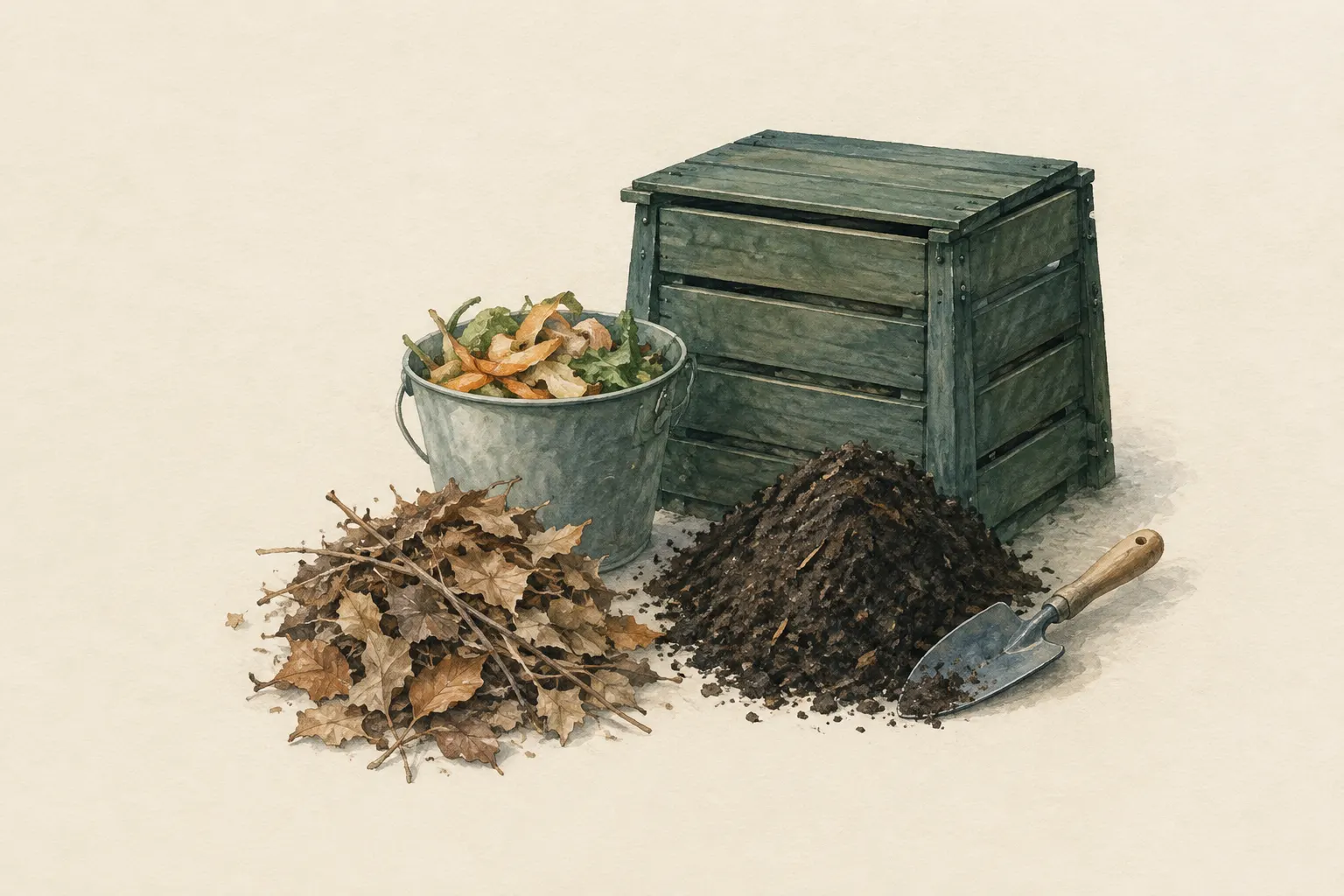
Explained simply
Compost is something like nature's recycling centre. Vegetable peelings, leaves, grass clippings and coffee grounds are not thrown away but put on a heap or into a bin. There, worms, fungi and tiny creatures you can only see under a microscope slowly eat the material. After a few months it has turned into dark, crumbly soil that smells like a forest floor – compost.
The compost helpers need a good mix, just as you need a balanced meal: “green”, moist material such as vegetable scraps, and “brown”, dry material such as leaves, twigs or torn cardboard. Add air and just the right moisture – about as damp as a wrung-out sponge.
Meat, fish, cheese and cooked leftovers do not belong on an open compost because they attract rats. And after working with compost, always wash your hands thoroughly.
How it works
Composting is decomposition that you steer. Bacteria and fungi start by breaking down soft plant parts. Then larger helpers join in: compost worms, woodlice, springtails and many other soil creatures. They break the material down further and further until it becomes humus – the dark, nutrient-rich part of good soil.
These creatures need two kinds of food. Green material such as vegetable scraps, coffee grounds or fresh grass clippings mainly provides nitrogen – you can think of it as protein for the small creatures. Brown material such as leaves, straw, twigs or cardboard provides carbon – more like the energy. If one or the other is missing, the process runs poorly.
Most of these organisms also need oxygen. If the compost is too wet and dense, air is lacking. Then other microbes that work without oxygen take over, and it starts to rot and smell unpleasant. If it is too dry, everything stalls. A well-mixed, loose compost, on the other hand, hardly smells and can warm up noticeably inside – a sign that the microbes are hard at work.
What really matters
The site: put the bin on bare soil so worms and other soil creatures can move in from below, ideally in partial shade so it does not dry out. It should be easy to reach – even in winter with a bowl of kitchen scraps in your hand. A layer of coarse twigs at the bottom helps air get in.
The mix: add green and brown in alternating layers or mixed together. Grass clippings only in thin layers, otherwise they mat together into a putrid layer. Chop coarse material – smaller pieces decompose faster. If the compost is too dry, moisten it; if it is wet and smells, add more brown material and cover it.
Turning it occasionally or loosening it with a garden fork lets air in and speeds up decomposition. The compost is ready when it is dark and crumbly, smells earthy and the original materials are barely recognisable. Sieve it and work it into the bed. Do not put immature compost directly on young, delicate plants.
What goes in – and what does not
Well suited: raw fruit and vegetable scraps, coffee grounds, tea leaves, eggshells, leaves, grass clippings in thin layers, straw, small twigs, unprinted paper and torn cardboard. The more varied the mix, the better.
Not for an open home compost: meat, fish, bones, dairy products and cooked leftovers – they attract rats and other animals. Also leave out diseased plants and weeds with ripe seeds, because diseases and seeds can survive in the compost and spread later in the bed.
Also off-limits are pet faeces, treated or painted wood and coal ash. They can contain pathogens or pollutants that do not belong in your vegetable garden. Human waste does not belong on a garden compost either.
Safety: what to watch out for
Compost is full of microorganisms – that is the point, but it also means you wear gloves while working and wash your hands thoroughly afterwards. Turning dry material can raise dust containing fungal spores. Do not breathe it in: do not lean into the dust cloud, and lightly moisten dry compost first.
Anyone with a weakened immune system – for example due to illness or medication – should check with a doctor beforehand whether compost work is suitable. Small children can help with the compost but should not play in it and should always wash their hands afterwards.
Whether and how garden compost is allowed, for example how far it must be from the neighbouring plot, differs between municipalities – check local rules. A well-managed compost hardly smells. If it smells putrid or attracts animals, that is a sign the mix or contents are wrong.
Good to know
The US Environmental Protection Agency describes home composting with exactly these basic ingredients: green and brown material, water and air. It also lists what does not belong in a home compost. Gardening handbooks add different bin types – open slatted bins, closed insulated bins or simple heaps.
If you have no garden, you can compost with a worm bin. In it, special compost worms process kitchen scraps, even on a balcony or in a basement. A worm bin does need even temperatures and some care, though, so that the worms thrive.
Compost closes a loop: what grows in the garden returns as food for the soil. That saves waste and fertiliser and makes the soil looser and more fertile over the years. For a vegetable garden, home-made compost is one of the most valuable treasures there is.
Step by step
Site and bin
Set the bin on bare soil, in partial shade, easy to reach. A layer of coarse twigs at the bottom for air.
- 1
Site and bin
Set the bin on bare soil, in partial shade, easy to reach. A layer of coarse twigs at the bottom for air.
- 2
Mix green and brown
Add green (vegetable scraps, coffee grounds, thin layers of grass clippings) and brown (leaves, straw, torn cardboard, twigs) in alternating layers or mixed.
- 3
Chop up
Chop coarse material; smaller pieces decompose faster.
- 4
Check moisture
Moisten when dry; when wet, add more brown material and cover.
- 5
Turn
Turn or loosen occasionally to let in air; this speeds up decomposition.
- 6
Use mature compost
Compost is ready when it is dark, crumbly and smells earthy and the original materials are barely recognisable. Sieve it and work it into beds.
Common mistakes
- Only grass clippings in a thick layer – turns putrid
- Food scraps with meat – rats
- Too dry
- Immature compost on young plants
Quick view
Materials
Compost bin
Wear gloves when turning and wash hands afterwards.
Sturdy work gloves
When handling flood mud or chemicals, also wear waterproof gloves.
Suitable for
- Home and community gardens
- Less waste
- Improving soil for beds
Not suitable for
- Meat, fish, bones, dairy, cooked food
- Diseased plants, seeding weeds
- Pet faeces
- Treated wood, coal ash
Prerequisites
- A spot in the garden in contact with soil, partly shaded
- Enough brown material (leaves, twigs, cardboard)
Safety
- Wear gloves when turning, avoid breathing in dust and wash hands afterwards. Anyone with a weakened immune system should check with a doctor beforehand whether compost work is suitable.
- Whether and how garden compost is allowed (e.g. distance to neighbours) differs between municipalities – check local rules.
How it works
Microorganisms, worms and other soil life break down organic matter. They need nitrogen from green material, carbon from brown material, oxygen and moisture like a wrung-out sponge. Too wet and dense, the compost turns putrid; too dry, it stalls.
Advantages
- Free soil improver
- Less waste
- A closed loop in the garden
Disadvantages
- Needs space and time
- Can smell or attract animals if done wrong
Deep knowledge
Background
The US Environmental Protection Agency describes home composting with a mix of green and brown materials, water and air, and lists materials that do not belong in a home compost.
Gardening handbooks add bin types and use in beds.
Variants
- Worm bin
- In a worm bin, composting worms process kitchen scraps even on a balcony; it needs even temperatures and care.
Common mistakes
- Only grass clippings in a thick layer – turns putrid
- Food scraps with meat – rats
- Too dry
- Immature compost on young plants
Limits and risks
- No ratios or temperature figures
- No composting of human waste
Sources
U.S. Environmental Protection Agency (EPA): Composting At Home
Green and brown material, air and water; unsuitable materials
Royal Horticultural Society – Dorling Kindersley: RHS Encyclopedia of Gardening
Compost bins and use in the garden