Storing food safely away from wildlife
Food, rubbish and scented items such as toothpaste or sunscreen attract animals – from mice and foxes to bears. Storing them out of reach and away from where you sleep protects you, your supplies and the animals: an animal that has once found food from people returns and, in the worst case, has to be killed. In some areas specific containers are required.
- A few minutes each evening
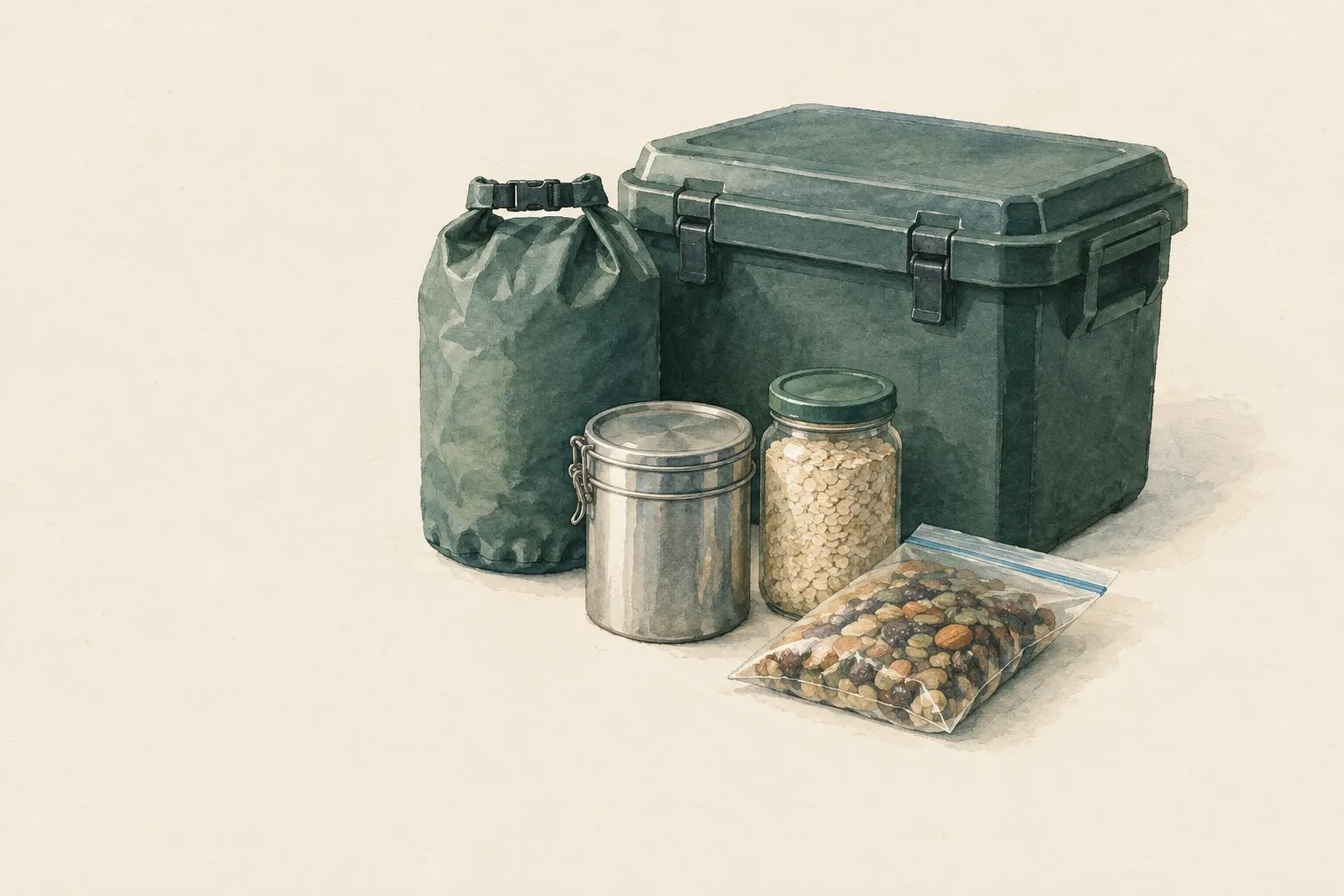
Explained simply
Many animals have a far better nose than we do. They smell your bread, your chocolate and even your toothpaste from a long way off. If they find something to eat at your campsite, they remember it – like a child who knows which drawer the biscuits are in. Then they keep coming back.
So in the evening you put away everything that smells: food, rubbish, pots with leftovers, but also toothpaste, sunscreen and soap. These things do not stay in the tent but in a safe place at a distance from where you sleep. Exactly where and how is set by the rules of the area.
This matters not only for you but also for the animals. An animal that gets used to human food can become dangerous and, in the worst case, has to be killed. Packing away carefully therefore protects both sides. And of course you never feed wild animals on purpose.
How it works
Many mammals find their food mainly by smell. To them a campsite is full of exciting scents: food scraps, grease on pots, packaging, but also perfumed things such as lip balm or sunscreen. An animal cannot know that toothpaste is not food – it only smells that something interesting is there.
Animals also learn fast. If an animal once finds food at a campsite, it links people and tents with an easy meal. It returns, grows bolder and loses its natural shyness. Experts call this habituation. Such animals are hard to break of the habit.
The solution therefore has three parts: keep odours as low as possible, store everything scented so animals cannot reach it, and separate sleeping and eating areas. If one of these parts is missing, the whole system works less well.
What really matters
The most important step happens before the trip: find out which rules apply in the area. In some parks certain wildlife-resistant containers are required, at some campsites fixed food lockers are provided, and elsewhere other rules apply. These rules can change. Ask the park administration or read its current guidance.
Think of everything that smells, not just food. That includes rubbish, used cookware, drink powder, toothpaste, soap, sunscreen, lip balm and scented insect repellent. The easiest way is to have one fixed bag or container for all of these in the evening so nothing is forgotten.
Cook and eat at a distance from the tent, ideally so that the wind carries smells away from your sleeping spot. Clothing with strong food odours is better taken off before sleeping. And snacks left in a jacket pocket overnight are one of the most common mistakes.
Safety: what to watch out for
In areas with large wildlife, food, rubbish and scented items never belong in the tent. An animal that smells food at night may, in the worst case, try to get into the tent – with you lying inside. This applies even to seemingly harmless small things such as a cereal bar.
Whether you should use a canister, a food locker or another method is decided by the local park or conservation authority. This entry deliberately does not explain how to hang food in trees, because whether that is allowed and effective differs greatly by area and species. Follow the rules on site.
Never feed animals on purpose – not even birds, squirrels or foxes at the campsite. Do not leave scraps lying around and do not tip anything into the bushes. What is just a crumb to you teaches an animal that being near people pays off.
Typical situations
Even where there are no bears, care pays off. Mice gnaw holes in packs, foxes or crows tear open bags, and in some countries monkeys or raccoons are very skilful at campsites. Tightly packed supplies and a tent with no food in it protect your gear.
Always take your rubbish back with you. Buried scraps are dug up by animals, and burnt packaging often leaves residue that still smells. A rubbish bag in your pack is the simplest solution – in the evening it is one of the scented items to be stored safely.
At campsites with food lockers it is especially easy: everything scented goes in, the locker is closed, done. The only important thing is to really close it every time, even if you only step away briefly.
Good to know
The Leave No Trace principles call for storing food and rubbish securely so wildlife does not get used to human food. The US National Park Service describes detailed rules for storing food and scented items in bear country.
Wildlife-resistant containers add weight and cost money. Even so, they are mandatory in some areas, and often only approved models count there. The relevant authority tells you which ones – this entry makes no statements about that.
Step by step
Check the rules on site
Ask the park administration whether containers are required or food lockers are provided.
- 1
Check the rules on site
Ask the park administration whether containers are required or food lockers are provided.
- 2
Separate cooking, eating and sleeping
Cook and eat at a distance from the tent, ideally downwind. Do not wear clothing with strong food odours in the sleeping bag.
- 3
Pack everything scented
Store not only food but also rubbish, cookware with leftovers, toothpaste, sunscreen, soap and lip balm together.
- 4
Store out of reach
In required containers, food lockers on site or according to local guidance. Place containers away from the tent.
- 5
Pack out rubbish
Take all leftovers and packaging with you; do not bury or burn anything that animals can dig up or that leaves residue.
Common mistakes
- Snacks in the tent or jacket pocket overnight
- Forgetting toothpaste and sunscreen
- Tipping food scraps into the bushes
- Burying rubbish
- Applying rules from another park
Quick view
Materials
Wildlife-resistant food container
Where required or recommended
Where specific containers are required, use only approved models – check local rules.
Plastic sheet / large bin bag
Bin bag to pack out rubbish
Tears easily; never pull over the head (suffocation risk).
Do not use for drinking water unless food-grade.
Suitable for
- Camping and multi-day trips
- Areas with bears, raccoons, foxes, monkeys or rodents
- Campsites with food lockers
Not suitable for
- Storage inside the tent in areas with large wildlife
Prerequisites
- Knowledge of the area's rules (container requirements, food lockers on site)
- A separate place for cooking and storage
Safety
- Whether bear canisters, food lockers or hanging are required, allowed or appropriate is set by the local park or conservation authority. Check and follow local rules.
- Never feed animals deliberately – and do not leave food scraps behind.
How it works
Many animals have an excellent sense of smell and learn quickly. If they smell food at a campsite and get to it, they associate people with food. The solution has three parts: limit odours, store food so it is inaccessible, and separate sleeping and eating areas.
Advantages
- Protects people, supplies and animals
- Little effort
- Often legally required
Disadvantages
- Containers add weight and cost
- Requires discipline every evening
Deep knowledge
Background
The Leave No Trace principles call for storing food and rubbish securely so wildlife does not become habituated to human food. The US National Park Service describes detailed rules for storing food and scented items in bear country.
Which method applies in an area – canisters, lockers or hanging – varies greatly and can change. This entry therefore gives no instructions for hanging food and refers to the local authority.
Variants
- Against rodents and small animals
- Even where there are no large animals, mice, foxes or birds damage packs and supplies. Do not leave food or scraps in packs or tents, and keep supplies tightly packed.
Common mistakes
- Snacks in the tent or jacket pocket overnight
- Forgetting toothpaste and sunscreen
- Tipping food scraps into the bushes
- Burying rubbish
- Applying rules from another park
Limits and risks
- No instructions for hanging food
- No statements on container approvals – check local rules
Material alternatives
Derived from material properties: a substitute must have all relevant properties. Observe the notes on the substitute.
- Wildlife-resistant food container
- Single-wall stainless steel bottle (Heat only single-wall bottles without paint/plastic; remove the lid before heating.), Double-wall insulated bottle (Never heat directly.), PET bottle (clear, max. 2 litres) (Do not heat or place in a fire.), Food-grade water container (Only use containers that never held chemicals or fuel.), Used chemical or fuel container (Never for drinking water or food – residues cannot be reliably removed.), Galvanised bucket (Do not heat: the zinc coating can release harmful fumes when heated.), Waterproof case or bag, Airtight food-grade storage container (Fill only when clean and completely dry; never use containers that previously held chemicals.), Small metal tin with lid (Burn off coated or painted tins outdoors first.), Collapsible water container or bag (Protect from sharp objects.), Food-grade water bag (Use only for drinking water, never for chemicals or fuel.), Fermentation jar or crock (Use only food-grade containers of glass, food-safe glazed stoneware or food-grade plastic – no metal containers for acidic food.), Resealable food bags (Use only bags intended for food; do not use with boiling water unless the manufacturer explicitly allows it.)
- Plastic sheet / large bin bag
- Tarp, Emergency blanket (Tears easily once punctured; short-term shelter only.), Document folder (waterproof) (Store securely – contains sensitive personal data.), Rain poncho (When used as a shelter, it no longer protects your body from rain.), Bivy bag (Never fully close off the face.), Tent (Do not cook or heat inside the tent (fire and carbon monoxide danger).), Heavy-duty bin bag (large) (Suffocation risk: never pull plastic bags over the head or face and keep them away from small children.), Group shelter bag (Airtight – ventilate regularly.)
Results come exclusively from structured entries. No improvised instructions are generated.
Sources
Leave No Trace Center for Outdoor Ethics: The Seven Principles of Leave No Trace (Principle 5: Minimize Campfire Impacts)
Store food and rubbish securely; do not feed wildlife
U.S. National Park Service: Bear Safety
Storage of food and scented items in bear country