Reading animal signs – for awareness, not hunting
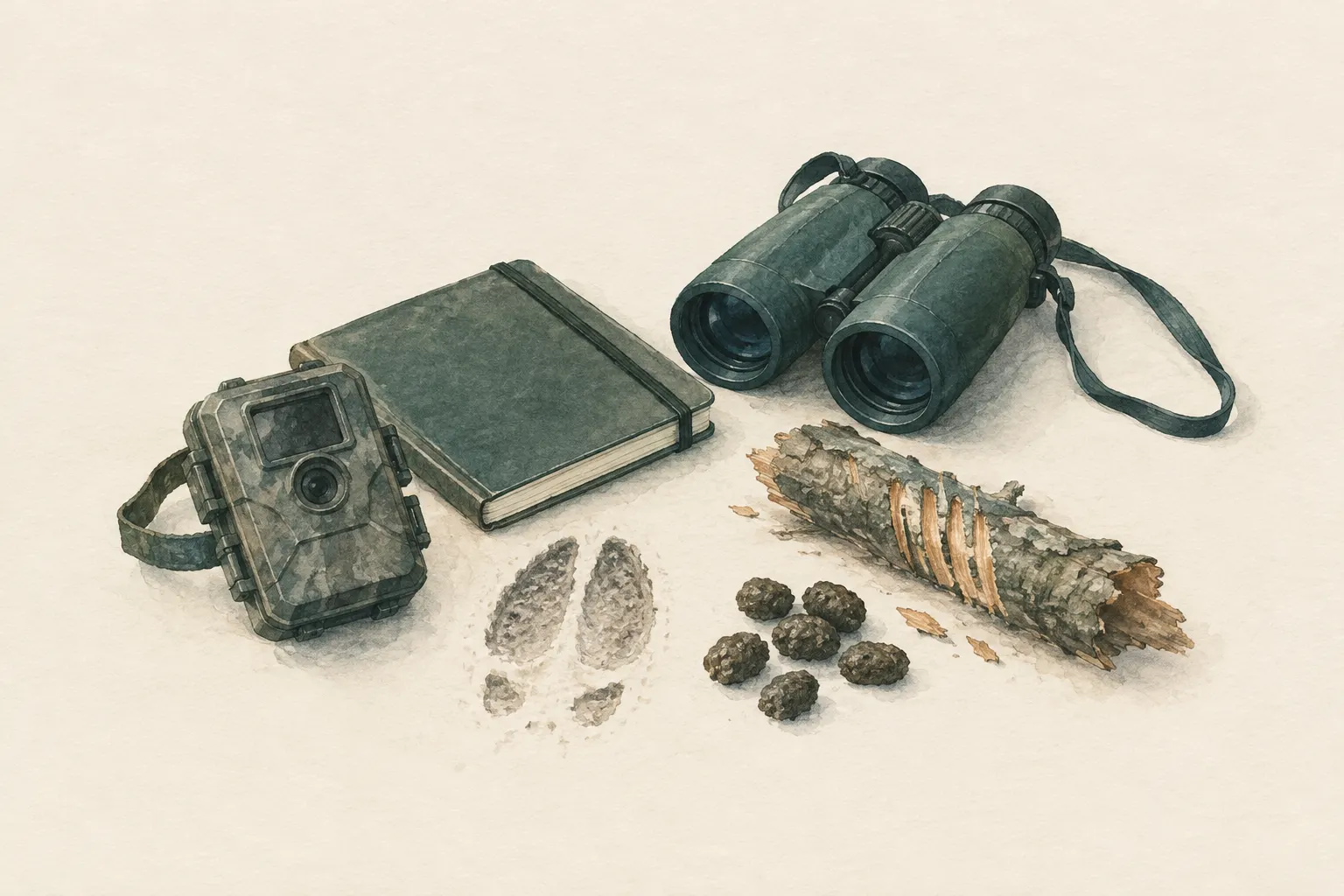
Footprints, droppings, feeding signs, game trails and scratch marks reveal which animals move through an area and how fresh their traces are. This knowledge helps you choose campsites wisely, avoid encounters with large wildlife and experience nature more consciously. Signs are observed and photographed – not followed in order to track animals down.
- Practice over many outings
Explained simply
Animals write a kind of diary every day – not with a pen, but with their paws, hooves and teeth. A print in the mud, a nibbled cone or a narrow path through the grass tells you: an animal passed through here. Reading signs means learning to read this diary.
You do not need to know exactly which animal it was. Simple questions are often enough: was the animal small or large? Is the sign fresh or already old? Did one animal pass by just once, or is this a well-used path? The answers help you, for example, to find a good place to rest.
The most important safety point: signs are looked at and photographed, not followed. If you find very fresh signs of a large animal, you do not go after it – you choose a different route. And you do not touch droppings, which trackers call scat.
How it works
Every animal leaves traces of its daily life. Footprints – trackers often just call them prints – appear when a foot presses into soft ground. How clear they are depends mainly on the surface: damp mud, fine sand and fresh snow show many details, hard forest floor covered in leaves shows almost none. That is why you find most prints along stream banks, the edges of puddles and on paths after rain.
Besides prints there are many other signs. Scat (droppings) shows that an animal was here and roughly what it ate. Feeding signs such as bitten-off shoots, gnawed bark or stripped cones reveal where animals feed. Game trails are narrow, worn paths that animals use again and again. Hair on fences, scratch marks on trees or churned-up ground complete the picture.
Many small clues add up to a story: roughly what kind of animal, how often a place is used and how long ago. For your safety the rough classification is usually enough – small or large, old or fresh, single or heavily used.
What really matters
Good trackers look slowly and deliberately. They stop, crouch down and view the ground from a low angle. Light coming in at a slant, for example in the morning or evening, casts small shadows inside prints and makes them far more visible than the midday sun. A torch held to the side also helps in a dark forest during the day.
Always photograph a print from directly above and place something of known size next to it, such as a pen or a ruler – but without touching the track. That way you can compare calmly at home later. Do not step into the track or change it, because then the information is lost.
Be careful with quick conclusions. A single print can deceive: in snow, tracks melt and look bigger; in mud, feet slip; and different species have similar feet. Reliable species identification needs a lot of experience and often several clues together. A regional field guide or an expert body will help you with that.
Safety: what to watch out for
Fresh signs of large wildlife are a signal to avoid the area. These include very fresh droppings, freshly churned ground or a carcass, that is, a dead animal. Large animals defending their food may stay near carcasses in particular. Do not follow such signs out of curiosity – turn back or choose another route, and follow local guidance.
Do not touch droppings, carcasses or dead animals. They can transmit pathogens and parasites. If you did touch something, wash your hands thoroughly before eating. Eyes, a camera and a small stick are all you need to examine signs.
Also pay attention to the rules of the area. In many protected areas you must stay on the trails, and at certain times – for example when animals are nesting or giving birth – some areas should not be entered at all. Reading signs is no reason to roam cross-country through such zones. Check local rules and do not disturb animals.
When it makes sense – and when not
Reading signs is useful when you are looking for a rest or camp site. A heavily used game trail, a water hole with many prints or a spot full of feeding signs is not a good place for your tent: animals pass by there at night, and you disturb them. A little distance and a quieter spot are better for everyone.
It also makes hikes much more exciting, especially with children. Once you know what to look for, you suddenly see signs everywhere – at the edge of a puddle, in snow, on a gnawed hazelnut. This creates a more mindful view of nature without getting too close to any animal.
This entry is not meant for hunting, trapping or deliberately locating animals. Those activities are strictly regulated by law and are not a topic of this knowledge base. Nor will you find identification keys for individual species here – regional specialist literature exists for that.
Good to know
Reading signs is one of humanity's oldest skills. In the past it was closely tied to hunting. Today it is used mainly by nature watchers, researchers and protected-area staff to learn which animals live in an area – often without ever seeing the animals themselves.
The Leave No Trace principles, a widely used set of rules for considerate behaviour outdoors, call for observing wildlife from a distance, not following it and never feeding it. Reading signs fits this exactly, as long as it stays observation and does not become pursuit.
Step by step
Look deliberately
Soft ground such as mud, sand and snow shows prints best. Also look for game trails, browsed plants, disturbed ground and hair on branches or fences.
- 1
Look deliberately
Soft ground such as mud, sand and snow shows prints best. Also look for game trails, browsed plants, disturbed ground and hair on branches or fences.
- 2
Record the size
Photograph prints from directly above with an object of known size next to them. Do not step on or alter the tracks.
- 3
Estimate the age
Sharp edges, moist ground and walls that have not collapsed suggest fresh tracks; rain, leaves or insect trails inside suggest older ones. The estimate remains rough.
- 4
Draw a conclusion
Heavily used game trails, water holes and feeding areas are not campsites. With fresh signs of large animals, gain distance and adjust your route.
- 5
Identify later
Compare photos at home with a regional field guide or an expert body. Reliable species identification is demanding and often only succeeds with experience.
Common mistakes
- Following fresh tracks of large animals out of curiosity
- Touching droppings
- Roaming off trail through protected areas
- Drawing firm conclusions about species from a single print
Quick view
Materials
Binoculars
Never look directly at the sun.
Mobile phone
Photos with a size reference
The battery drains quickly in cold and with continuous screen and GPS use.
Do not plan on it as your only means of navigation or emergency calls.
Suitable for
- Hikes and nature observation
- Choosing rest and camp sites
- Nature education with children
Not suitable for
- Hunting, trapping or pursuing animals
- Entering protected zones, breeding or birthing areas off trail
Prerequisites
- Knowledge of the area's rules (stay-on-trail rules, protected areas)
- Willingness to keep your distance
Safety
- Fresh signs of large wildlife (e.g. very fresh droppings, disturbed ground, a carcass) are a sign to avoid the area: do not follow, turn back or choose another route, and follow local guidance.
- Do not touch droppings, carcasses or dead animals – they can transmit pathogens and parasites. Wash hands afterwards.
- Many areas have stay-on-trail rules and protection periods. Check local rules and do not disturb animals.
How it works
Every animal leaves traces of its daily life: where it walks, feeds, rests and marks. From the shape, size, spacing and condition of the traces you can read how often a place is used and whether a trace is old or fresh. For your own safety a rough classification is often enough – small or large, old or fresh, single or heavily used.
Advantages
- Increases awareness and safety
- Enriches nature experiences
- Possible without equipment
Disadvantages
- Species identification requires a lot of experience
- Tracks are often unclear
Deep knowledge
Background
The Leave No Trace principles call for observing wildlife from a distance, not following it and not feeding it. Reading signs fits this when practised as observation rather than pursuit.
Traditionally, tracking was closely linked to hunting; this entry treats it exclusively as a means of orientation, safety and nature observation. Hunting and trapping are subject to strict laws and are not a topic of this knowledge base.
Variants
- In snow
- Snow shows tracks particularly clearly but changes them quickly through sun and wind – prints then look larger than they were.
Common mistakes
- Following fresh tracks of large animals out of curiosity
- Touching droppings
- Roaming off trail through protected areas
- Drawing firm conclusions about species from a single print
Limits and risks
- No identification keys for species
- No guidance on locating animals
Material alternatives
Derived from material properties: a substitute must have all relevant properties. Observe the notes on the substitute.
- Mobile phone
- Headlamp / flashlight, Battery lantern / LED light
Results come exclusively from structured entries. No improvised instructions are generated.
Sources
Leave No Trace Center for Outdoor Ethics: The Seven Principles of Leave No Trace (Principle 5: Minimize Campfire Impacts)
Observe wildlife from a distance, do not follow, do not feed (principle “Respect Wildlife”)