Saving seed from your own garden
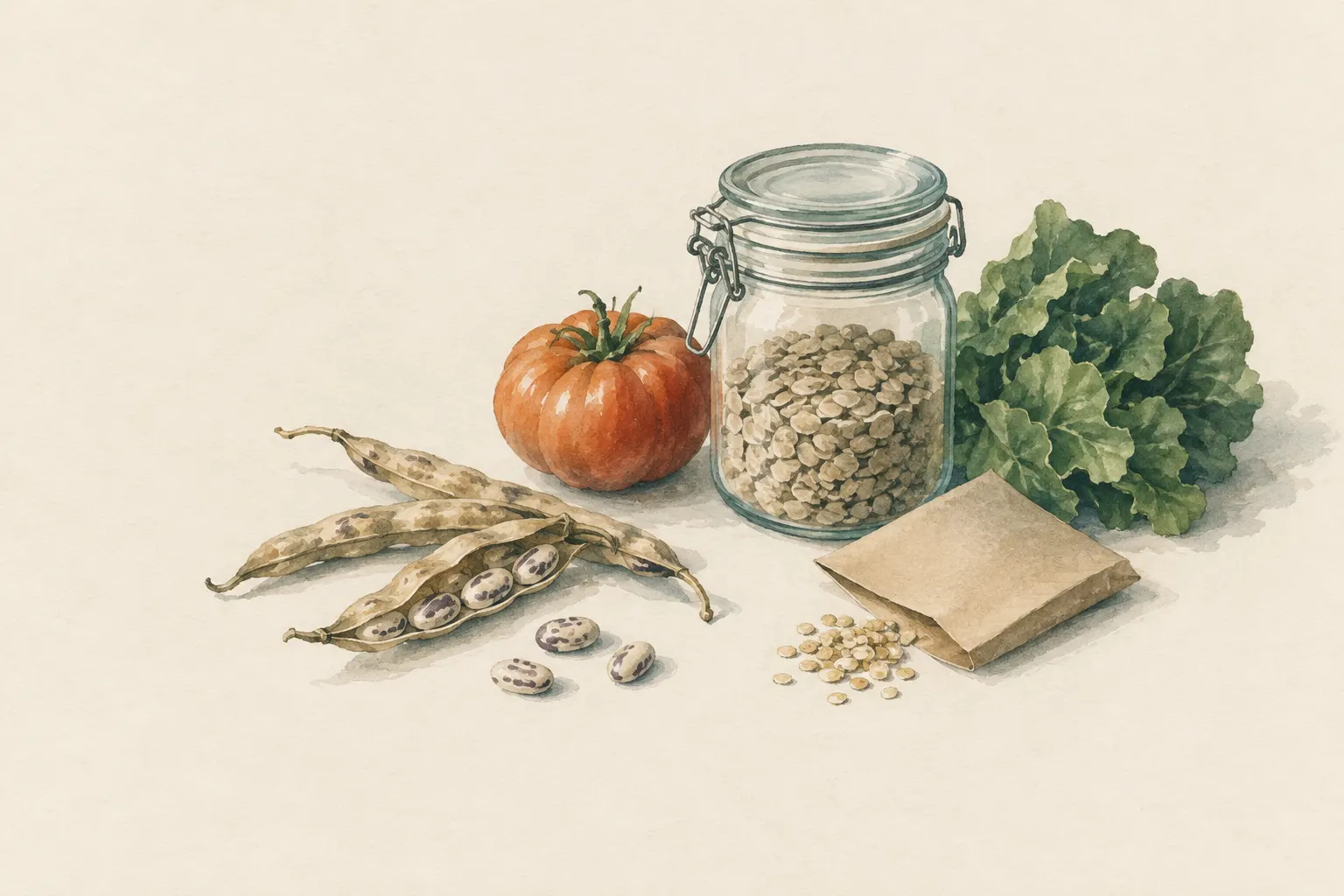
From open-pollinated varieties you can save your own seed that produces similar plants again next year. It is easiest with self-pollinating crops such as beans, peas, tomatoes and lettuce. Seed from F1 hybrids, on the other hand, gives inconsistent results. Well dried, labelled and stored cool, seed remains viable for a number of years.
- A few hours spread over the season
Explained simply
Every seed is like a little suitcase: inside is a tiny plant, some food for the journey and the blueprint for the whole future plant. If you collect seeds from your own garden, you can grow the same beans, peas, tomatoes or lettuces again next year – without having to buy new seeds.
But this only works with so-called open-pollinated varieties. With them, the children look like the parents. F1 hybrids are different: they are a cross between two different parents, and their seeds produce a mixed bag of often disappointing plants. The seed packet usually says whether it is an F1 variety.
Important: bought seeds are sometimes treated with chemicals and are often brightly coloured. You never eat such seeds, and you store them separately from food.
How it works
For a seed to form, a flower must be pollinated: pollen reaches the female part of the flower. Some plants mostly pollinate themselves – they are called self-pollinating. These include beans, peas, tomatoes and lettuce. Because the pollen usually comes from the same flower, unwanted crosses are rare, and the seeds produce plants very similar to the parent.
Cross-pollinating plants such as squash or maize, on the other hand, need pollen from other plants, often carried by insects or wind. If other varieties of the same species grow nearby, they cross easily. Getting true-to-type seed from them requires knowledge of distances and screening – that is why they are not suited for beginners.
F1 hybrids are created when breeders deliberately cross two different parent lines. The first generation is very uniform. Their offspring, however, segregate into different forms – some resemble one parent, some the other, some neither. That is why it is not worth saving seed from F1 plants.
What really matters
Choose the best plants as seed bearers: healthy, vigorous and typical of their variety. Mark them early with a ribbon so they are not harvested by mistake. Over the years, this favours traits that work well in your garden.
Seeds must be ripe. Let beans and peas dry on the plant until the pods are brown and papery and the seeds rattle inside. Harvest tomatoes fully ripe. Their seeds sit in a slippery gel; many instructions recommend leaving seeds and gel in a little water for a few days before washing them. Follow established instructions from a specialist book for this.
Then comes drying – the step where most things go wrong. Spread the seeds on paper or a plate in an airy, shady place and let them dry completely. Damp seeds go mouldy in the bag or jar. Better to wait a few days longer than to pack them too early.
Storing and testing
Seeds are alive, even while they sleep. Dryness, cool and darkness slow their metabolism and keep them viable for longer. Warmth and moisture make them age faster. So keep them in paper bags or tightly closing jars in a cool, dry and dark place.
Label every bag with the variety and the year of harvest. Without labels, next spring you will no longer know what is in which bag – or how old it is. How long seeds stay viable varies greatly from species to species; specialist books give guidance on this.
Before sowing, do a germination test: put, say, ten seeds on damp kitchen paper, keep it moist and warm and count after a few days how many have sprouted. If eight out of ten sprout, you can sow as normal. If only a few sprout, sow more densely or use fresh seed.
Safety: what to watch out for
Bought seed is sometimes dressed, meaning treated with agents against fungi or pests. Such seed is often brightly coloured, for example pink, blue or green. It is not meant to be eaten. Store it separately from food, out of reach of children, and wash your hands after sowing.
Only collect seed from wild plants if you have identified the plant with certainty – and even then not to eat it. Some seeds are poisonous, and mix-ups happen easily. This entry deliberately limits itself to familiar garden vegetables.
Passing on, swapping and selling seed may be legally regulated, and this differs from country to country – check local rules. Saving seed for your own garden is generally unproblematic.
Good to know
“Seed to Seed” by Suzanne Ashworth (Seed Savers Exchange) is considered a standard work on seed saving in the vegetable garden. For many vegetables it describes the type of pollination, isolation needs and storage. Anyone who wants to move on to cross-pollinating crops after their first successes will find the details there.
Your own seed has a special value: over the years it adapts a little to your garden, because you always choose the plants that did well for you. Many old varieties only still exist today because gardeners passed on their seeds.
In a crisis, seed can become scarce. Knowing how to save it yourself makes you more independent. But even without any crisis, seed saving is fascinating – especially for children, who get to see the whole cycle from seed to plant to new seed.
Step by step
Choose varieties and plants
Grow open-pollinated varieties and mark the healthiest, most typical plants as seed bearers.
- 1
Choose varieties and plants
Grow open-pollinated varieties and mark the healthiest, most typical plants as seed bearers.
- 2
Let them ripen
Let beans and peas dry on the plant until the pods rattle. Harvest tomatoes fully ripe.
- 3
Extract the seed
Open dry pods. Scoop out tomato seeds with their gel, leave them in a little water for a few days following established instructions, then wash.
- 4
Dry
Spread out on paper or a plate in an airy, shady place and let them dry completely.
- 5
Store
Label paper bags or jars with variety and year and store cool, dry and dark.
- 6
Germination test
Before sowing, germinate a few seeds on damp kitchen paper to estimate viability.
Common mistakes
- Saving seed from F1 hybrids
- Harvesting unripe seed
- Storing before fully dry – mould
- Storing without labels
Quick view
Materials
Labels and waterproof marker
Airtight food-grade storage container
Fill only when clean and completely dry; never use containers that previously held chemicals.
Suitable for
- Beans, peas, tomatoes, lettuce for beginners
- Preserving proven varieties
- Independence from the seed trade
Not suitable for
- F1 hybrids
- Cross-pollinating crops such as squash or maize without knowledge of isolation
- Wild plants without reliable identification
Prerequisites
- Open-pollinated (non-F1) varieties
- Healthy, vigorous parent plants
- A dry, airy place for drying
Safety
- Bought seed may be chemically treated (often coloured). Never eat such seed and store it separately from food.
- Passing on, swapping and selling seed may be legally regulated – check local rules.
How it works
Open-pollinated varieties pass on their characteristics through seed largely unchanged. F1 hybrids are crosses of two parent lines; their offspring segregate into different forms. Self-pollinating plants mostly pollinate themselves, so unwanted crosses are rare. Seed is a living organism: dryness, cool and dark extend its viability.
Advantages
- Free, locally adapted seed
- Preserving varieties
- Independence
Disadvantages
- Demanding for cross-pollinating crops
- Space needed for seed plants
Deep knowledge
Background
"Seed to Seed" by Suzanne Ashworth (Seed Savers Exchange) is a standard work on seed saving in the vegetable garden and describes pollination types, isolation needs and storage for many vegetables.
This entry is limited to simple self-pollinating crops.
Common mistakes
- Saving seed from F1 hybrids
- Harvesting unripe seed
- Storing before fully dry – mould
- Storing without labels
Limits and risks
- No isolation distances
- No figures on how long individual species stay viable
Material alternatives
Derived from material properties: a substitute must have all relevant properties. Observe the notes on the substitute.
- Airtight food-grade storage container
- Single-wall stainless steel bottle (Heat only single-wall bottles without paint/plastic; remove the lid before heating.), Double-wall insulated bottle (Never heat directly.), PET bottle (clear, max. 2 litres) (Do not heat or place in a fire.), Food-grade water container (Only use containers that never held chemicals or fuel.), Collapsible water container or bag (Protect from sharp objects.), Food-grade water bag (Use only for drinking water, never for chemicals or fuel.), Fermentation jar or crock (Use only food-grade containers of glass, food-safe glazed stoneware or food-grade plastic – no metal containers for acidic food.), Resealable food bags (Use only bags intended for food; do not use with boiling water unless the manufacturer explicitly allows it.)
Results come exclusively from structured entries. No improvised instructions are generated.
Sources
Suzanne Ashworth – Seed Savers Exchange: Seed to Seed: Seed Saving and Growing Techniques for Vegetable Gardeners
Pollination types, seed extraction and storage