Protection from mosquitoes: a net over the sleeping area
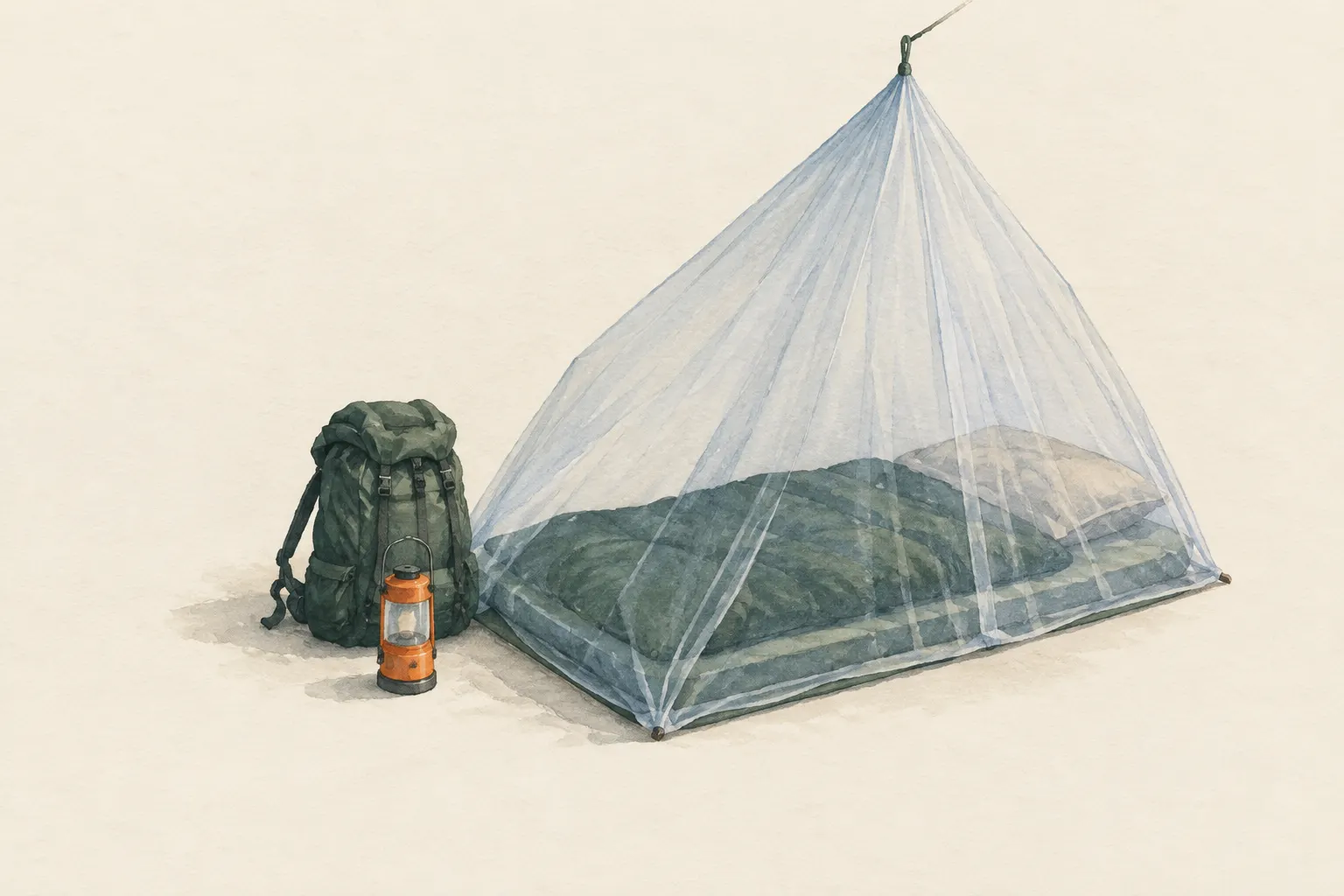
In areas with many mosquitoes or insect-borne diseases, a mosquito net over the sleeping area is important protection. It is hung from a line or a single point, tucked in without gaps under the pad or groundsheet, and must not touch the body because mosquitoes can bite through the net.
- About 5–10 minutes
Explained simply
A mosquito net is a fine net that hangs over your sleeping place like a small room made of curtain fabric. The holes are so small that air gets through but mosquitoes do not. It is like a fly screen on a window – only all around your bed.
For it to really protect you, two things must be right. First: no gaps. The edges are tucked under the pad all round, because a mosquito will find even the tiniest opening. Second: the net must not touch your skin. Mosquitoes can bite through the net if your arm or foot is resting against it.
Hang the net up before dusk, because that is when many mosquitoes become active. In some countries mosquitoes can transmit diseases. There the net is especially important – and before such a trip you get advice from a travel-medicine doctor.
How it works
The net is a simple physical barrier: the mesh openings are smaller than the insects you want to keep out. It needs no power, no scent and no poison to work. That is exactly why it is so reliable – as long as it is intact and hung correctly.
Mosquitoes find people by their breath, body heat and smells. They land on the net and search for a way in. If everything is sealed, they get no further. But if a part of the body lies directly against the net, their mouthparts reach through. That is why distance from the skin is just as important as having no gaps.
Some nets are additionally treated with an insecticide. They not only keep mosquitoes out but also act against those that land on them. In malaria areas, according to travel-medicine guides, treated nets are among the most important protective measures, always together with other protection.
What really matters
Check the net for holes before every trip, ideally against the light. You can close small tears with tape or needle and thread. One hole that you overlook makes the whole net almost useless.
Hang the net from a line, the tarp ridge or a branch so that it hangs well clear of your face. Tuck the edges under the pad or groundsheet all round, or weigh them down. Before you get in, check whether insects are already inside. Then slip in quickly and close the net at once.
Plan so the net is up before dusk. Many mosquitoes are most active at dusk and at night; anyone who sets up only in the dark often shuts some in already. During the night, make sure your arms and feet do not slide against the net.
Safety: what to watch out for
In areas with malaria, dengue or other insect-borne diseases, a net alone is not enough. Get travel-medicine advice before the trip; there you will learn which further measures make sense for your destination. If you develop a fever after a stay there, seek medical help and mention the trip. Some mosquito species also bite during the day, by the way, so protection does not end with the net.
Nets are flammable. Candles, mosquito coils, stoves and other flames have no place near them. This applies especially in huts and tents, where the net hangs close to other flammable materials.
Use insect repellents and treated nets only as the manufacturer directs. Special instructions often apply to children and during pregnancy; if in doubt, ask at a pharmacy or a doctor.
Typical situations
Under a tarp, hang the net from the ridgeline and tuck the edges under the pad. The tarp protects from rain, the net from insects – together they make a light, airy camp for warm, humid regions.
In a hammock, a net from above is not enough, because mosquitoes can bite from below through the hammock fabric. For this there are nets that enclose the whole hammock and hang from the ridgeline.
In accommodation without screens, hang the net over the bed and tuck it under the mattress. A head net over a hat helps while working in camp or walking through swarms of mosquitoes, but it does not replace the net for sleeping.
Good to know
Even where mosquitoes do not transmit diseases, a net improves sleep enormously. Anyone who is not constantly woken by buzzing at night is more rested and alert the next day and makes fewer mistakes.
A net also has drawbacks: it does not protect from rain, tears easily on branches and thorns and makes the sleeping area somewhat warmer and less airy. Handle it with care, pack it dry and check it regularly – then it will accompany you on many trips.
Step by step
Check the net
Check for holes and close small tears with tape or needle and thread.
- 1
Check the net
Check for holes and close small tears with tape or needle and thread.
- 2
Hang it
Hang it from a line, the tarp ridge or a branch so it hangs well clear of the face.
- 3
Tuck in
Tuck the edges under the pad or groundsheet all round, or weigh them down – without gaps.
- 4
Get in quickly
Check for insects inside before getting in, slip in quickly and close it at once.
- 5
Keep distance
Make sure arms and feet do not touch the net during the night.
Common mistakes
- Net touches the skin
- Edges not tucked in
- Net hung only after dusk
- Holes ignored
Quick view
Materials
Mosquito net
Flammable – keep away from flames.
Use treated nets as directed by the manufacturer.
Paracord
Hanging line
Not a climbing or safety rope.
Tarp
Rain roof over the net
Suitable for
- Tropics and humid summer regions
- Tarp and hammock camps
- Accommodation without screens
Not suitable for
- As the only protection in malaria areas – get travel-medicine advice there
Prerequisites
- An intact net without holes
- A hanging point (line, branch, tarp ridge)
Safety
- In areas with malaria, dengue or other insect-borne diseases, get travel-medicine advice before the trip. With fever after a stay there, seek medical help and mention the trip.
- Use insect repellents and treated nets only as directed by the manufacturer; take special note of the instructions for children and during pregnancy.
How it works
The net forms a physical barrier. It only protects if it has no gaps and keeps a distance from the skin. Many mosquitoes are active at dusk and at night; the net should therefore be up before dusk and stay closed.
Advantages
- Light and cheap
- Effective protection without continuous use of chemicals
- Improves sleep
Disadvantages
- No rain protection
- Tears easily on branches
- Warmer and less airy
Deep knowledge
Background
Mosquito nets, especially insecticide-treated nets, are among the most important measures against malaria in affected areas; travel-medicine guides such as the CDC Yellow Book recommend them there together with other protective measures.
Even without disease risk, a net greatly improves sleep in areas with many mosquitoes.
Variants
- For hammocks
- There are nets that enclose the whole hammock and hang from the ridgeline; otherwise mosquitoes can bite through the fabric from below.
- Head net
- A head net over a hat protects while working in camp but does not replace the net for sleeping.
Common mistakes
- Net touches the skin
- Edges not tucked in
- Net hung only after dusk
- Holes ignored
Limits and risks
- No medical advice on prophylaxis or repellents
- No figures for mesh sizes
Material alternatives
Derived from material properties: a substitute must have all relevant properties. Observe the notes on the substitute.
- Mosquito net
- Cotton cloth / T-shirt (Removes coarse particles only – no disinfection.), Sterile dressings and bandages (Open sterile packaging only immediately before use; observe the expiry date.)
- Paracord
- Rope (Never use unknown or damaged rope for life-safety purposes.)
- Tarp
- Plastic sheet / large bin bag (Tears easily; never pull over the head (suffocation risk).), Emergency blanket (Tears easily once punctured; short-term shelter only.), Document folder (waterproof) (Store securely – contains sensitive personal data.), Rain poncho (When used as a shelter, it no longer protects your body from rain.), Bivy bag (Never fully close off the face.), Tent (Do not cook or heat inside the tent (fire and carbon monoxide danger).), Heavy-duty bin bag (large) (Suffocation risk: never pull plastic bags over the head or face and keep them away from small children.), Group shelter bag (Airtight – ventilate regularly.)
Results come exclusively from structured entries. No improvised instructions are generated.
Sources
Centers for Disease Control and Prevention: CDC Yellow Book: Health Information for International Travel
Protection from insect bites while travelling, including bed nets