Hanging a hammock: straps, angle, lie
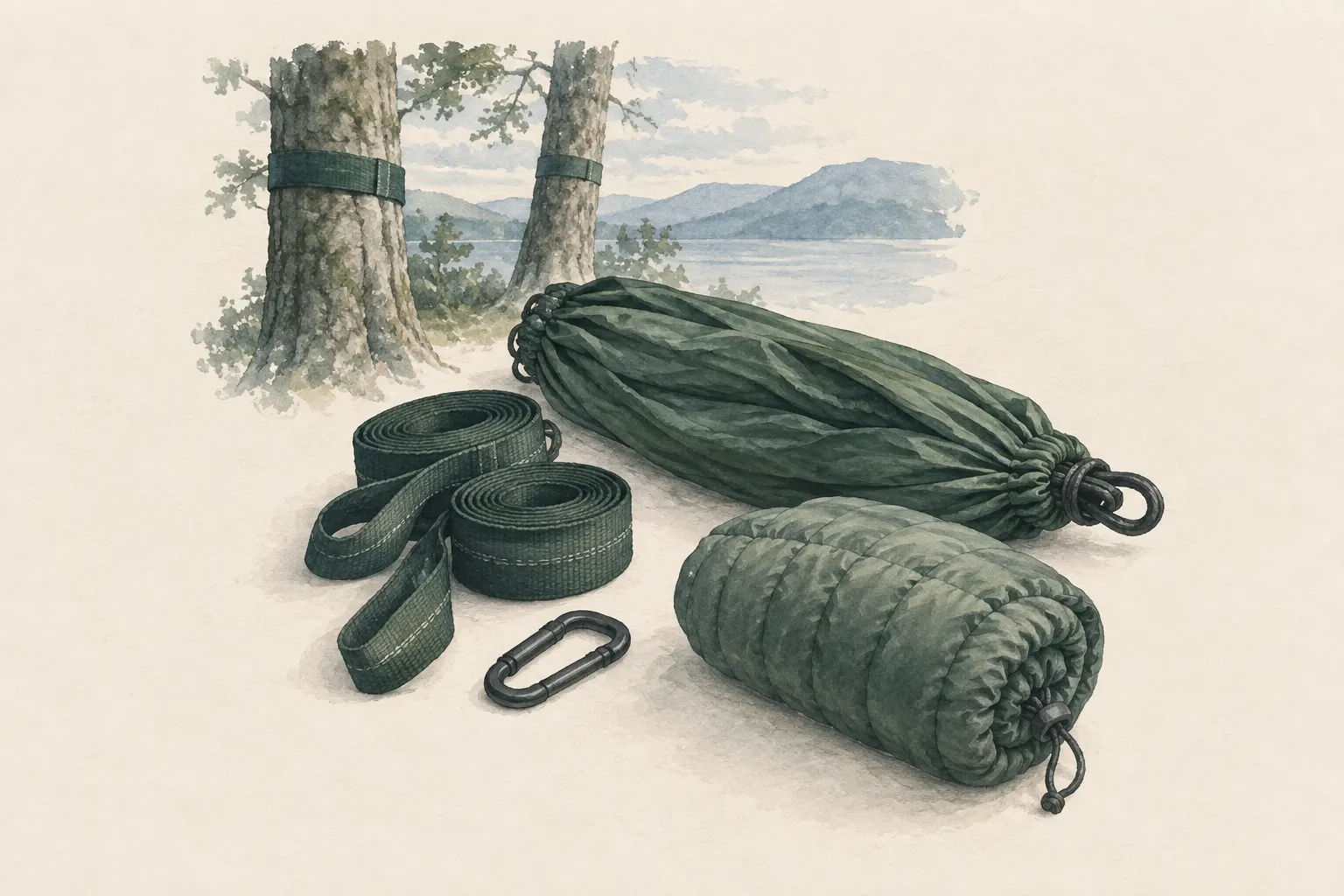
Whether a hammock is comfortable and safe depends mainly on the hang: healthy trees, wide tree straps, a sag that is not too tight, a low height above the ground and a diagonal lie. Insulation under the body is almost always needed because the hammock is cooled from below.
- About 10–15 minutes, less with practice
Explained simply
A hammock is like a bed floating between two trees. Whether you sleep well and safely in it depends almost entirely on how you hang it. It should not be tight like a washing line, but sag loosely like a smiling mouth. Then it pulls less hard on the trees and you lie more comfortably.
Do not lie exactly straight down the middle but slightly at an angle – head a little to one side, feet to the other. That makes the lying surface almost flat, so you do not hang like a banana. Hang the hammock only as high as you can comfortably sit in it, like on a chair. If you fall out, it is then only a short way to the ground.
And a secret many people only discover at night: a hammock gets cold from below. The sleeping bag underneath you gets squashed flat and hardly keeps you warm there. That is why you need a sleeping pad or a special quilt that hangs outside beneath the hammock.
How it works
The forces in a hammock depend strongly on the angle of the suspension. When you lie down, your weight pulls downwards and the straps have to carry it at an angle up to the trees. The flatter the straps run, the greater the pulling force needed to hold you. With very tight, almost horizontal lines, the force on the trees can be several times your body weight.
A rule of thumb often given is an angle of about 30 degrees from horizontal. In theory, each side then carries roughly as much as your whole body weight – a good compromise between low forces and a comfortable shape. But it is a rule of thumb, not a value you need to measure exactly: just make sure the straps run clearly downwards at an angle to the hammock.
The diagonal lie uses the width of the fabric. Lying at an angle stretches the fabric crosswise and your back lies flatter. The cold from below happens because sleeping bag fill only keeps you warm when it is fluffy and traps air. Under your weight it is squashed flat, and cool air flows past underneath.
What really matters
Everything starts with the trees. They must be alive, healthy and strong enough, and there must be no dead branches above you – these can fall without warning in wind. Young, thin trees, dead trunks and posts whose stability you do not know are unsuitable. Look up before you hang anything.
Use wide tree straps instead of thin cord. A thin line cuts into the bark under load and can injure the tree; a wide strap spreads the pressure. Straps, carabiners and hammock must only be loaded within the manufacturer's limits. Check them for wear, tears and bent parts before each use.
Before lying down, sit in carefully and load the hammock with your weight. Straps often slip a little the first time they are loaded, and the hammock sinks lower. There should be no stones, rock edges or sharp branches beneath you. Better a little too low than too high – at worst you briefly touch the ground.
Warmth from below
On warm summer nights a thin blanket is sometimes enough. But as soon as the night turns cool, many people quickly notice their back getting cold even though the sleeping bag is thick. The solution is insulation that is not squashed underneath you.
One option is a sleeping pad that you lay inside the hammock. It insulates well but can slide around at night; some hammocks have a double layer or a pocket for it. The other option is an underquilt: a filled quilt that hangs outside beneath the hammock. Because your weight does not squash it, the fill stays fluffy and warm.
Try out your system on a night close to home, for example in the garden or at a campsite. That way you find out without risk whether suspension, insulation and lie are right, and you can go indoors if necessary.
Safety and consideration
The biggest dangers are falls from height, failing material and falling branches. The same things help against all three: hang low, check the material and look up before hanging. When a storm is coming, a spot under trees is generally a poor choice.
In some parks, protected areas and campsites, hanging hammocks on trees is forbidden or restricted. Find out the local rules beforehand. Do not cut branches to make room, and take the straps down again in the morning so the tree is not harmed.
When it makes sense – and when not
Hammocks show their strengths in forest where the ground is wet, rocky, sloping or full of roots. You lie independently of the ground, have no contact with puddles and small animals and can set up quickly with practice. Many people who sleep badly on the ground find a hammock more comfortable.
Without trees it does not work, and on cold nights you need extra insulation. With a tarp against rain and an underquilt against cold, a hammock is not necessarily lighter than a small tent either. So it is not a miracle solution but one of several good options that has to suit the terrain.
Step by step
Check the trees
Choose two living, healthy trees with no dead branches above. No saplings, dead trunks or posts of unknown stability.
- 1
Check the trees
Choose two living, healthy trees with no dead branches above. No saplings, dead trunks or posts of unknown stability.
- 2
Fit the tree straps
Put wide straps around the trunks at about head height. Thin cord directly around the trunk cuts into the bark.
- 3
Set the sag
Hang the hammock with a clear sag rather than pulling it tight; the suspension should run downwards at an angle.
- 4
Check the height
Loaded, the hammock should hang at about sitting height. Test carefully with your body weight before lying down.
- 5
Insulate from below
Attach an underquilt outside or lay a sleeping pad inside the hammock.
- 6
Lie diagonally
Lie at an angle – head slightly to one side of centre, feet to the other. This gives a flatter lie.
Common mistakes
- Pulled too tight – high forces and a "banana" lie
- Hung too high
- Thin cord directly around the bark
- No insulation from below on a cool night
- Not tested before lying down
Quick view
Materials
Hammock
Attach only to healthy, sufficiently strong trees and with wide straps.
Does not insulate – cold from below.
Tree straps
Wide enough to protect the bark
Load only within the manufacturer's limits.
Check for wear before each use.
Sleeping pad
Or an underquilt as insulation from below
Tarp
As a rain roof above
Suitable for
- Forest with wet, rocky or uneven ground
- Warm to mild nights
- People who sleep badly on the ground
Not suitable for
- Treeless areas
- Cold nights without an underquilt or pad
- Areas where hammocks on trees are prohibited
Prerequisites
- Two healthy, sufficiently strong trees at a suitable distance
- Knowing the permitted load according to the manufacturer
Safety
- Hang it only high enough to sit in comfortably – a fall from height can cause serious injury. No rock edges, stones or branches directly underneath.
- Load straps, carabiners and hammock only within the manufacturer's limits and check them for wear before each use. Test with your body weight before lying down.
- Wild camping, bivouacking, hammocks on trees and collecting material are regulated very differently from region to region. Check local rules and leave the site without a trace.
How it works
A taut line creates very high forces at the anchors; a sag with a flatter suspension angle reduces them. A suspension angle of about 30 degrees from horizontal is often given as a rule of thumb. Lying diagonally makes the lying surface flatter. Because sleeping bag fill is compressed under the body, insulation must come from below.
Advantages
- Independent of the ground
- No ground contact with wet and small animals
- Quick setup with practice
Disadvantages
- Needs suitable trees
- Cold from below
- With tarp and underquilt not lighter than a small tent
Deep knowledge
Background
Hammocks have long been used for sleeping in many tropical regions; in temperate latitudes they are popular mainly in forests. Many people discover on their first cool night that a hammock gets cold from below.
Principles of camp ethics recommend protecting trees with wide straps and not cutting branches. A trial night close to home shows whether suspension and insulation work.
Variants
- With a structural ridgeline
- A fixed line between the ends of the hammock keeps the sag constant regardless of tree spacing and can carry a mosquito net or tarp.
- Suspension with rope
- Without buckles, the suspension can be tied with proven knots, e.g. a round turn and two half hitches on the strap. Rope and knots must be suitable for the load.
Common mistakes
- Pulled too tight – high forces and a "banana" lie
- Hung too high
- Thin cord directly around the bark
- No insulation from below on a cool night
- Not tested before lying down
Limits and risks
- The 30-degree angle is a rule of thumb, not a measured value
- No figures for tree diameters or breaking loads
Material alternatives
Derived from material properties: a substitute must have all relevant properties. Observe the notes on the substitute.
- Tree straps
- Rope (Never use unknown or damaged rope for life-safety purposes.), Paracord (Not a climbing or safety rope.), Thin twine (Low breaking strength – light loads only.), Accessory cord (Use only certified cord after training for life-safety purposes.), Webbing (tubular webbing) (Inspect knotted webbing before every use.), Jute or sisal twine (bought) (Low strength, absorbs water and rots – light loads and practice only.)
- Sleeping pad
- Dry leaves, grass or conifer boughs (Collect only where allowed; no protected plants. Check for ticks and insects.), Backpack, Dry spare clothing (Carry it in waterproof packaging – wet clothing barely insulates.), Wool blanket / duvet (Keep away from candles, stoves and heaters.), Insulated cool box (Keeps cold only for a limited time; without ice packs or ice it is not a fridge.), Sleeping bag (Do not store compressed long-term; do not pack away damp.), Newspaper and cardboard (Flammable – keep away from candles, stoves, heaters and embers.), Insulated cooking box (hay box, thermal cooker) (Never put open flame or embers inside – only the hot, closed pot.)
- Tarp
- Plastic sheet / large bin bag (Tears easily; never pull over the head (suffocation risk).), Emergency blanket (Tears easily once punctured; short-term shelter only.), Document folder (waterproof) (Store securely – contains sensitive personal data.), Rain poncho (When used as a shelter, it no longer protects your body from rain.), Bivy bag (Never fully close off the face.), Tent (Do not cook or heat inside the tent (fire and carbon monoxide danger).), Heavy-duty bin bag (large) (Suffocation risk: never pull plastic bags over the head or face and keep them away from small children.), Group shelter bag (Airtight – ventilate regularly.)
Results come exclusively from structured entries. No improvised instructions are generated.
Sources
Leave No Trace Center for Outdoor Ethics: The Seven Principles of Leave No Trace (Principle 5: Minimize Campfire Impacts)
Principles for low-impact camping
Wilderness & Environmental Medicine (Wilderness Medical Society) (2019): Wilderness Medical Society Clinical Practice Guidelines for the Out-of-Hospital Evaluation and Treatment of Accidental Hypothermia: 2019 Update
Wind, wet and ground contact as factors in hypothermia; calling for help at signs of hypothermia