Hammock with tarp
A hammock between two healthy trees with a tarp above keeps you off wet, uneven or crawling ground. Because cold air passes underneath, it almost always needs insulation under the body. Wide tree straps protect the bark; in some areas hammocks on trees are not permitted.
- About 15–20 minutes
Explained simply
In a hammock you float above the ground between two trees – away from wet, stones, roots and crawling creatures. Above it you pitch a tarp like a roof so that the rain does not fall on you.
But there is a surprise: cool air flows along underneath the hammock and carries your warmth away, just as wind cools you when cycling. Your sleeping bag is squashed flat underneath you and hardly keeps you warm there. So you need a sleeping pad or a special underquilt beneath you, even on nights that are not very cold.
Look up before you hang it to check for dead branches overhead, and hang the hammock only so high that your feet reach the ground when you sit in it.
How it works
The hammock separates your body from the ground. That is practical on wet, stony or uneven ground. But cold still comes from below – not through the ground, but through the air flowing past underneath you. This loss of warmth through moving air is called convection.
A sleeping bag keeps you warm because its filling holds a lot of still air. Under your body, however, the filling is compressed and the insulating air is gone. So the hammock needs insulation that is not squashed flat under you: a sleeping pad inside the hammock or a so-called underquilt, a kind of down quilt that hangs on the outside underneath the hammock.
The tarp hangs on its own ridgeline above the hammock and comes down low enough at the sides to keep off slanting rain. It can be pitched as an A-frame or as a diamond (diagonally) – what matters is that both ends of the hammock are covered.
What really matters
The trees: two healthy, living trees with no dead branches above. Use wide tree straps instead of thin cord – thin cord cuts into the bark and can injure the tree. No figures for the load capacity of trees or suspension are given here; test carefully with your weight before lying inside.
The sag: a hammock pitched too tight is uncomfortable and puts more load on trees and suspension. With a moderate sag and a diagonal lying position you lie much flatter – that is the trick many beginners do not know.
Drip lines: rainwater likes to run along the straps straight into the hammock. A short piece of cord knotted to the suspension and hanging down diverts the water first, because it follows the cord end and drips off.
Safety: what to watch out for
Look up: dead trees and hanging branches can fall in wind or under snow and ice load. In a hammock you are right underneath, and the tarp gives no protection. In a severe storm with a risk of falling branches, a hammock between trees is not a good place.
Hang the hammock only so high that you can reach the ground when sitting. Then a fall while getting in or out, or if the suspension fails, is less dangerous. Test the suspension and trees carefully before lying in it.
Without insulation under your body you can get cold even in mild temperatures. Take shivering seriously and put a sleeping pad or extra clothing underneath you. And note the rules: in some areas hanging from trees is not permitted.
When it makes sense – and when not
Hammocks have a long tradition in tropical regions because they protect against wet and ground-dwelling animals. In temperate latitudes, too, they are popular with hikers where the ground is wet, stony or sloping and there are enough trees.
In treeless terrain the hammock does not work. On cold nights without insulation underneath it quickly becomes uncomfortably or even dangerously cold. And because hammocks are becoming more popular, some protected areas now have rules to protect trees – find out beforehand.
How to practise it
First hang the hammock in a garden or park where this is permitted, and try different amounts of sag and lying positions. Notice how the diagonal position feels.
A trial night close to home in cool weather shows you how important the insulation underneath is. Pitch the tarp as well, and pour some water onto the straps to see whether your drip lines work.
Step by step
Choose trees
Choose two healthy, living trees with no dead branches above. Use wide straps instead of thin cord to protect the bark.
- 1
Choose trees
Choose two healthy, living trees with no dead branches above. Use wide straps instead of thin cord to protect the bark.
- 2
Hang the hammock
Hang with a moderate sag; hammocks pitched too tight are uncomfortable and put more load on trees and suspension.
- 3
Pitch the tarp above
Rig a ridgeline above the hammock and pitch the tarp as an A-frame or diamond so that both ends are covered.
- 4
Add drip lines
Short cords on the suspension stop rainwater running along the straps into the hammock.
- 5
Insulate underneath
Put a sleeping pad in the hammock or attach an underquilt, then the sleeping bag.
- 6
Test
Load carefully, lie diagonally (lies flatter) and check that the tarp covers enough.
Common mistakes
- Sleeping without underside insulation
- Hanging too high
- Thin cord around the trees – bark damage
- Dead trees as anchors
- No drip lines
Quick view
Materials
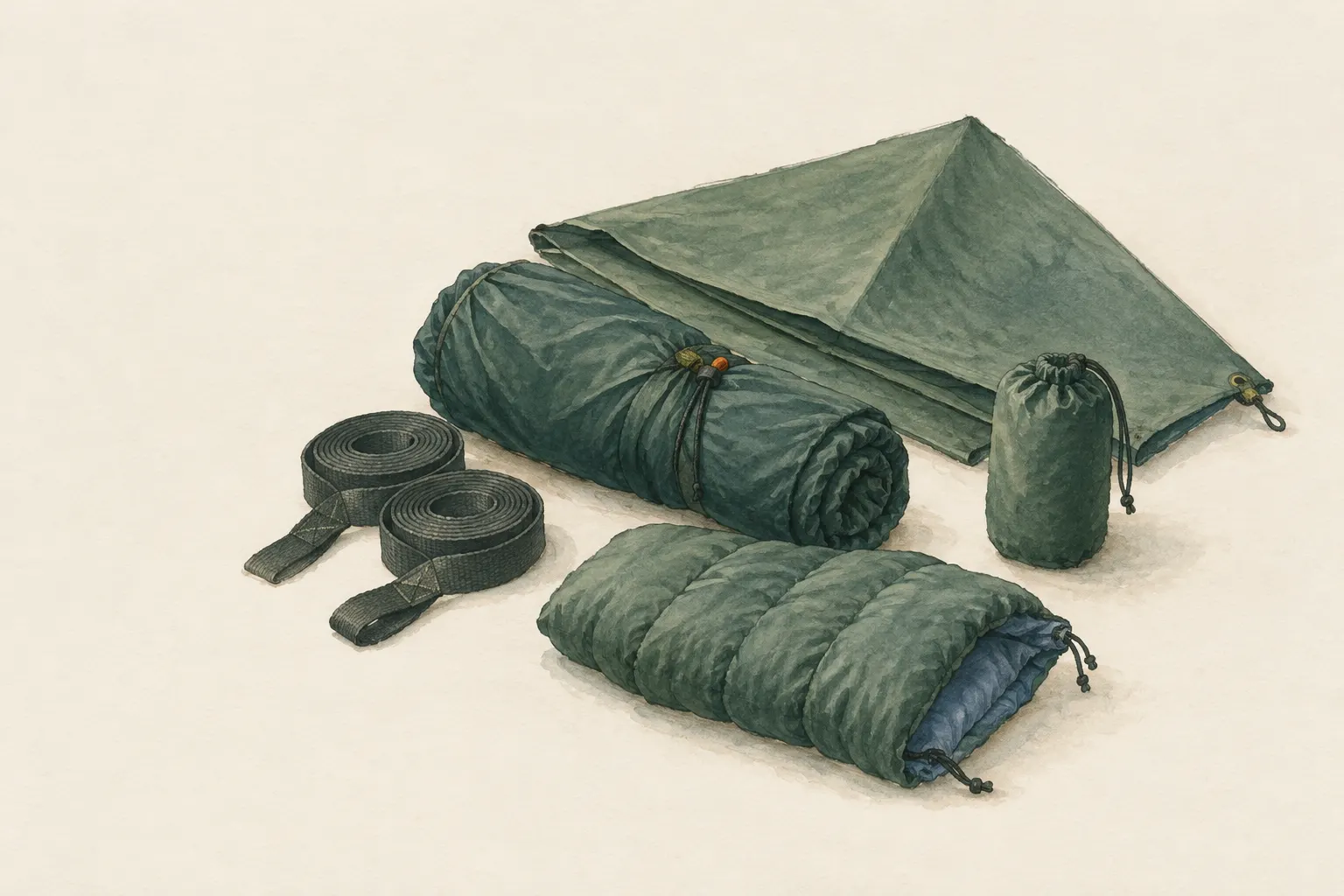
Hammock
Attach only to healthy, sufficiently strong trees and with wide straps.
Does not insulate – cold from below.
Tarp
Longer than the hammock
Paracord
Not a climbing or safety rope.
Sleeping pad
Or an underquilt against cold from below
Tent stakes
Sleeping bag
Do not store compressed long-term; do not pack away damp.
Suitable for
- Wet, rocky or uneven ground
- Forest and tropics
- Areas with many ground insects (with a net)
Not suitable for
- Treeless terrain
- Cold nights without underside insulation
- Severe storms with risk of falling branches
Prerequisites
- Two healthy, sufficiently strong trees at a suitable distance
- Local rules allow hammocks
Safety
- Hang the hammock only so high that you can reach the ground when sitting; load-test the suspension and trees before lying in it.
- A sleeping bag is compressed under the body and barely insulates there. Without a sleeping pad or underquilt you can get cold even in mild temperatures.
- Wild camping, bivouacking, collecting material and fires are regulated very differently from region to region. Check local rules, do not damage living trees and leave the site without a trace.
How it works
The hammock separates the body from the ground, but cold comes from below through air flowing past (convection). It therefore needs insulation that is not compressed under the body. The tarp is pitched over its own ridgeline and hangs low enough at the sides to keep off slanting rain.
Advantages
- Independent of ground conditions
- Less damage to the ground
- Often comfortable
Disadvantages
- Cold from below without insulation
- Needs suitable trees
- Sometimes not permitted
Deep knowledge
Background
Hammocks have long been common in tropical regions because they protect against wet and ground-dwelling animals. In temperate latitudes they are increasingly used for hiking, which has led to rules protecting trees in some protected areas.
The most common mistake is underestimating the cold from below: the hammock itself does not insulate.
Variants
- Using it as a ground bivouac
- Without suitable trees the tarp can be pitched as an A-frame and the hammock used as a liner or cover on the ground.
Common mistakes
- Sleeping without underside insulation
- Hanging too high
- Thin cord around the trees – bark damage
- Dead trees as anchors
- No drip lines
Limits and risks
- No figures for the load capacity of trees or suspension
- Legal situation varies by region
Material alternatives
Derived from material properties: a substitute must have all relevant properties. Observe the notes on the substitute.
- Tarp
- Plastic sheet / large bin bag (Tears easily; never pull over the head (suffocation risk).), Emergency blanket (Tears easily once punctured; short-term shelter only.), Document folder (waterproof) (Store securely – contains sensitive personal data.), Rain poncho (When used as a shelter, it no longer protects your body from rain.), Bivy bag (Never fully close off the face.), Tent (Do not cook or heat inside the tent (fire and carbon monoxide danger).), Heavy-duty bin bag (large) (Suffocation risk: never pull plastic bags over the head or face and keep them away from small children.), Group shelter bag (Airtight – ventilate regularly.)
- Paracord
- Rope (Never use unknown or damaged rope for life-safety purposes.)
- Sleeping pad
- Dry leaves, grass or conifer boughs (Collect only where allowed; no protected plants. Check for ticks and insects.), Backpack, Dry spare clothing (Carry it in waterproof packaging – wet clothing barely insulates.), Wool blanket / duvet (Keep away from candles, stoves and heaters.), Insulated cool box (Keeps cold only for a limited time; without ice packs or ice it is not a fridge.), Sleeping bag (Do not store compressed long-term; do not pack away damp.), Newspaper and cardboard (Flammable – keep away from candles, stoves, heaters and embers.), Insulated cooking box (hay box, thermal cooker) (Never put open flame or embers inside – only the hot, closed pot.)
- Tent stakes
- Sturdy sticks / poles (Do not cut live wood where prohibited.)
- Sleeping bag
- Sleeping pad, Dry leaves, grass or conifer boughs (Collect only where allowed; no protected plants. Check for ticks and insects.), Backpack, Dry spare clothing (Carry it in waterproof packaging – wet clothing barely insulates.), Wool blanket / duvet (Keep away from candles, stoves and heaters.), Insulated cool box (Keeps cold only for a limited time; without ice packs or ice it is not a fridge.), Newspaper and cardboard (Flammable – keep away from candles, stoves, heaters and embers.), Insulated cooking box (hay box, thermal cooker) (Never put open flame or embers inside – only the hot, closed pot.)
Results come exclusively from structured entries. No improvised instructions are generated.
Sources
Leave No Trace Center for Outdoor Ethics: The Seven Principles of Leave No Trace (Principle 5: Minimize Campfire Impacts)
Principles for low-impact camping
Wilderness & Environmental Medicine (Wilderness Medical Society) (2019): Wilderness Medical Society Clinical Practice Guidelines for the Out-of-Hospital Evaluation and Treatment of Accidental Hypothermia: 2019 Update
Wind, wet and ground contact as factors in hypothermia