Tarp as an open roof (flat fly / group fly)
A tarp is guyed out raised at all corners to form an open roof over a cooking area, seating or gear. It protects several people from rain and sun but gives hardly any wind protection. To prevent water pooling, the roof must slope or be raised in the middle.
- About 15–30 minutes
Explained simply
A tarp is a large, waterproof sheet with grommets and loops around the edge. If you stretch it up high at all its corners, it makes an open roof – like a parasol or a gazebo at a garden party. Several people can sit, cook or keep their things dry underneath.
The most important thing: the roof must not be completely flat. A horizontal sheet forms small dips in rain where water collects. The dips get deeper and heavier until the sheet tears or everything comes down. So you set one side lower than the other or raise the middle – then the water runs off like on a house roof.
An open roof keeps off rain and sun, but hardly any wind. When the wind picks up, the high sheet acts like a sail. Then you lower it or take it down. And fires or stoves never go directly underneath, because hot air rises and can melt or ignite the sheet.
How it works
A tensioned sheet only stays smooth when there is even pull on all sides. Rain falling on a horizontal surface finds no way down. It collects at the lowest point, pushes it further down, and that makes even more water run there. These water pockets can become surprisingly heavy and overload the sheet, the grommets or the supports.
A slope breaks this cycle. If one side is lower, the water runs straight off to the edge. With large sheets, a raised point in the middle also helps – a pole underneath or a line pulling up to a branch. The sheet then takes the shape of a shallow tent roof from which water runs off in all directions.
The open sides have an advantage: air can flow through and you can see all around you. That makes the flat fly an ideal living area in sun and light rain. But it also has a drawback: wind can get under the sheet from every side.
What really matters
For a flat fly you need four or more anchor points: trees at a suitable distance or poles, for example trekking poles. Each pole is guyed with two lines running outwards at an angle so it does not topple. Tensioning hitches that can be tightened again make fine adjustment much easier.
Plan the slope deliberately. The run-off should not flow onto the path, into the seating area or onto the cooking spot, but to a place where it bothers no one. At the first drops, check whether water is collecting anywhere and re-tension.
One variant is the sloping wing: two opposite corners are guyed high and two low. The sheet twists, sheds rain well and gives some wind protection on the low side.
Safety: what to watch out for
Fires and stoves must only be run at a good distance from the tarp. Hot air and sparks rise, and many sheet fabrics melt or burn from heat alone, long before a flame touches them. Always check the local rules too: fires are forbidden in many places or allowed only at fixed spots, and fire bans often apply in dry weather.
A high flat roof acts like a sail in wind. Gusts can knock over poles, tear out grommets or rip the whole sheet loose. Lower the roof or take it down in good time before anything breaks – not only once something is already flapping.
Look up before setting up: dead branches above the spot can fall in wind. In snowfall a flat roof is unsuitable, because snow does not slide off and its weight can tear the sheet.
When it makes sense – and when not
The open roof is ideal for group camps, as a cooking area at a distance from the flame, for breaks in the rain and as sun shade. A single large sheet creates a shared space where everyone can sit, eat and talk in the dry.
As a sleeping area it is only suitable in calm weather. In driving rain, which the wind blows in at an angle, you will get wet under an open roof. For the night the flat fly is therefore often combined with closed forms such as an A-frame or a lean-to, which sit lower and have a weather side.
How to practise it
Practise the setup first in good weather in the garden or on a meadow. Try out how high you can raise the corners, where best to build in the slope and how to raise the centre. A garden hose or watering can shows you whether the water runs off where you want it.
Also practise lowering it: how quickly can you get the roof down low if the wind suddenly picks up? Anyone who has tried this once without pressure acts more calmly and quickly when it matters.
Step by step
Choose a site
Sheltered from wind, without dead branches, with anchor points at a suitable distance.
- 1
Choose a site
Sheltered from wind, without dead branches, with anchor points at a suitable distance.
- 2
Raise the corners
Attach the corners to trees or to poles with two guylines each.
- 3
Build in a slope
Set one side lower than the other so rain runs off in one direction – not onto the path or into the seating area.
- 4
Raise the centre
With large tarps, raise the centre with a pole or a line pulling upwards so no water pockets form.
- 5
Tension and check
Re-tension evenly and check in rain whether water is collecting anywhere.
Common mistakes
- Roof completely horizontal
- Run-off directed into the seating area
- Too high in wind
- Cooking area directly underneath
Quick view
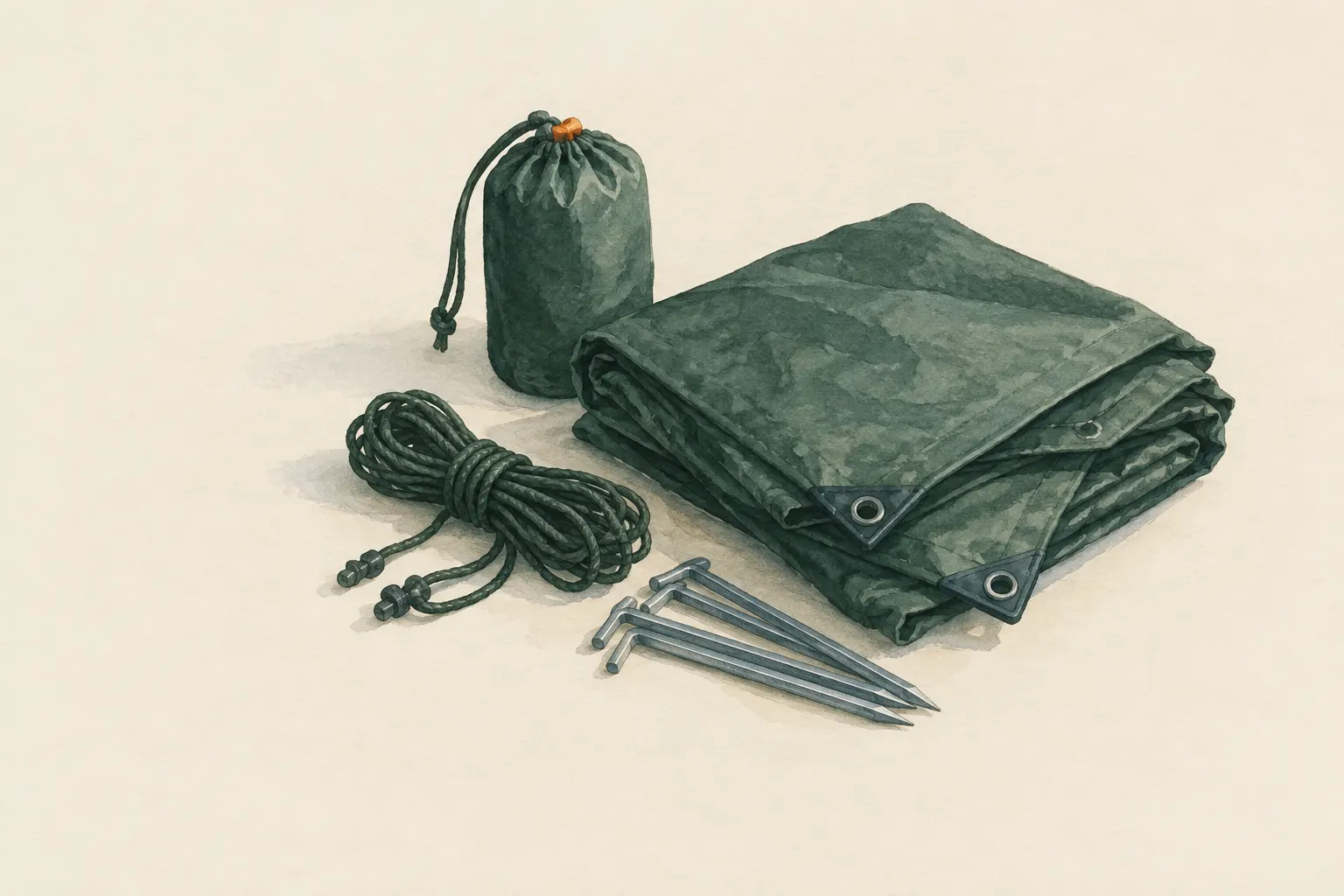
Materials
Tarp
Large tarp with many grommets
Paracord
Not a climbing or safety rope.
Trekking poles
Or poles as supports
Tent stakes
Suitable for
- Group camps, cooking area, breaks in the rain
- Sun shade
- Sheltered locations
Not suitable for
- Strong wind
- A sleeping area in driving rain
- Snowfall (snow load)
Prerequisites
- Four or more anchor points or poles
- A tensioning hitch
Safety
- A high flat roof acts like a sail. Lower or take it down when the wind picks up, before poles topple or grommets tear.
- Wild camping, bivouacking, hammocks on trees and collecting material are regulated very differently from region to region. Check local rules and leave the site without a trace.
How it works
A horizontal sheet forms sags in rain where water collects until it tears or collapses. A slope to one side or a point raised in the middle (a pole or a line pulling upwards) lets water run off. Open sides provide airflow and visibility.
Advantages
- Lots of covered space
- Good for groups and cooking (at a distance)
- Airy, good sun shade
Disadvantages
- Hardly any wind protection
- Many anchor points needed
- Water pools without a slope
Deep knowledge
Background
Open sheet roofs are common in group camps, among scouts and in bushcraft practice because a single large sheet creates a living area. Literature on camp practice treats sheets as a versatile basic element.
For the night, the open roof is usually combined with closed forms such as an A-frame or lean-to.
Variants
- Sloping wing
- Two opposite corners high and two low – a twisted surface that sheds rain well and gives some wind protection.
Common mistakes
- Roof completely horizontal
- Run-off directed into the seating area
- Too high in wind
- Cooking area directly underneath
Limits and risks
- No dimensions or wind limits
- For sleeping areas only in calm weather
Material alternatives
Derived from material properties: a substitute must have all relevant properties. Observe the notes on the substitute.
- Tarp
- Plastic sheet / large bin bag (Tears easily; never pull over the head (suffocation risk).), Emergency blanket (Tears easily once punctured; short-term shelter only.), Document folder (waterproof) (Store securely – contains sensitive personal data.), Rain poncho (When used as a shelter, it no longer protects your body from rain.), Bivy bag (Never fully close off the face.), Tent (Do not cook or heat inside the tent (fire and carbon monoxide danger).), Heavy-duty bin bag (large) (Suffocation risk: never pull plastic bags over the head or face and keep them away from small children.), Group shelter bag (Airtight – ventilate regularly.)
- Paracord
- Rope (Never use unknown or damaged rope for life-safety purposes.)
- Trekking poles
- Sturdy sticks / poles (Do not cut live wood where prohibited.), Tent pole repair sleeve (Temporary only – have broken sections replaced at home.)
- Tent stakes
- Sturdy sticks / poles (Do not cut live wood where prohibited.)
Results come exclusively from structured entries. No improvised instructions are generated.
Sources
Mors L. Kochanski – Lone Pine Publishing: Bushcraft: Outdoor Skills and Wilderness Survival
Sheet and tarp shelters, camp practice
Leave No Trace Center for Outdoor Ethics: The Seven Principles of Leave No Trace (Principle 5: Minimize Campfire Impacts)
Principles for low-impact camping