Rigging a camp ridgeline
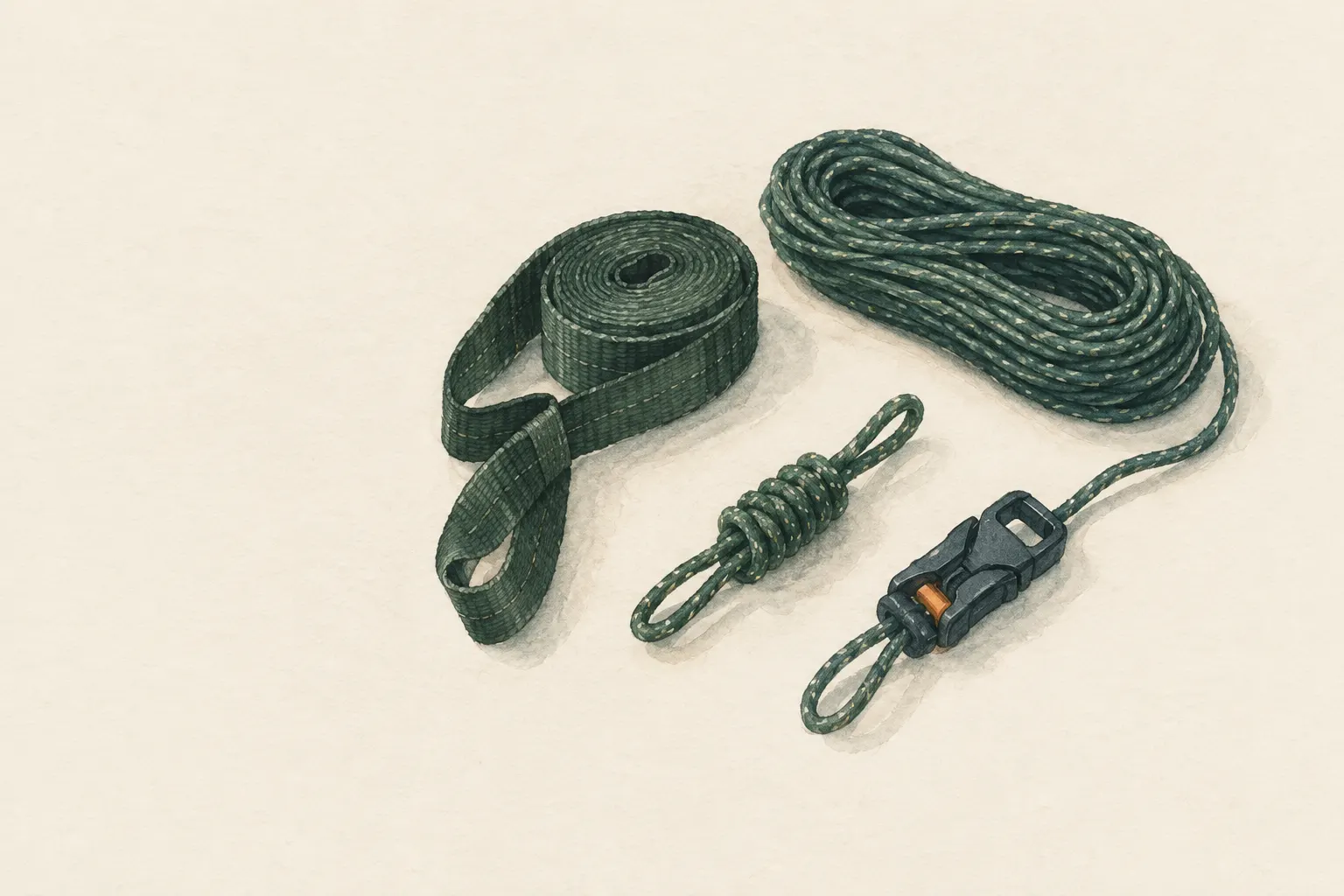
A taut line between two trees is the backbone of many camps: a ridgeline for the tarp, a drying line and a hanger for gear. It is built with tree-protecting straps, a fixed knot on one side and a tensionable, quick-release connection on the other. Friction hitches on the line act as sliding hooks.
- 10–15 minutes
Explained simply
A camp line – also called a ridgeline – is a taut cord between two trees. It is the camp's washing line and coat rack in one. You can hang a tarp over it as a roof. You can dry clothes on it and hang a lamp, bags or mugs from it so they do not lie in the dirt.
So that the trees are not harmed, you first put a wide strap around each trunk and attach the line to that. On one side goes a fixed knot, on the other a knot you can use to tension the line and release it quickly. Small loops with a friction hitch on the line work like sliding hooks.
Very important: a camp line is only for things, never for people. Nobody hangs from it, balances on it or uses it to get across a stream. And because a thin line is hard to see in the dark, you never string it across a path and you mark it with bright tape.
How it works
If something hangs from the middle of a taut line, its weight pulls the line down. The flatter the line stays, the greater the force in the line and at the trees – it can be many times the weight hanging on it. That is pure physics: a nearly horizontal line can only hold a weight up with a great deal of pull. So “as tight as possible” is not automatically good; an over-tightened line can snap under load.
The tree straps spread the force over a wide area. A thin cord directly around the trunk acts like a saw by contrast: it presses into the bark and rubs with every movement. Under the bark lies the layer through which the tree grows and transports nutrients – injuries there harm the tree.
Friction hitches such as the Prusik hold by friction. Unloaded they can be slid along the line; under load they grip firmly. That way you can hang tarp corners or a lamp exactly where you need them and move them later without re-tying anything.
What really matters
Choosing the trees comes first. You need two healthy, sturdy trees at a suitable distance, away from paths. Look up: no dead trees and no trees with dead branches above the spot, because you spend time under a line and may even sleep beneath it.
On the first side you attach the line to the strap with a fixed knot such as a bowline. On the second side you tension with a trucker's hitch or a taut-line hitch and finish with a slipped hitch – a hitch with a loop that comes undone with a pull on the loose end. Instead of a slipped hitch you can push a short wooden toggle through a loop; it pulls out easily even with cold hands.
Many cords stretch, especially when they get wet. That is why the quick-release side matters so much: after a shower or in the morning you simply re-tension. Knots that jam when wet and will not come undone cost a lot of time and patience when breaking camp. Take the breaking strength of your cord from the manufacturer's data; this entry gives no figures.
Safety: what to watch out for
A camp line is not a safety system and not a climbing rope. Never hang people from it, balance on it or cross water with it. Rope bridges and rope crossings need tested equipment, training and experience; they are deliberately not described here. The same goes for play: children do not hang from the line.
Taut lines at head or neck height are a real danger in the dark. Anyone who walks into one can fall or injure their neck. So never string lines across paths, mark them with bright tape or reflective strips and check them again as darkness falls. A tarp's guy lines are trip hazards too.
Under tension, a snapping line or a slipping carabiner can whip back. So tension in a controlled way, not with your full body weight, and keep your face out of the line of pull. Against dead branches from above, only the right choice of trees helps.
How to practise it
Practise the knots at home first, for example between two chair backs or in the garden: bowline, trucker's hitch or taut-line hitch, slipped hitch and Prusik. Once you can tie them without thinking and with gloves on, it works much better outdoors in rain and cold.
Then rig the line completely once in daylight: choose trees, fit straps, fixed side, tensioning side, Prusik hooks, tarp over it. Hang some weight in the middle and watch how much the line gives and what re-tensioning feels like. When breaking camp, take the straps and every scrap of cord with you.
Good to know
Ridgelines with friction hitches are common in bushcraft and tarp guides because they let you pitch tarps without any poles. One line then does several jobs: roof, drying place and storage system. Especially in rain it is pleasant when pack, lamp and mug hang under the tarp instead of lying in the mud.
Wet clothing hanging under the tarp only dries, however, if air moves past it. More about how drying in camp works is in the entry on drying clothes and gear. The knots themselves each have their own entries with detailed instructions.
Step by step
Choose trees
Two healthy, sturdy trees, not dead, with no dead branches overhead, away from paths.
- 1
Choose trees
Two healthy, sturdy trees, not dead, with no dead branches overhead, away from paths.
- 2
Fit tree protection
Put a length of webbing around each trunk instead of wrapping the cord directly around the bark.
- 3
Fixed end
On the first side attach the line to the strap with a bowline or a loop.
- 4
Tension
On the second side tension with a trucker's hitch or taut-line hitch and finish with a slipped hitch so it can be released quickly.
- 5
Friction hitches as hooks
Fit short loops with Prusik knots on the line; hang tarp corners, a lamp or bags on them and slide them as needed.
- 6
Mark and dismantle
Mark the line, check it at night and take all straps and scraps of cord with you when breaking camp.
Common mistakes
- Wrapping cord directly around thin bark
- Stringing it across a path
- Pulling the line so tight that it snaps under load
- Knots that cannot be undone when wet
Quick view
Materials
Accessory cord
Or paracord, long enough
Use only certified cord after training for life-safety purposes.
The diameter must suit the main rope or friction hitches will not grip.
Webbing (tubular webbing)
As tree protection
Inspect knotted webbing before every use.
UV light and abrasion age webbing; do not load damaged webbing.
Accessory carabiner (not a safety device)
Accessory carabiners are not rated for personal protection.
Suitable for
- Pitching a tarp
- Drying clothing
- Keeping camp tidy
Not suitable for
- Securing or carrying people – never
- Rope bridges or rope crossings
- Trees with dead branches overhead
Prerequisites
- Two healthy trees at a suitable distance
- Able to tie a bowline, taut-line or trucker's hitch and a Prusik
Safety
- Lines at head or neck height are a trip and injury hazard in the dark. Do not string them across paths and mark them with bright tape.
- Look up before rigging: do not use trees with dead branches or dead trees.
How it works
A taut line is heavily loaded by weight in the middle – the tighter it is, the greater the force at the trees. Wide straps spread the pressure and protect the bark. A quick-release tensioning hitch allows re-tightening when the cord stretches or gets wet.
Advantages
- Versatile and quick to rig
- Protects trees with straps
- Order and dry gear
Disadvantages
- Needs suitable trees
- Hazard from invisible lines at night
Deep knowledge
Background
Ridgelines with friction hitches are common in bushcraft and tarp guides because they let you pitch tarps without poles and re-tension them quickly.
Rope bridges and rope crossings, by contrast, belong in the hands of trained people with tested equipment and are deliberately not described here.
Variants
- Toggle release
- Instead of a slipped hitch, a short wooden toggle in a loop – easy to release with cold hands.
Common mistakes
- Wrapping cord directly around thin bark
- Stringing it across a path
- Pulling the line so tight that it snaps under load
- Knots that cannot be undone when wet
Limits and risks
- No breaking-strength figures – follow the cord manufacturer's data
- Not for people or heavy loads
Material alternatives
Derived from material properties: a substitute must have all relevant properties. Observe the notes on the substitute.
- Accessory cord
- Rope (Never use unknown or damaged rope for life-safety purposes.), Paracord (Not a climbing or safety rope.), Thin twine (Low breaking strength – light loads only.), Webbing (tubular webbing) (Inspect knotted webbing before every use.), Jute or sisal twine (bought) (Low strength, absorbs water and rots – light loads and practice only.), Tree straps (Load only within the manufacturer's limits.)
- Webbing (tubular webbing)
- Rope (Never use unknown or damaged rope for life-safety purposes.), Paracord (Not a climbing or safety rope.), Thin twine (Low breaking strength – light loads only.), Accessory cord (Use only certified cord after training for life-safety purposes.), Jute or sisal twine (bought) (Low strength, absorbs water and rots – light loads and practice only.), Tree straps (Load only within the manufacturer's limits.)
Results come exclusively from structured entries. No improvised instructions are generated.
Sources
Mors L. Kochanski – Lone Pine Publishing: Bushcraft: Outdoor Skills and Wilderness Survival
Lines and knots in camp, pitching a tarp
Clifford W. Ashley – Doubleday, Doran & Co. (1944): The Ashley Book of Knots
Tensioning and friction hitches