Drying clothes and gear in camp
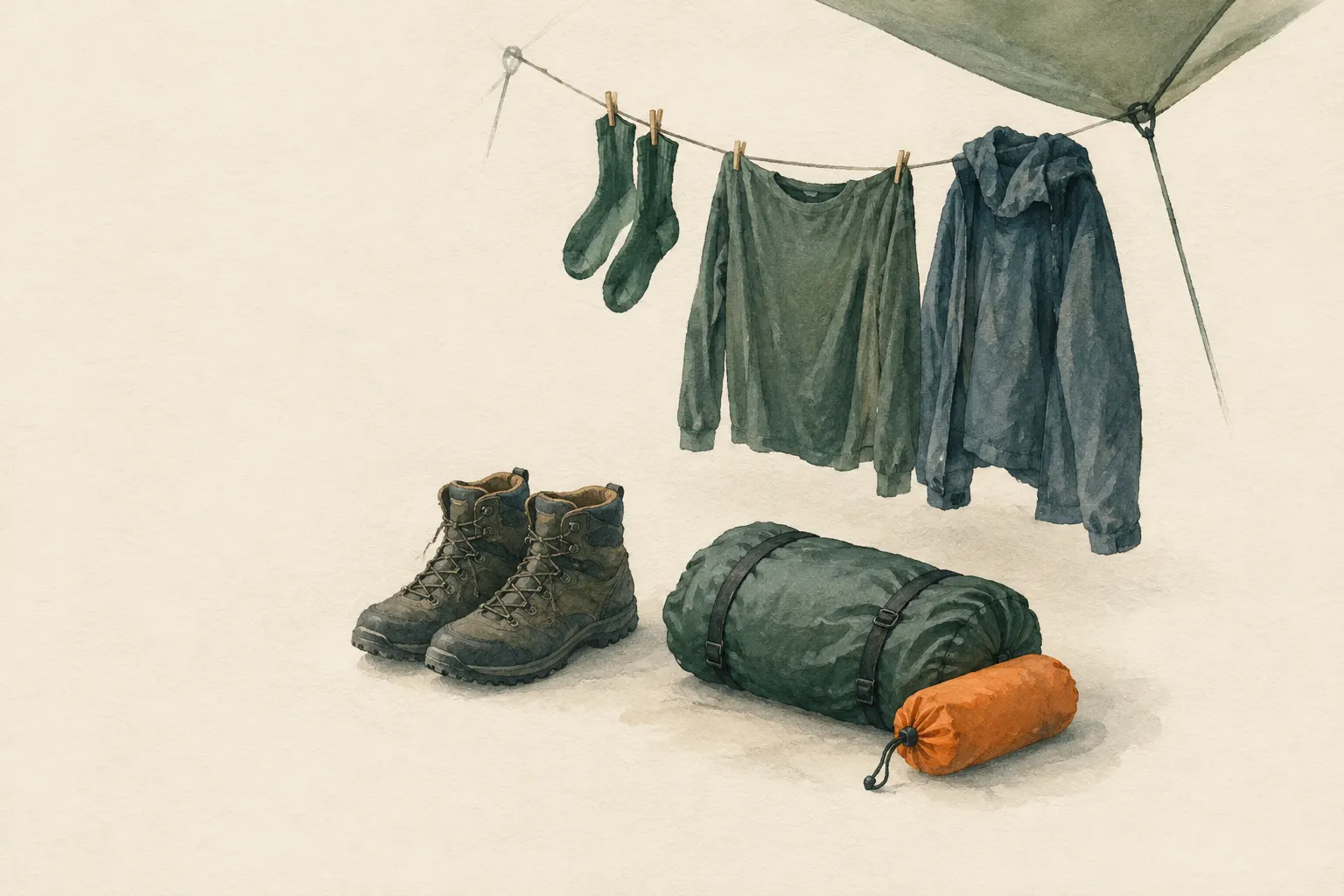
Wet clothing chills and chafes. In camp you dry things systematically: wring out, use wind and sun, string a line under the tarp, dry small items with body heat and keep boots at a distance from the fire. A dry set for sleeping always stays untouched.
- Ongoing during camp
Explained simply
Wet clothing makes you cold much faster than dry clothing. That is because water carries the warmth of your body away much better than air does. Dry clothing, on the other hand, holds tiny pockets of air, and this air keeps you warm like a blanket. That is why getting things dry again matters so much outdoors.
Drying works like this: the water first has to come out of the fabric and then evaporate into the air. First you wring things out hard. After that, wind, sun and a little warmth help. A line under the tarp is handy because the rain cannot get there but the wind can. And one complete dry set for sleeping always stays in its waterproof bag.
Very important: if you are freezing and shivering in wet clothes, put on something dry first – drying can come later. And a stove or barbecue is never lit inside a tent to dry things. It can produce an invisible, poisonous gas, and the tent can catch fire.
How it works
For water to evaporate, it needs energy in the form of warmth and air that carries the resulting water vapour away. If the air is still and already very humid, it can hardly take up any more vapour – then nothing dries. Wind constantly replaces the moist air right at the fabric with drier air, and sun supplies warmth. That is why a shirt dries quickly on a windy, sunny day but hardly at all on a foggy, still evening.
Most of the work is mechanical: every drop you squeeze out no longer has to evaporate later. Wringing hard, or rolling the item in a towel and kneeling on it, saves a great deal of drying time. Clothing hangs loose and spread out, not folded, so that air reaches as much surface as possible. Socks are turned inside out and pockets pulled out.
Wet clothing is so cold because water conducts heat much better than air and because evaporation draws extra heat from the body. The air pockets between the fibres that normally insulate are filled with water. Wool and many synthetics still keep you somewhat warm when damp, whereas cotton hardly does – which is why it is often not recommended for wet, cold trips.
What really matters
The most important rule is the dry sleeping set: underwear, socks and a hat, packed in a waterproof bag and worn only in the sleeping bag. No matter how wet the day was, this set stays untouched. If you wear it during the day, you have nothing dry left in the evening. It is your insurance for a warm night.
Use every chance: during breaks in dry weather, damp things go on the outside of the pack or over a bush. A line in the wind but under the tarp dries things a little even in light rain. You can dry slightly damp socks or gloves overnight in a thin bag inside your jacket or sleeping bag with body heat – but not dripping-wet items, or the sleeping bag gets damp and keeps you less warm.
Boots need patience. Take out the insoles, open the laces wide and stuff the boots with dry paper or cloth that you change regularly. Place them at a distance from the fire, never in the embers. In very humid climates some things do not dry for days – then it is more important to avoid getting wet than to remove the wetness later.
Safety: what to watch out for
Stoves, barbecues and heaters that burn gas, petrol, wood or charcoal have no place in a tent – not even “just briefly” for drying. They can produce carbon monoxide, a gas you can neither see nor smell and which is dangerous even in small amounts. Tent fabrics also burn quickly. Anyone who notices headache, dizziness or nausea near such devices goes into the fresh air at once and, if in doubt, calls the local emergency number (112 in the EU).
By the fire: keep a distance and stay with it. Synthetics can melt if they hang too close to the heat, and sparks burn holes in them. Leather becomes hard and cracked with too much heat, and boot soles can come unglued. A drying rack of two poles with a cross bar stands at a safe distance beside the fire, not in the direction the sparks fly.
Hypothermia often starts quietly with feeling cold and shivering; later come clumsiness, slurred speech or confusion. Take these signs seriously in yourself and others: get out of wind and wet, put on dry clothes, wrap up warmly. If someone seems confused or stops shivering although they are cold, that is an emergency – call the local emergency number (112 in the EU).
How to practise it
Try the system on a short trip or even in the garden: pack a dry sleeping set in a waterproof bag, string a line under a tarp and watch how quickly wrung-out socks dry in different weather. That gives you a feeling for what is realistic.
Get into fixed routines: arrive, take off wet things at once, put on dry ones, wring out the wet things and hang them up. Do not leave them crumpled in the pack – nothing dries there, and it starts to smell. Never string the line across a path, or someone will walk into it in the dark.
Step by step
Protect the sleeping set
One complete dry set (underwear, socks, hat) stays in its bag and is worn only in the sleeping bag.
- 1
Protect the sleeping set
One complete dry set (underwear, socks, hat) stays in its bag and is worn only in the sleeping bag.
- 2
Wring out
Wring clothing hard or roll it in a towel and kneel on it. Turn socks inside out.
- 3
String a line
String a line in the wind but under the tarp. Hang clothing loosely, not folded.
- 4
Use sun and wind
In breaks and dry weather spread gear on the outside of the pack or over bushes.
- 5
Body heat
Dry slightly damp socks or gloves overnight inside your jacket or in the sleeping bag in a thin bag – not soaking items that would wet the bag.
- 6
Boots
Remove insoles, open the laces wide, stuff with dry paper or cloth and change it regularly. Keep a distance from the fire, never in the embers.
Common mistakes
- Wearing the dry sleeping set during the day
- Putting boots right next to the fire
- Leaving wet clothes crumpled in the pack
- Stringing a line across a path
Quick view
Materials
Paracord
As a drying line
Not a climbing or safety rope.
Dry bag
For the dry sleeping set
Dry spare clothing
Carry it in waterproof packaging – wet clothing barely insulates.
Suitable for
- Multi-day trips in changeable weather
- After stream crossings or rain
- Camps with a fire
Not suitable for
- Persistent rain without cover – limit wetness instead of drying
- Drying with heaters or stoves inside a tent
Prerequisites
- A dry change of clothes in a waterproof bag
- Tarp or tent as weather protection
Safety
- Synthetics melt, leather cracks and soles can come unglued if hung too close to a fire. Never leave clothing unattended by the fire.
- If you are shivering in wet clothes, change into dry clothes first – drying can wait. Take signs of hypothermia seriously.
How it works
Evaporation needs warmth and moving air. Squeezing water out of the fabric saves most of the drying time; after that wind, sun and body heat do the work. A fire dries quickly but unevenly, and only while someone watches.
Advantages
- Less chilling and skin problems
- Gear lasts longer
Disadvantages
- Very slow in high humidity
- Drying by the fire needs constant attention
Deep knowledge
Background
Bushcraft textbooks stress how important dry clothing is for warmth and advise avoiding wetness rather than laboriously removing it later.
Why wet clothing chills so much is explained in the entry on dead air and heat conduction.
Variants
- Drying rack by the fire
- Two poles with a cross bar at a safe distance beside the fire; only under supervision and not downwind of sparks.
Common mistakes
- Wearing the dry sleeping set during the day
- Putting boots right next to the fire
- Leaving wet clothes crumpled in the pack
- Stringing a line across a path
Limits and risks
- No treatment of hypothermia – see first-aid entries
- In humid climates some things do not dry for days
Material alternatives
Derived from material properties: a substitute must have all relevant properties. Observe the notes on the substitute.
- Paracord
- Rope (Never use unknown or damaged rope for life-safety purposes.)
- Dry spare clothing
- Sleeping pad, Dry leaves, grass or conifer boughs (Collect only where allowed; no protected plants. Check for ticks and insects.), Backpack, Wool blanket / duvet (Keep away from candles, stoves and heaters.), Insulated cool box (Keeps cold only for a limited time; without ice packs or ice it is not a fridge.), Sleeping bag (Do not store compressed long-term; do not pack away damp.), Newspaper and cardboard (Flammable – keep away from candles, stoves, heaters and embers.), Insulated cooking box (hay box, thermal cooker) (Never put open flame or embers inside – only the hot, closed pot.)
Results come exclusively from structured entries. No improvised instructions are generated.
Sources
Mors L. Kochanski – Lone Pine Publishing: Bushcraft: Outdoor Skills and Wilderness Survival
Importance of dry clothing, drying in camp
Centers for Disease Control and Prevention: Carbon Monoxide Poisoning – Prevention guidance
No fuel-burning devices in enclosed spaces or tents