Satellite messengers and satellite SOS on phones
Satellite messengers send text messages, position data and – in an emergency – an SOS alert to an emergency response centre via commercial satellite networks. Unlike a PLB they usually allow two-way communication, but require a subscription. Some smartphones also offer emergency messaging via satellite in certain countries.
- Setup and a test message before the trip
Explained simply
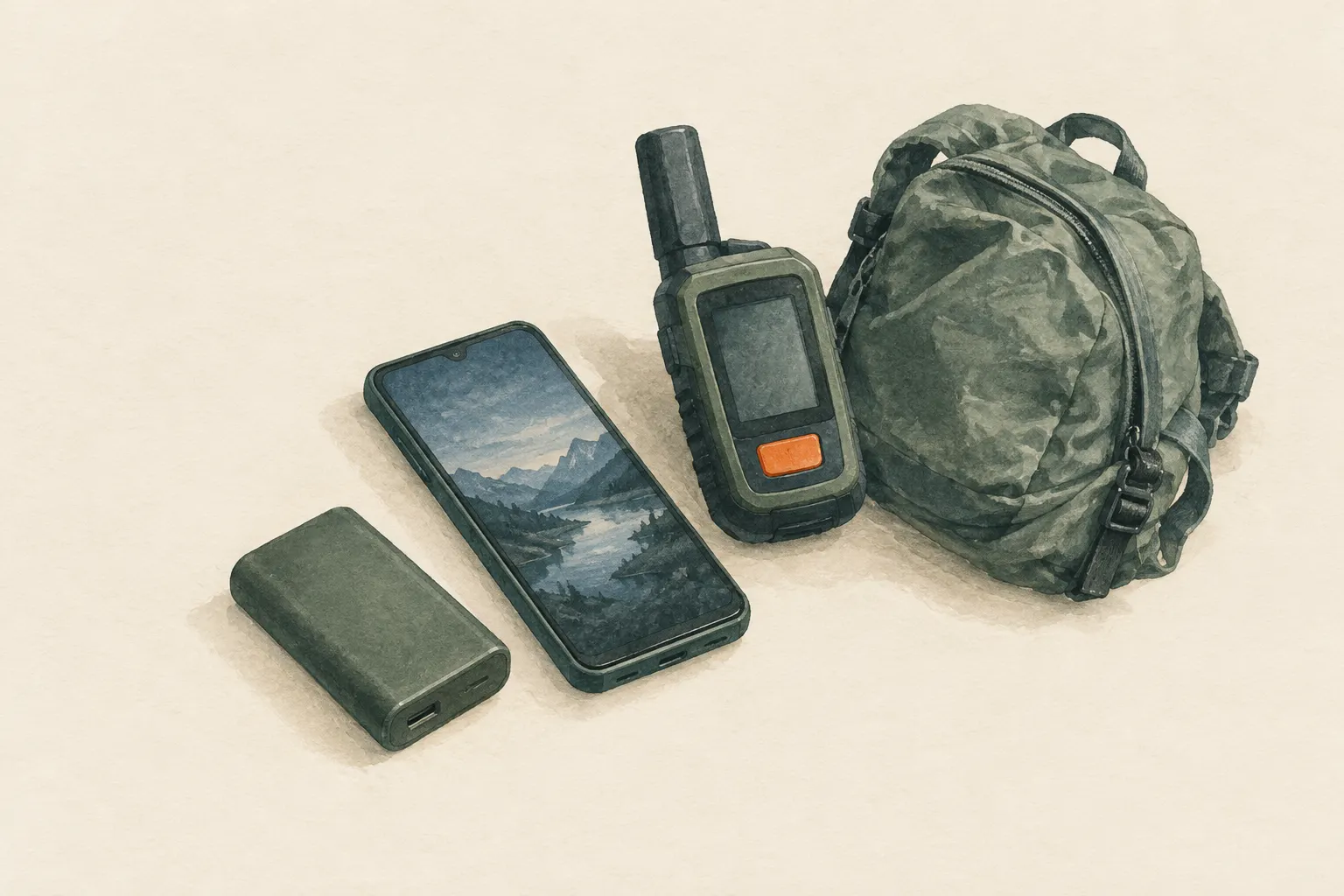
A satellite messenger is a small device you can use to write messages even when your phone has no signal. Instead of going through a phone mast, it sends the message up to satellites, which pass it back down to Earth. For emergencies it has an SOS button that alerts an emergency response centre.
The special thing: the response centre can write back to you. It will ask, for example, what happened and how many people are hurt. For that to work, the device needs a clear view of the sky – under dense trees, in a narrow gorge or indoors it often does not work. And messages sometimes take a few minutes.
A satellite messenger usually only works with a paid subscription and a charged battery. The SOS button is only meant for real emergencies. Some newer phones can also send emergency messages via satellite themselves in certain countries – but you need to check that beforehand.
How it works
The device determines its position via satellite navigation (GNSS), like a satnav. It sends messages and position data to communication satellites of a commercial network, which relay them to ground stations. From there, ordinary text messages go to your contacts and SOS alerts go to the provider's emergency response centre, which alerts the responsible rescue services in that country.
Because the satellite link carries only a little data and needs a clear view of the sky, it can take minutes for a message to get through. Dense trees, rock walls, tent roofs or your own body can weaken the signal. It is best to place the device in an open spot with as much open sky as possible.
The big difference from a PLB: a messenger usually allows two-way communication. The response centre can ask questions and you can describe details – which helps rescuers send the right help. In exchange, it depends on a subscription, a commercial network and a charged battery.
What really matters: preparation
A satellite messenger is only as good as its preparation. Activate the service in good time before the trip and check that the subscription is still running – without an active service, the SOS function may not work. Store emergency contacts and important medical notes, and create preset messages such as 'All fine, we are at camp'.
Before the trip, send a test message under open sky – explicitly not an SOS – and have its receipt confirmed. That way you know the device, service and contacts work, and you practise using it. Fully charge the battery and take a power bank if possible.
Agree with your contact person when you will check in and what they should do if messages do not arrive. A missing check-in can have many harmless causes – poor sky view, a flat battery. That is why it is important to settle beforehand how long they should wait before calling for help.
In an emergency: using SOS correctly
Trigger SOS only in genuine distress. If you have mobile signal, calling the local emergency number (112 in the EU) is usually faster and more direct. After triggering it, leave the device on, place it with a clear view of the sky and answer the response centre's questions: type of emergency, number of people, injuries, hazards.
Save battery by writing only what is necessary and switching off unneeded functions. Stay in one place if possible. Also use visual and sound signals so rescuers can find you on the spot. If SOS is triggered by mistake, cancel it as instructed and tell the response centre at once that it was a false alarm.
Satellite emergency messaging on phones and satellite phones
Some newer smartphones can send emergency messages via satellite without mobile coverage in certain countries. Availability, countries and operation vary greatly and change over time. Before travelling, check whether your phone can do it and whether the service is offered in your destination country. If there is a demo function, try it out – in a real emergency there is no time to learn how it works.
A satellite phone allows real voice calls but is more expensive and heavier. Some countries restrict importing or using one – check local rules before you take one along. For all satellite devices: they need a clear view of the sky and power.
When it makes sense – and when not
A satellite messenger is especially useful on trips in areas without reliable mobile coverage: remote mountains, deserts, waterways or sparsely populated regions. Beyond emergencies, it also helps day to day on the trip, for example to send relatives regular check-ins – which can prevent needless worry and searches.
As your only emergency device, it is only as reliable as its battery and subscription. In narrow gorges, dense forest or indoors it can fail. This entry does not assess individual devices or providers; coverage and services change. What matters is that you know your device, that it is charged and activated, and that your contact person is in the loop.
Step by step
Set up
Activate the service, store emergency contacts and medical notes, create preset messages.
- 1
Set up
Activate the service, store emergency contacts and medical notes, create preset messages.
- 2
Test
Before the trip, send a test message (not SOS) under open sky and have receipt confirmed.
- 3
Make arrangements
Agree with your contact when check-ins will arrive and what to do if they do not.
- 4
SOS in an emergency
Trigger SOS, place the device with a clear view of the sky, answer questions and conserve battery.
Common mistakes
- Subscription expired
- Never tested
- Sending under trees or in a tent and expecting instant delivery
- Contact person not briefed
- Battery flat
Quick view
Materials
Satellite messenger
Usually only works with an active subscription.
Needs a clear view of the sky.
Power bank
Do not use damaged or swollen batteries; do not charge while covered.
Suitable for
- Trips without mobile coverage
- Exchanging messages with rescuers and relatives
- Regular check-ins
Not suitable for
- Narrow gorges, dense forest, indoors (no clear sky view)
- As the only device with an uncharged battery
Prerequisites
- Active subscription or activated service
- Emergency contacts stored
- Operation practised
Safety
- Without an active subscription or with an expired service, the SOS function may not work. Check before every trip.
- Use distress signals only in genuine distress. False alarms tie up rescuers and in many countries can lead to costs or penalties. Report accidental alerts immediately.
How it works
The device determines its position by GNSS and sends data to communication satellites, which relay them to ground stations. SOS messages go to the provider's emergency response centre, which alerts the responsible rescue services. Because the satellite link is slow and needs a clear view, messages can take minutes.
Advantages
- Two-way communication
- Check-ins for relatives
- Rescuers can ask questions
Disadvantages
- Subscription required
- Battery must be charged
- Slow transmission, clear sky view needed
Deep knowledge
Background
Satellite messengers have been widespread since the 2000s. Textbooks and mountain sports bodies list them alongside PLBs as a way of calling for help from areas without coverage.
The choice between PLB and messenger depends on destination, budget and the wish to communicate. Some people carry both.
Variants
- Satellite emergency messaging on smartphones
- Some newer smartphones can send emergency messages via satellite without mobile coverage in certain countries. Availability, countries and operation differ – check beforehand and try the demo function if there is one.
- Satellite phone
- Allows voice calls but is more expensive and heavier. Some countries restrict import – check local rules.
Common mistakes
- Subscription expired
- Never tested
- Sending under trees or in a tent and expecting instant delivery
- Contact person not briefed
- Battery flat
Limits and risks
- No assessment of individual devices or providers
- Coverage and services change
Sources
The Mountaineers Books (2017): Mountaineering: The Freedom of the Hills, 9th edition
Communication devices for remote areas
International Maritime Organization (IMO) and International Civil Aviation Organization (ICAO): IAMSAR Manual (International Aeronautical and Maritime Search and Rescue Manual), Volume III – Mobile Facilities
Distress alerting and cooperation with rescue coordination centres