Personal locator beacon (PLB): how it works, registration, activation
In an emergency a PLB sends a signal to an international satellite system for search and rescue services, usually with a GNSS position. It works worldwide without a mobile network and usually without a subscription, but it is one-way: you can only raise the alarm, not communicate. Registration and correct handling are crucial.
- One-time registration; activation in seconds
Explained simply
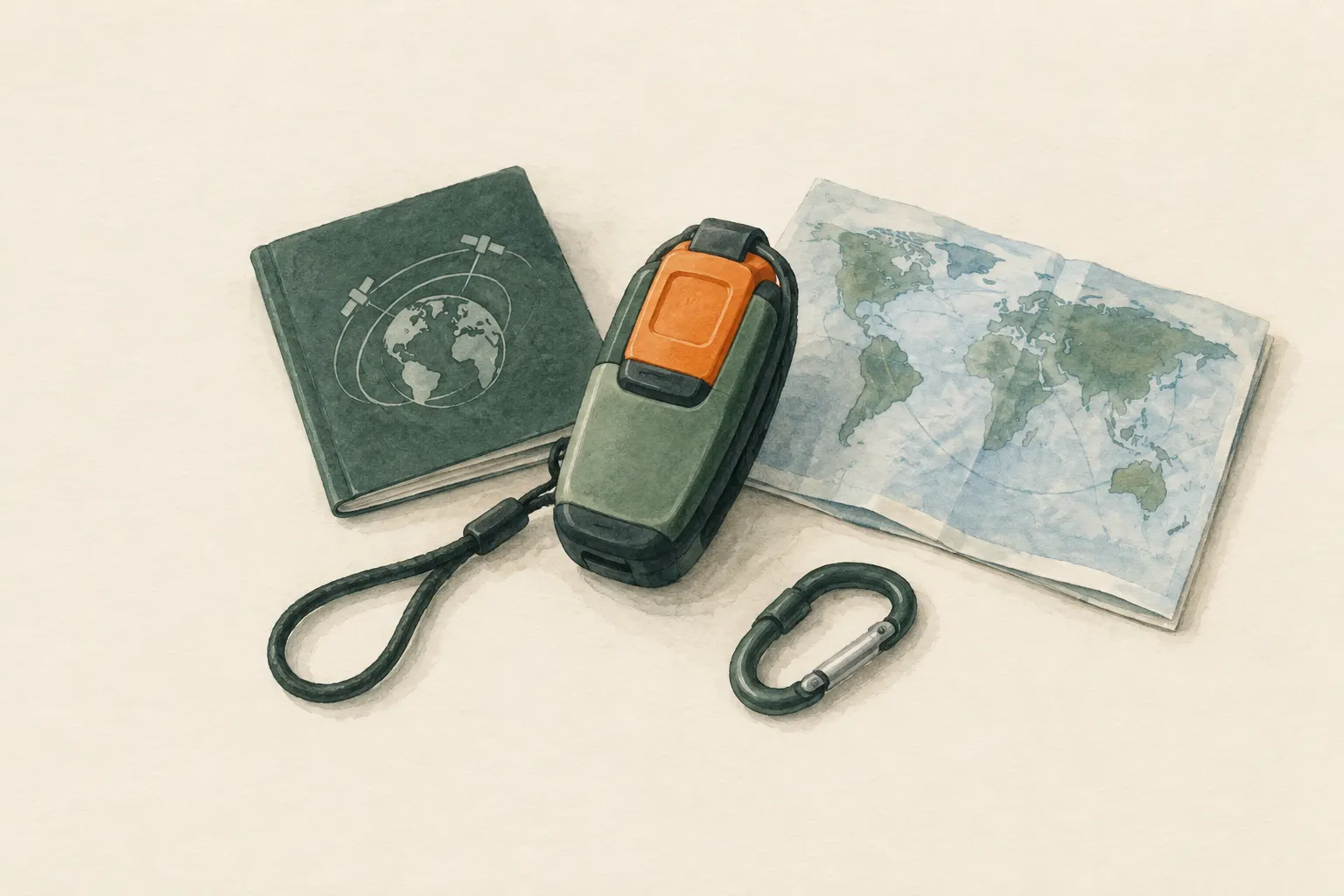
A personal locator beacon, or PLB, is a small device, about the size of a chunky phone. It has just one job: when you are in real danger to life and press the button, it calls for help – via satellites in space, without any mobile network. The satellites pass the alert on to rescue services, usually together with your position.
A PLB is like an alarm bell, not a telephone. You cannot talk to the rescuers and usually get no reply. You press the button, leave the device switched on, hold the antenna towards the open sky and stay where you are.
So that rescuers know whose beacon it is, it is registered in advance. And it is only for real emergencies – not when you are just running late. If it goes off by mistake, you switch it off and report it to the responsible authority.
How it works
The PLB transmits on an internationally designated distress frequency to satellites of the Cospas-Sarsat system. This system was set up by several states in the 1980s and is operated internationally. It receives signals from maritime, aviation and personal beacons. Ground stations pick up the signals and pass the alert to a rescue coordination centre, which then organises a search.
The signal contains a unique identifier that points to the registration data: who owns the device, whom to contact in an emergency, sometimes details of the planned trip. That lets rescuers make enquiries and rule out false alarms more easily. Most PLBs also determine their position via satellite navigation (GNSS) and send it along, which narrows the search considerably.
Many beacons also send a weaker homing signal. With it, rescue teams nearby – for example in a helicopter – can pinpoint the beacon over the last stretch. How quickly an alert arrives and how accurate the position is depends on many factors; this entry deliberately gives no figures on that.
What really matters: registration and preparation
Register the beacon with the responsible national authority and keep the contact details up to date. Without registration, rescuers do not know whom to ask and may lose valuable time. Some authorities let you store details of the planned trip. Registration requirements, responsible authorities and permitted device types differ by country – check local rules, including when travelling abroad.
Read the instructions calmly at home. Run the self-test only as the manufacturer describes – a wrong 'test' can trigger a real alert. Check the battery and expiry dates before every trip. The battery is usually not user-replaceable and must be changed by a dealer or the manufacturer.
Carry the PLB on your body, for example on a vest or shoulder strap, not in your pack. In a fall, a capsize or an avalanche the pack can be lost – and the beacon with it.
Activating it correctly in an emergency
A PLB is intended for grave and imminent danger. If you can make a call, dial the local emergency number first (112 in the EU) – on the phone you can describe what is going on. If that is not possible, deploy the antenna as instructed, activate the beacon and hold it with a clear view of the sky, or place it that way. Do not cover the antenna with your body, and if possible do not put it in a narrow rock crevice or under dense trees.
A common mistake: switching the device off because nothing seems to happen. A PLB usually gives no feedback on whether the alert has arrived. Leave it switched on until you are rescued anyway, because rescuers use the signal to locate you. Stay in one place if possible and also use visual and sound signals: whistle, mirror, lamp, coloured cloth.
Avoiding false alarms
A PLB is not for non-life-threatening problems, for example when you are running late or are no longer sure of the way but are unhurt and sheltered. Every alert sets a search in motion that ties up people and equipment. False alarms can lead to costs or penalties in many countries.
If the beacon is activated accidentally, switch it off and immediately inform the responsible rescue coordination centre or registration authority so that no search is started. That is no reason to feel ashamed – what matters is that you report it. Store the beacon so the trigger cannot be pressed by accident, for example between hard objects in a pack.
PLB or satellite messenger?
A PLB has advantages: it works worldwide without a mobile network, usually needs no subscription and is built rugged for emergencies. Its drawback: it is one-way. You can only raise the alarm, not describe what happened, and you do not find out whether help is on its way.
Satellite messengers, on the other hand, usually allow two-way messages but need a subscription and a charged battery. Which solution fits depends on destination, budget and the wish to communicate; some people carry both. On vessels, similar beacons are called EPIRBs, in aircraft ELTs. They use the same satellite system but are registered to the vessel or aircraft.
Step by step
Register
Register the beacon with the responsible national authority and keep contact details up to date. Some authorities also allow details of the planned trip.
- 1
Register
Register the beacon with the responsible national authority and keep contact details up to date. Some authorities also allow details of the planned trip.
- 2
Check before the trip
Run the self-test only as the manufacturer describes; check the battery and expiry dates.
- 3
Carry it on your body
Carry the PLB on your body (vest, shoulder strap), not in a pack that could be lost in a fall or on the water.
- 4
Activate in an emergency
Deploy the antenna, activate the device, hold or place it with a clear view of the sky. Do not cover it with your body.
- 5
Leave it on and stay put
Leave the device on until rescued, stay in one place if possible and use visual and sound signals as well.
Common mistakes
- Not registered
- Expired battery
- Device stowed in the pack
- Switching it off after activation because nothing seems to happen
- Antenna covered
Quick view
Materials
Personal locator beacon (PLB)
Register under your country's rules and keep the registration up to date.
Activate only in genuine distress; observe battery and expiry dates.
Suitable for
- Remote areas without network
- Solo travellers
- Sea, mountains, desert, polar regions
Not suitable for
- Non-life-threatening problems (e.g. running late)
- Situations where a phone emergency call is possible (call first)
Prerequisites
- Device registered under your country's rules
- Instructions read at home and self-test understood
Safety
- If activated accidentally, switch the device off and inform the relevant rescue coordination centre or registration authority so that no search is launched.
- Registration requirements, responsible authorities and permitted device types differ by country. Check local rules and, when travelling abroad, clarify whether the device may be used there.
How it works
The PLB transmits on an international distress frequency to satellites of the Cospas-Sarsat system. Ground stations pass the alert to a rescue coordination centre. A unique identifier in the signal points to the registration data – emergency contacts, vehicle, trip details – so rescuers can make enquiries and rule out false alarms. An additional homing signal helps rescue teams in the close-range search.
Advantages
- Usable worldwide, independent of mobile networks
- Usually no running costs
- Rugged and built for emergencies
Disadvantages
- No feedback or communication
- Battery limited and usually not user-replaceable
- Only for serious emergencies
Deep knowledge
Background
The Cospas-Sarsat system was set up by several states in the 1980s and is operated internationally. It receives signals from maritime, aviation and personal beacons. National bodies such as NOAA in the USA run registration databases.
In mountain sports, PLBs and satellite messengers are now often recommended when trips lead into areas without reliable mobile coverage.
Variants
- EPIRB and ELT
- On vessels similar beacons are called EPIRBs, in aircraft ELTs. They use the same satellite system and are registered to the vessel or aircraft.
Common mistakes
- Not registered
- Expired battery
- Device stowed in the pack
- Switching it off after activation because nothing seems to happen
- Antenna covered
Limits and risks
- No figures on alert times or accuracy
- No legal advice on registration requirements
Sources
International Cospas-Sarsat Programme: International Cospas-Sarsat Programme – system information (organisation website)
How the satellite system for distress beacons works
U.S. National Oceanic and Atmospheric Administration (NOAA): Search and Rescue Satellite Aided Tracking (SARSAT) – beacon information and registration
Beacon registration and handling false alerts
International Maritime Organization (IMO) and International Civil Aviation Organization (ICAO): IAMSAR Manual (International Aeronautical and Maritime Search and Rescue Manual), Volume III – Mobile Facilities
Distress alerting and search and rescue procedures