Marine VHF radio: MAYDAY distress call – basics
On the water, marine VHF radio is the standard way to call for help: channel 16 is internationally reserved for distress, urgency and safety traffic, and DSC-equipped sets send a digital distress alert at the press of a button. MAYDAY only for grave and imminent danger. Operating the radio requires a certificate and licence in many countries.
- Training for the operator certificate; distress call in one minute
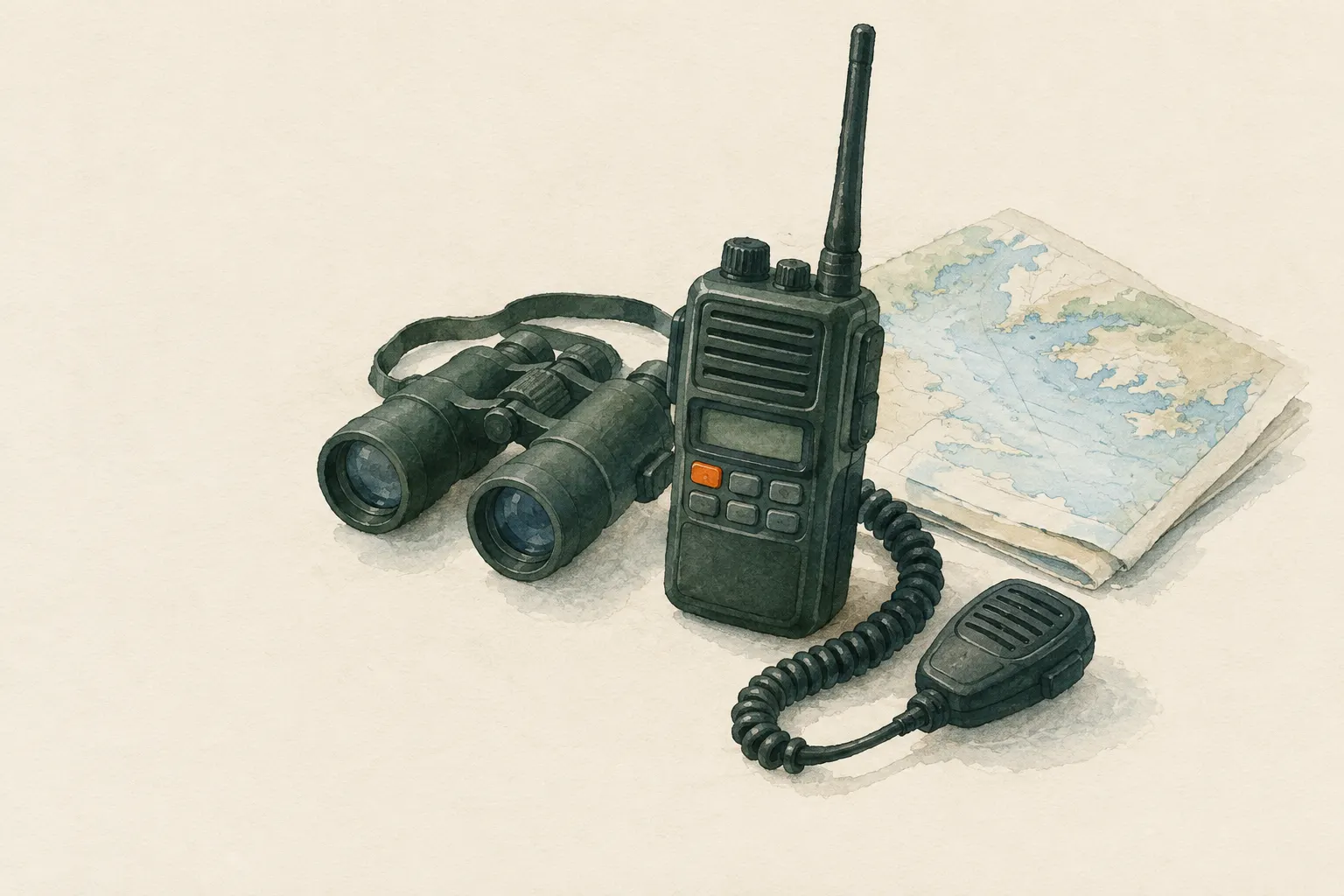
Explained simply
On the water there is often no mobile signal, and even if there is, a phone call only reaches one person. A marine radio, by contrast, transmits so that all vessels nearby and the coast stations can listen at the same time – like a loudspeaker over the whole area. There is a special channel for this, channel 16, on which you call for help in an emergency.
The distress word is 'MAYDAY'. You say it three times in a row, then the vessel's name, where you are, what has happened and how many people are on board. Many radios also have a red distress button that automatically sends a digital alert.
MAYDAY is only for serious danger to life, for example when the boat is sinking or someone has gone overboard. Calling it for fun is a punishable offence in many countries. And to use a marine radio you need training and an operator certificate in many countries.
How it works
Marine radio uses internationally agreed channels and procedures so that coast stations, rescue coordination centres and other vessels can hear and understand a distress call – whatever country they come from. Channel 16 is internationally reserved for distress, urgency and safety traffic. Many vessels and coast stations listen to it constantly. So anyone calling MAYDAY on channel 16 reaches everyone listening within radio range.
VHF radio waves travel roughly in line of sight. The higher the antenna, the further the signal reaches – which is why large ships with tall masts and coast stations on hills reach further than a handheld on a kayak. An exact range cannot be stated in general; it depends on antenna height, transmit power, terrain and weather.
DSC (Digital Selective Calling) is an additional digital function. Pressing the distress button makes the radio send an automatic alert with the vessel's identity (MMSI) and – if a GNSS receiver is connected or built in – its position. A voice distress call on channel 16 in a fixed format follows.
What really matters: the MAYDAY message
The message follows a fixed format so nothing important is forgotten: 'MAYDAY, MAYDAY, MAYDAY – this is' and the vessel's name three times, plus call sign or MMSI; then 'MAYDAY' once more and the vessel's name; then position, nature of distress, assistance required, number of persons on board, other information – and finally 'OVER'. It helps to fix this format clearly visible next to the radio.
The position is the most important part – without it nobody can come. Read it from the navigation device or describe it as a bearing and distance from a known point, such as a lighthouse. Keep the vessel's name, call sign and MMSI at hand so you do not have to search for them under stress.
A radio cannot transmit and receive at the same time. As long as you press the transmit button, you hear nothing. Release it after the message and listen. If no reply comes, repeat the message at short intervals. Then follow the coast station's instructions, keep radio traffic short and conserve the battery.
MAYDAY, PAN PAN, SÉCURITÉ – the difference
There are three levels. MAYDAY means grave and imminent danger to people or the vessel – such as sinking, fire on board, person overboard. PAN PAN announces an urgent situation without immediate danger to life, for example an engine failure while the boat is still drifting safely. SÉCURITÉ introduces a safety message, for example about floating debris or a dangerous obstruction.
Anyone who hears a distress call that goes unanswered can pass it on as a MAYDAY RELAY. That can save lives when the vessel in distress is far from the coast and only you can hear it. Choosing the right level helps rescue services send their resources where they are needed most.
Safety and rules
MAYDAY is only for grave and imminent danger. Misuse – such as a prank call or a false distress call – is a punishable offence in many countries, because it ties up rescuers and can drown out genuine distress calls. Non-urgent conversations do not belong on channel 16 either; there are other channels for them.
Operator certificates, equipment licences and channel use are regulated nationally. In many countries you need an operator certificate to use a marine radio – for recreational skippers often a short certificate after a course with an exam – and the radio itself must be licensed. Check local rules. This entry does not replace radio training. In a genuine emergency, however, anyone may generally send a distress call.
A handheld should be waterproof or carried on the body in a waterproof pouch, not loose in the boat. If you capsize, you will still have it with you. On land, a marine radio is no substitute for a phone emergency call – there, the local emergency number (112 in the EU) is the right route.
Together with other distress signals
Marine radio is the standard tool on the water, but not the only one. A distress beacon (EPIRB on vessels, PLB on the body) raises the alarm via satellite even where there is no radio contact. A phone may have signal near the coast. Light signals, orange smoke, coloured cloths and slowly raising and lowering the arms help rescuers find you on the spot.
Rescuers can take radio bearings and so locate a radio. That is why it makes sense to stay reachable after a distress call and keep the radio switched on. Many countries offer short radio courses; there you practise the procedure until it works even under stress. A handheld carried on the body is a sensible complement to phone and PLB, even on small boats and kayaks.
Step by step
DSC distress alert (if available)
Open the cover of the distress button and hold it until the alert is sent. Then stay on channel 16.
- 1
DSC distress alert (if available)
Open the cover of the distress button and hold it until the alert is sent. Then stay on channel 16.
- 2
Channel 16, high power
Set the radio to channel 16 and high power. Press the transmit button, speak calmly and clearly.
- 3
MAYDAY message
'MAYDAY, MAYDAY, MAYDAY – this is [vessel name three times, call sign/MMSI] – MAYDAY [vessel name] – position – nature of distress – assistance required – number of persons on board – other information – OVER.'
- 4
Listen and repeat
Release the button after the message and listen. If there is no reply, repeat at short intervals.
- 5
Follow instructions
Follow the coast station's instructions, keep radio traffic short and conserve battery.
Common mistakes
- Holding the transmit button while trying to listen
- Position missing or vague
- MAYDAY in a non-life-threatening situation
- No certificate and procedure unknown
- Handheld not stowed waterproof
Quick view
Materials
Marine VHF radio
Operating it requires an operator certificate and licence in many countries – check local rules.
Suitable for
- Distress at sea and emergencies on board
- Coastal and inland waters with radio watch
Not suitable for
- On land as a substitute for a phone emergency call
- Non-urgent matters on channel 16
Prerequisites
- Radio ready and listening on channel 16
- Operator certificate/licence under local rules
- Own vessel details at hand (name, call sign, MMSI)
Safety
- Operator certificates, equipment licences and channel use are regulated nationally. Check local rules; this entry does not replace radio training. In a genuine emergency, anyone may generally send a distress call.
How it works
Marine radio uses internationally agreed channels and procedures so that coast stations, rescue coordination centres and other vessels hear and understand a distress call. DSC (Digital Selective Calling) sends an automatic alert with the vessel's identity (MMSI) and – if a GNSS is connected – position. A voice distress call follows in a fixed format.
Advantages
- Reaches rescue services and nearby vessels at once
- DSC with automatic position
- Rescuers can take radio bearings
Disadvantages
- Range limited by line of sight
- Licence and training required
- Handhelds have limited power and battery
Deep knowledge
Background
Procedures for distress calls at sea are regulated internationally and described in manuals such as the IAMSAR Manual. MAYDAY by radiotelephony is among the recognised distress signals of the collision regulations.
Many countries offer short radio courses with an exam for recreational skippers. A handheld radio carried on the body is a sensible complement to phone and PLB, even on small boats and kayaks.
Variants
- PAN PAN and SÉCURITÉ
- PAN PAN announces an urgent situation without immediate danger to life (e.g. engine failure), SÉCURITÉ a safety message (e.g. floating debris).
- MAYDAY RELAY
- Anyone who hears a distress call that goes unanswered can pass it on as a MAYDAY RELAY.
Common mistakes
- Holding the transmit button while trying to listen
- Position missing or vague
- MAYDAY in a non-life-threatening situation
- No certificate and procedure unknown
- Handheld not stowed waterproof
Limits and risks
- No frequency or range details beyond channel 16
- No legal advice on licences
- Does not replace a radio course
Sources
International Maritime Organization (IMO) and International Civil Aviation Organization (ICAO): IAMSAR Manual (International Aeronautical and Maritime Search and Rescue Manual), Volume III – Mobile Facilities
Distress call procedures at sea and in aviation
International Maritime Organization (IMO) (1972): Convention on the International Regulations for Preventing Collisions at Sea, 1972 (COLREGs) – Annex IV: Distress signals
MAYDAY and DSC alerts as recognised distress signals