Light signals at night: SOS and flashing
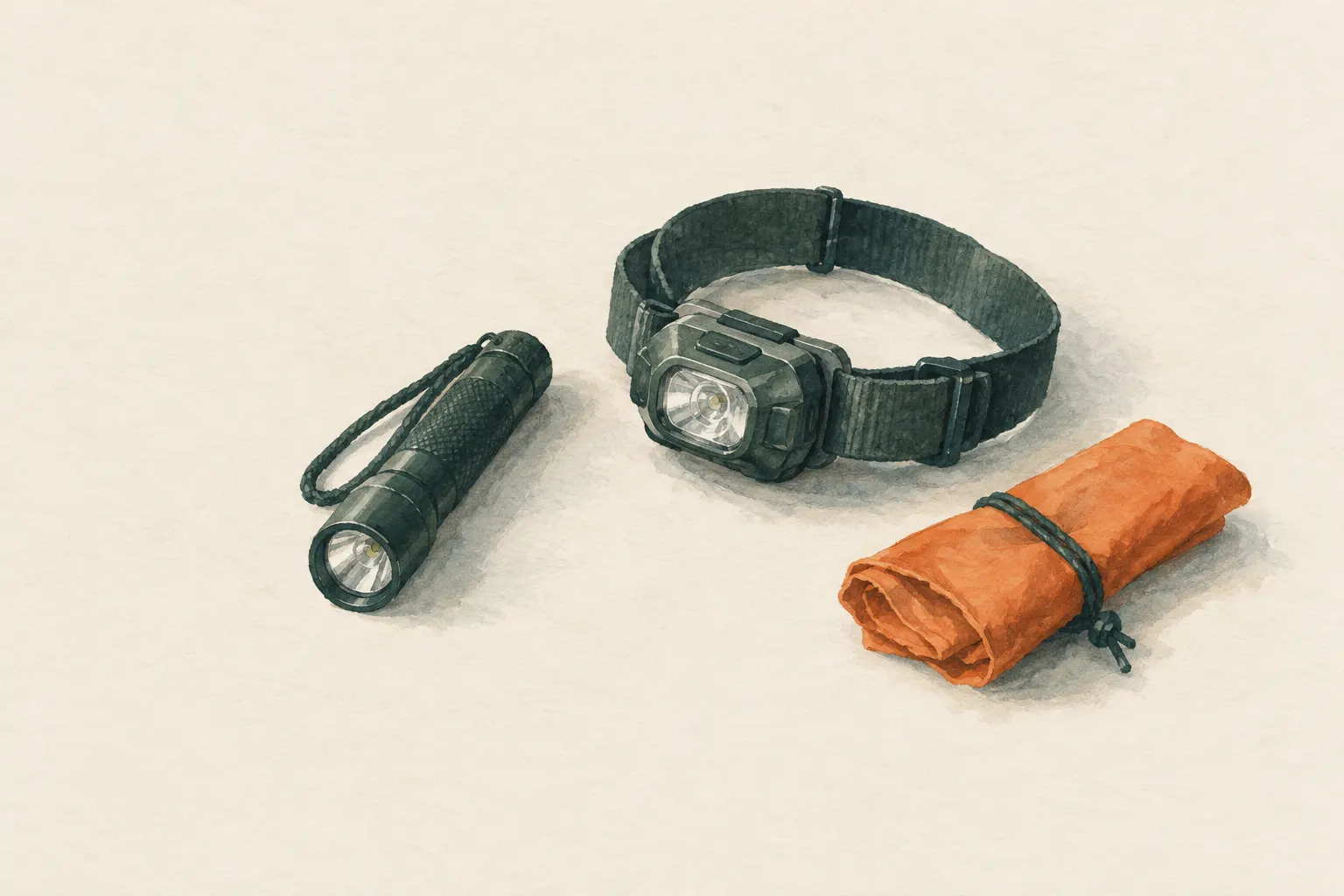
A torch or headlamp is one of the best signalling tools at night. The internationally known SOS is given as three short, three long, three short flashes (··· ––– ···) and repeated. Important: aim the light towards possible rescuers, save battery and do not dazzle aircraft crews.
- Immediate; practise the rhythm beforehand
Explained simply
At night even a small lamp can be seen from far away – just as you can see the lights of a village in the valley from a mountain. And if the lamp blinks, people notice: that is not a house or a street lamp, someone is giving a signal.
The best-known distress sign is SOS: three short, three long, three short, with no pause in between. A 'long' lasts about three times as long as a 'short'. Then you take a longer pause and start again. Many headlamps even have their own flashing or SOS button.
Two important rules: never shine your light directly into the cockpit of a helicopter or aircraft – the pilots can be dazzled. And save your battery by flashing at intervals instead of shining constantly.
How it works
In darkness the eye has little else to see, so every light source stands out. But there are many fixed lights – houses, roads, vehicles. What sets a signal apart is movement and rhythm. A light that flashes regularly or moves looks like a message.
SOS comes from Morse code, which was formerly used for radio telegraphy. Three short signals stand for S, three long ones for O. For the distress sign, the letters are given one after the other without a pause: ··· ––– ···. SOS is listed in the international rules for distress signals at sea as a light or sound signal and is known worldwide.
Not every observer can read Morse code. That does not matter: a regularly repeated pattern is still recognised as a human signal. Light signals in groups of three or the alpine distress signal (six signals per minute) are also understood. What counts is rhythm and repetition.
What really matters
Find a spot with a clear view towards where help may come from – a knoll, a clearing, a shore. Nobody can see you from a hollow or behind dense bushes. But only go there if you can do so without danger; at night the terrain is much harder to judge.
Point the lamp at possible observers – lights of vehicles, houses, boats, the direction of an engine noise – or sweep it slowly across the horizon. Many lamps have a strobe or SOS mode: it is conspicuous and saves battery. Try out before the trip how to switch it on, so you do not have to fumble in the dark.
Rationing energy is important. Signal at intervals, and especially when you hear or see something. Cold weakens batteries; keep spare batteries warm, for example in an inside pocket. If you also need the lamp for walking and working, think carefully about how much you can spare for signalling.
Safety: what to watch out for
Never shine powerful lamps directly into the cockpit of a helicopter or aircraft, and never point a laser at an aircraft. Crews often fly at night with night-vision devices that strongly amplify bright light – they can be dazzled by it. Pointing lasers at aircraft is illegal in many countries.
As soon as you have been spotted – for instance because a helicopter is flying towards you or circling overhead – stop flashing in its direction. Instead point the light at the ground or at yourself, so the crew can see your position without being dazzled, and follow their instructions.
SOS and other distress signals are only for genuine distress. Giving them for fun risks rescuers turning out for nothing and can lead to costs or penalties in some countries. And if your phone has signal, call the local emergency number first (112 in the EU).
Other light sources
Even without a headlamp there are options. A phone's torch function works, but uses battery you may need for an emergency call. Vehicle headlights or hazard lights can also be used to signal – but the vehicle battery should not run completely flat, or the engine will not start again.
A light stick swung in a circle on a cord creates a large, clearly visible ring of light. That is more conspicuous than a small, steady point of light. In fog and heavy rain, however, light signals are severely limited; then a whistle and shouting often help more.
How to practise it
Practise the SOS rhythm at home, for example with a torch against a wall or with the light switch: short-short-short, long-long-long, short-short-short, then a pause. Count in your head as you go – a short signal is about 'one', a long one about 'one-two-three'. After a few rounds the rhythm sticks.
Practise outdoors in a way that nobody could take for a real emergency – so not at night towards houses, boats or roads. Use the opportunity to check your lamp's modes too: how do you switch on strobe mode, how long does the battery last, where are the spare batteries?
Step by step
Get into a visible position
Move to a spot with a clear view towards where help may come from (knoll, clearing, shore) without putting yourself in danger.
- 1
Get into a visible position
Move to a spot with a clear view towards where help may come from (knoll, clearing, shore) without putting yourself in danger.
- 2
Send SOS
Three short flashes, three long (about three times as long), three short. Then a longer pause and repeat.
- 3
Aim the light
Point the lamp at possible observers or sweep it slowly across the horizon. A strobe mode saves battery and is conspicuous.
- 4
Ration energy
Signal at intervals and whenever you hear or see something. Keep spare batteries warm.
- 5
Switch once answered
Once you are spotted, stop flashing towards rescuers; light up your position steadily and follow instructions.
Common mistakes
- Draining the battery by constant light
- Pausing between the SOS letters
- Shining directly at a helicopter
- Signalling from a hollow where you cannot be seen
Quick view
Materials
Headlamp / flashlight
Mobile phone
Torch function as a backup
The battery drains quickly in cold and with continuous screen and GPS use.
Do not plan on it as your only means of navigation or emergency calls.
Suitable for
- At night within sight of rescuers, vehicles, vessels or aircraft
- Complementing whistle and voice
Not suitable for
- Daylight (use a mirror instead)
- When the lamp is urgently needed for walking and working and there is no spare
Prerequisites
- A working lamp with spare power
- Darkness or dusk
Safety
- Use distress signals only in genuine distress. False alarms tie up rescuers and in many countries can lead to costs or penalties. Report accidental alerts immediately.
How it works
In darkness even a weak lamp stands out, especially when it flashes: movement and rhythm distinguish a signal from fixed lights. SOS in Morse code (··· ––– ···) is sent without gaps between the letters and is internationally known as a distress sign. Signals in groups of three or the alpine distress signal are also understood.
Advantages
- Very conspicuous at night
- Light and usually carried anyway
- Internationally understood SOS
Disadvantages
- Depends on batteries
- Only within line of sight
- Severely limited in fog and rain
Deep knowledge
Background
The SOS signal comes from radio telegraphy and is listed in the international rules for distress signals at sea as a light or sound signal. Survival manuals describe torches and strobes as important night signalling tools.
Modern lamps often have their own SOS or strobe modes. It is worth trying them out before the trip.
Variants
- Vehicle headlights
- Vehicle headlights or hazard lights can also be used to signal; do not drain the vehicle battery completely.
- Swinging a light stick in a circle
- A light stick swung in a circle on a cord creates a large, conspicuous ring of light.
Common mistakes
- Draining the battery by constant light
- Pausing between the SOS letters
- Shining directly at a helicopter
- Signalling from a hollow where you cannot be seen
Limits and risks
- No range figures
- Observers' knowledge of Morse not guaranteed – rhythm and repetition matter
Material alternatives
Derived from material properties: a substitute must have all relevant properties. Observe the notes on the substitute.
- Headlamp / flashlight
- Mobile phone (The battery drains quickly in cold and with continuous screen and GPS use.), Battery lantern / LED light
- Mobile phone
- Headlamp / flashlight, Battery lantern / LED light
Results come exclusively from structured entries. No improvised instructions are generated.
Sources
International Maritime Organization (IMO) (1972): Convention on the International Regulations for Preventing Collisions at Sea, 1972 (COLREGs) – Annex IV: Distress signals
SOS by light or sound among distress signals at sea
Headquarters, Department of the Army (USA) (2002): FM 3-05.70 Survival
Light and Morse signals in survival situations