Levers, triggers and stored energy – harmless tabletop experiments
Behind many mechanisms – from a door handle to a mousetrap – lie three basic physical ideas: a lever changes forces, energy can be stored, and a small trigger can release a large amount of stored energy. Three tabletop experiments with a ruler, coins, a toy car and dominoes make this visible. The models cannot catch, hold or injure anything – and must not be adapted to do so.
- 30 minutes
Explained simply
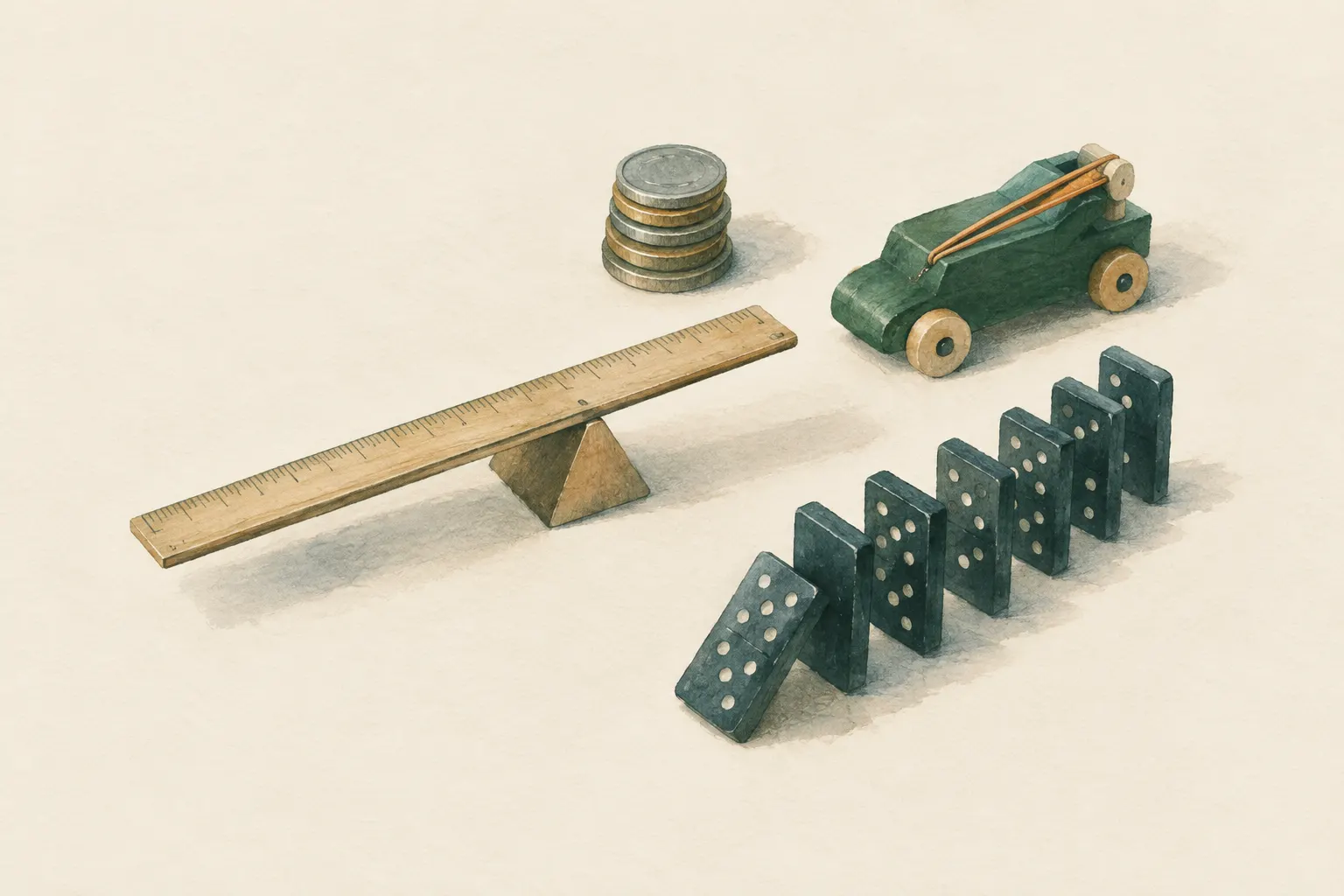
Picture a see-saw at the playground. A light child can lift a heavy child if the light one sits further out. That is a lever: a board turns around a point in the middle, and whoever pushes further away from that point needs less force. You rebuild exactly that on the table with a ruler, a pencil and a few coins.
The second idea is stored energy. A toy car at the top of a ramp is not moving yet, but it is just “waiting” to roll off. Dominoes standing upright are the same: a tiny nudge on the first one is enough, and they all fall one after another. The nudge is the trigger – small, but it releases far more energy than it had itself.
These experiments are pure physics to look at. They cannot catch or hurt anything, and that is exactly how they should stay. Never turn them into something that could hold or hit an animal or a person. And keep coins away from little brothers and sisters, because they could swallow them.
How it works
With a lever, it matters not only how hard you push but also where. Physicists call the product of force and distance from the pivot “torque”. If the torque on the left and right is equal, the ruler stays level. That is why a single coin balances two coins when it sits about twice as far from the pencil. This law of the lever is one of the oldest known laws of mechanics.
Stored energy is called “potential energy” in physics. When you carry the car up the ramp, you put work into it. That work is not lost but “parked” in the raised car. When you pull the gate card away, the potential energy turns into energy of motion. The higher the ramp, the more energy was stored and the further the car rolls – as long as it does not tip over.
A trigger works because a system is in a sensitive balance. An upright domino does stand, but even a slight tilt makes it fall. As it falls, it gives off energy that knocks over the next stone, and so on. The flick of your finger only supplies the tiny beginning; the real energy comes from all the stones you set up beforehand.
What really matters
For the lever experiment you need identical coins, all of the same value. Different coins weigh different amounts, and then the calculation no longer works. Lay the coins flat and exactly on the centimetre marks so you can read the distances. A round pencil rolls away easily – a piece of tape under the pencil holds it in place.
For the ramp, a shallow angle is better than a steep one. If the ramp is too steep, the car tips forward or bounces onto the table at the end. Repeat each run several times and take the middle value, because small differences in how you let go change the result. That way you also learn how real researchers handle measurements.
With the dominoes, spacing decides everything. If they stand too far apart, a falling stone does not reach the next one. If they stand too close, they have too little swing. Try different spacings and watch when the chain runs reliably.
Typical everyday situations
Levers are hidden in many things you use every day: a door handle is a lever that moves a latch with little force. Scissors are two levers with a shared pivot. A bottle opener, a wheelbarrow and even your forearm work on the same principle.
Stored energy and triggers are everywhere too. A click pen has a small spring that stores energy until a catch releases it. A light switch flips with a click because a spring pushes it over a tipping point. A wind-up alarm clock or a music box also uses a tensioned spring.
Precisely because stored energy can be released suddenly, machines have safety devices: covers, locks and switches that prevent unintended release. That is a good starting point for a conversation – why does a saw have a guard, and why must you not remove it?
Safety: what to watch out for
The experiments themselves are harmless. The only real risk for small children is coins and small parts that can be swallowed. So put everything away after the experiment and do not let small children play with the materials unsupervised.
The most important rule is a boundary: these models stay tabletop experiments. None of it is turned into a device that encloses, holds, strikes or drops onto something, and none of it is used outdoors or with animals. Such devices cause animal suffering, often catch the wrong animals, can injure people and are banned in many countries.
That is why this knowledge base describes traps only as history, law and animal welfare – not as building instructions. When children ask how a trap works, the honest answer is: with exactly these basic principles, and that is precisely why it is dangerous and strictly regulated.
How to practise it
Turn the three experiments into a small research series. With the lever, you can put three, four or five coins on one side and predict each time where the single coin has to sit. Guess first, then check: that turns a game into a real experiment.
For the ramp, make a table: ramp height in one column, rolling distance in the other. After a few runs you will see that a higher ramp leads to a longer roll, but not without limit – friction and tipping set boundaries. Older children can think about where the energy goes in the end: into heat and sound.
Finally, discuss together where you find the principles around the house. Collect examples on a sheet of paper: levers, springs, triggers, safety catches. Then take everything apart and put it away – that is part of the experiment.
Step by step
Experiment 1: ruler see-saw
Place a ruler centred on a round pencil. Put two coins close to the pivot on one side and one coin on the other side – and slide it outwards until the ruler is level. It will then sit about twice as far out: force times lever arm is equal.
- 1
Experiment 1: ruler see-saw
Place a ruler centred on a round pencil. Put two coins close to the pivot on one side and one coin on the other side – and slide it outwards until the ruler is level. It will then sit about twice as far out: force times lever arm is equal.
- 2
Experiment 2: ramp and gate card
Prop up a piece of cardboard with books as a slope, place a toy car at the top and hold it with a card placed across. Pull the card away: the car's potential energy becomes motion. Raise the ramp and compare how far the car rolls.
- 3
Experiment 3: domino chain
Stand dominoes in a row. A light flick of the finger on the first one releases the potential energy of all the stones. The flick is the trigger; the upright stones are the stored energy.
- 4
Discuss
Where do we meet these principles in everyday life? Door handles and scissors (levers), light switches and ballpoint pens (trigger and spring), safety mechanisms on machines designed to prevent exactly this unintended release.
- 5
Tidy up
Take everything apart and put it away. The models remain tabletop experiments.
Common mistakes
- Using unequal coins and being puzzled by the results
- Ramp too steep, car tips over
- Mistaking the experiments for a template for catching devices
Quick view
Materials
Sturdy sticks / poles
Or a round pencil as pivot
Do not cut live wood where prohibited.
Newspaper and cardboard
A piece of stiff cardboard as ramp and as a gate card
Flammable – keep away from candles, stoves, heaters and embers.
Loses almost all insulation when wet.
Suitable for
- Physics with children
- Understanding how mechanisms work
- Teaching forms of energy
Not suitable for
- Any modification meant to enclose, hold, strike or drop onto something
- Use outdoors or with animals
Prerequisites
- A table, a ruler, some identical coins, a toy car, dominoes, a pencil
- The basic idea from “Understanding levers and friction” helps
Safety
- Keep small parts such as coins away from small children (choking hazard).
How it works
Lever: a beam rotates about a pivot. It balances when force times lever arm is equal on both sides – a small force far out balances a large force close to the pivot. Stored (potential) energy: a raised object or a tensioned spring contains energy that turns into motion when released. Trigger: if a system is in a sensitive balance, a tiny nudge is enough to release far more stored energy than the nudge itself had. This amplification is what makes triggers so effective – and uncontrolled released energy so dangerous.
Advantages
- Completely harmless
- Everyday materials
- Makes abstract physics tangible
Disadvantages
- Simplified models without friction calculations
Deep knowledge
Background
The law of the lever and conservation of energy are among the foundations of classical mechanics as presented in physics textbooks. The same principles explain tools, machines and historical traps.
In this knowledge base, traps are explained only at this abstract level. Specific trigger or construction designs for devices that catch or injure animals are deliberately not described.
Variants
- With measuring
- Older children can read distances on the ruler and check the law of the lever by calculation, or record the car's rolling distance at different ramp heights in a table.
Common mistakes
- Using unequal coins and being puzzled by the results
- Ramp too steep, car tips over
- Mistaking the experiments for a template for catching devices
Limits and risks
- No trap mechanisms, no trigger designs
- Only qualitative physics
Material alternatives
Derived from material properties: a substitute must have all relevant properties. Observe the notes on the substitute.
- Newspaper and cardboard
- Sleeping pad, Dry leaves, grass or conifer boughs (Collect only where allowed; no protected plants. Check for ticks and insects.), Backpack, Dry spare clothing (Carry it in waterproof packaging – wet clothing barely insulates.), Wool blanket / duvet (Keep away from candles, stoves and heaters.), Insulated cool box (Keeps cold only for a limited time; without ice packs or ice it is not a fridge.), Sleeping bag (Do not store compressed long-term; do not pack away damp.), Insulated cooking box (hay box, thermal cooker) (Never put open flame or embers inside – only the hot, closed pot.)
Results come exclusively from structured entries. No improvised instructions are generated.
Sources
David Halliday, Robert Resnick, Jearl Walker – John Wiley & Sons: Fundamentals of Physics
Torque, law of the lever and potential energy