Travelling with children: emergency card and a plan for separation
At stations, airports, beaches or festivals children get lost easily. An emergency card with a contact number in their pocket, a current photo on the parents' phone, an agreed meeting point and a simple rule ("Stay where you are and ask a parent with children or someone in uniform/at a till") help to reunite quickly.
- 15 minutes of preparation, a short daily recap
Explained simply
Imagine a big railway station: hundreds of people walking in all directions, noise everywhere, announcements all the time. If a child looks away for a moment, Mum or Dad are suddenly gone. This happens to lots of families – and it is usually over quickly, especially if everyone has a plan beforehand.
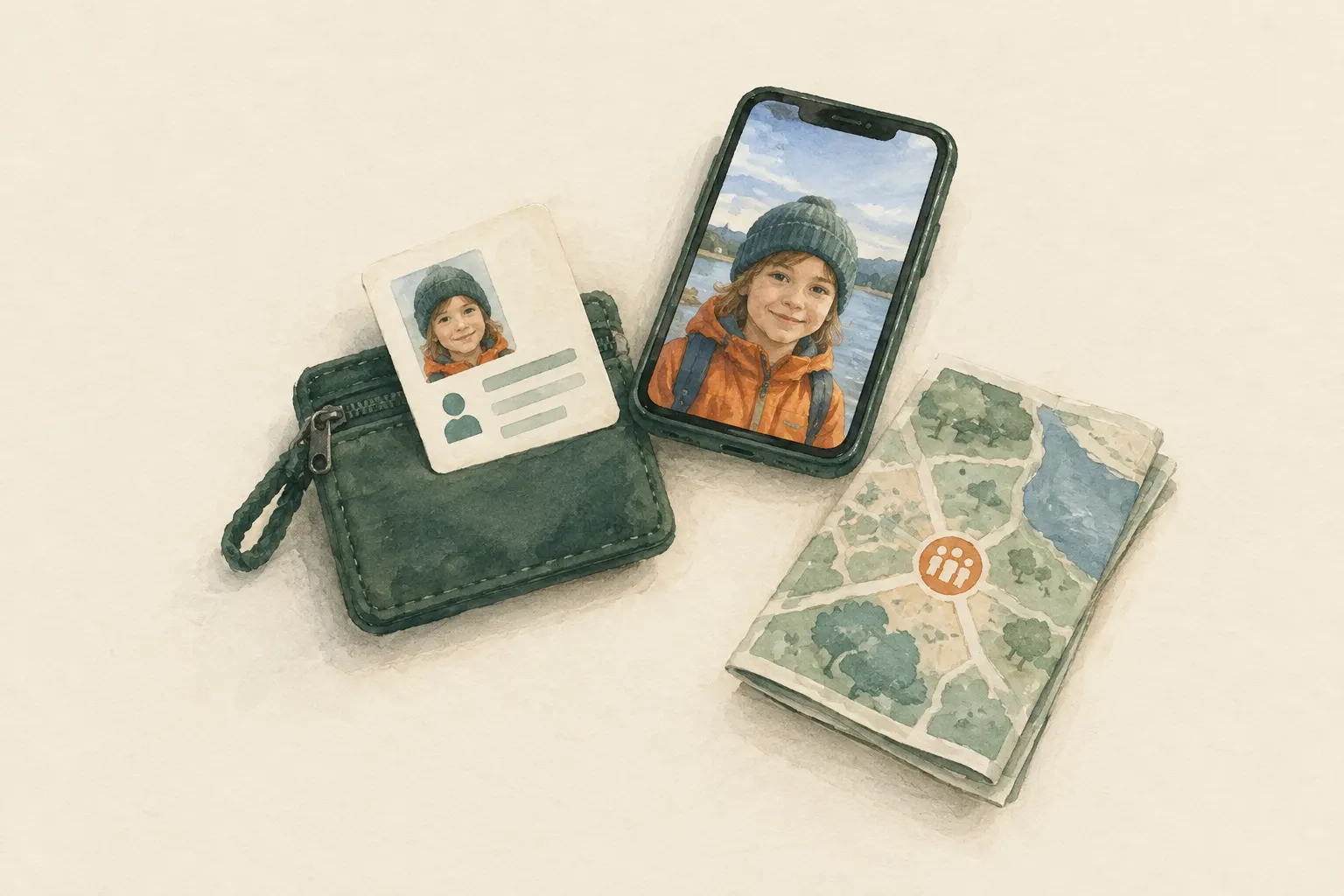
The plan has three parts, like a rope made of three strands: the child has a small card with the parents' phone number in an inside pocket. The parents have a photo of the child in today's clothes. And everyone knows the rule: if you get lost, stay where you are and ask someone who works there – for example at a till or in uniform – or a mum or dad with children.
The most important point for the adults: if you cannot find a child quickly, do not search alone for long. Tell staff, security or the police straight away and call the local emergency number (112 in the EU). Many eyes find a child faster than two.
How it works
When parents and child search for each other and both keep moving, they easily miss each other – like two people looking for each other in a supermarket, walking in circles round the same shelves. If one of them stays in a fixed place, only one has to search. That is why the basic rule for the child is: stay where you are or go to the agreed meeting point, do not wander around.
Staff and security can do things parents cannot: they know the site, often have radios, can alert the exits and make announcements. To search effectively they need a good description. Under stress many parents cannot remember exactly what their child was wearing today – a photo taken that morning answers the question in seconds.
The card in the child's pocket is the bridge back. A child may be upset, crying or have forgotten the number. If they show the card, the helper can call the parents directly. This works even if the child does not speak the local language.
What really matters
The card should carry the first name, a parent's phone number with the country code (for example +49 for Germany or +44 for the UK), important allergies or conditions and the lodging. The country code matters because a helper abroad would otherwise dial the wrong number. Make sure the number really works in the destination country and that the phone stays switched on and charged.
The card belongs in an inside pocket, not visible on the outside of a jacket or backpack. A name that everyone can read can help a stranger address the child by name and seem familiar. For small children a wristband with the number written on the inside can be practical.
The meeting point must be fixed and clearly visible: an information desk, a large sign, a particular entrance. Anything that moves or appears more than once is unsuitable, such as “by the red bus” or “by the ice-cream van”. Show the child the meeting point in person instead of only describing it, and repeat this at every new place.
How to practise it with your child
Children learn rules like these best through play and without fear. Ask at breakfast: “What do you do if you can't see us any more?” and let the child answer. Praise the right answer instead of telling scary stories. A calm tone shows the child: getting lost can happen, and we know what to do then.
Practise showing the card to someone once, for example a familiar person who plays along. Older children memorise a parent's phone number and say it out loud – including the country code. Having said it aloud a few times makes it easier to remember in an exciting situation.
The second half of the rule matters too: do not go off with anyone, but stay where help was found. Helpers can call the parents or make an announcement; the child does not need to go anywhere for that. A short recap each day is enough – long lectures are not needed.
Safety: if it happens
As soon as you notice a child is missing, split up: one adult stays at the last known place or the meeting point, the other goes straight to staff, security or the police. Show the morning photo and give age, height and anything distinctive. The earlier an organised search starts, the better.
If the child is not found quickly, call the local emergency number (112 in the EU). Searching alone for a long time wastes valuable time. If there is any sign that the child has been taken, this plan no longer applies: alert the police immediately.
When you are back together, stay calm and do not scold. The child should have the courage to look for help again next time and to tell you what happened. Later, talk together about what went well and what you want to improve in the plan.
Typical situations
At airports families easily get separated at security or around toilets and shops. On a beach, umbrellas and loungers all look the same from a distance, and a child often comes out of the water at a different spot from where they went in. At festivals and markets crowds quickly push families apart.
The same plan helps in all these situations: set and show a meeting point on arrival, take a photo, put the card in the pocket. In an evacuation, for example from a hotel or during a storm, the same principles apply, just with more time pressure. That is when it is especially valuable that the child already knows the rule.
The plan does not replace supervision. In crowds, near water and near roads small children belong within reach or holding your hand. The card and the meeting point are the safety net for the moment when something goes wrong anyway.
Step by step
Emergency card
Put a card with first name, parents' phone number (with country code), any allergies or conditions and lodging in the child's pocket.
- 1
Emergency card
Put a card with first name, parents' phone number (with country code), any allergies or conditions and lodging in the child's pocket.
- 2
Take a photo
Take a photo of the child in the day's clothes every morning.
- 3
Meeting point
When arriving somewhere new, agree and point out a clearly visible meeting point.
- 4
Practise the rule
Practise with the child: stay put, do not go off with anyone, seek help from staff, uniformed people or parents with children, show the card.
- 5
Learn the number
Older children memorise a parent's phone number.
- 6
If it happens
One adult stays at the last known place or meeting point while the other immediately informs staff or security.
Common mistakes
- Phone number only stored in the child's phone
- Name visible on clothing
- No meeting point
- Searching alone for too long
Quick view
Materials
Emergency card (contacts and health details)
Note only necessary data; for children do not display the address visibly on clothing but carry the card in a pocket.
Mobile phone
The battery drains quickly in cold and with continuous screen and GPS use.
Do not plan on it as your only means of navigation or emergency calls.
Suitable for
- Travel with children
- Large events
- Evacuations
Not suitable for
- A substitute for supervision
Prerequisites
- An age-appropriate agreement with the child
Safety
- Do not write the name and address visibly on clothing or backpack; carry the card in an inside pocket.
How it works
Children who stay where they are are found more easily. A reachable phone number and a current photo speed up searches by staff and police considerably.
Advantages
- Simple and cheap
- Gives children confidence
Disadvantages
- Must be kept current daily
Deep knowledge
Background
Ready.gov recommends meeting places, contact lists and contact cards, including for children, as part of family planning. The same principles apply when travelling.
Which bodies are responsible locally (security, police, public address) differs by place.
Variants
- Wristband
- For small children a wristband with the phone number on the inside can be practical.
Common mistakes
- Phone number only stored in the child's phone
- Name visible on clothing
- No meeting point
- Searching alone for too long
Limits and risks
- No procedure for abduction cases – call the police immediately
Material alternatives
Derived from material properties: a substitute must have all relevant properties. Observe the notes on the substitute.
- Mobile phone
- Headlamp / flashlight, Battery lantern / LED light
Results come exclusively from structured entries. No improvised instructions are generated.
Sources
Ready.gov – U.S. Federal Emergency Management Agency (FEMA): Make A Plan
Meeting places, contact lists and contact cards for family members
European Commission: 112 – the European emergency number
European emergency number 112