Preventing theft and scams while travelling – relaxed, not paranoid
Most crimes against travellers are pickpocketing and tricks, not violence. A few habits are enough: split money and cards, carry valuables close and discreetly, put a hand on your bag during distractions (crowds, "help", spilled drinks), politely decline unsolicited offers. If robbed: hand over valuables, do not resist.
- Set up once, then habit
Explained simply
Most problems travellers have with crime are not robberies but small tricks: someone slips your phone out of your pocket unnoticed or distracts you while someone else grabs. That is annoying, but a few simple habits protect you well – without having to distrust everyone.
Thieves look for easy opportunities, just as water always finds the easiest way down. If your valuables are at the front of your body and well closed, you do not keep everything in one bag, and you pause briefly when things suddenly get crowded or hectic, you are not an easy target. And if something is lost anyway, not everything is gone at once.
The most important point: if someone threatens or robs you, hand things over and do not resist. Money, phone and bag can be replaced, you cannot. Afterwards, go somewhere safe and call the police or the local emergency number (112 in the EU).
How it works
Pickpocketing and confidence tricks almost always use two tools: distraction and time pressure. A bump in a crowd, a question about directions, a supposed stain on your jacket, a petition held under your nose or a “helper” at the ticket machine – while your attention is there, someone grabs.
Scams often add pressure: an offer valid “only now”, a taxi without an agreed price, a surprisingly friendly stranger who wants to take you to a particular shop. Stopping briefly and taking your time breaks this pattern without being rude.
Splitting is the second principle. If daily money, reserve money, a second card and your ID are in different places, a thief can never take everything at once. A loss then remains annoying but does not end the trip.
What really matters
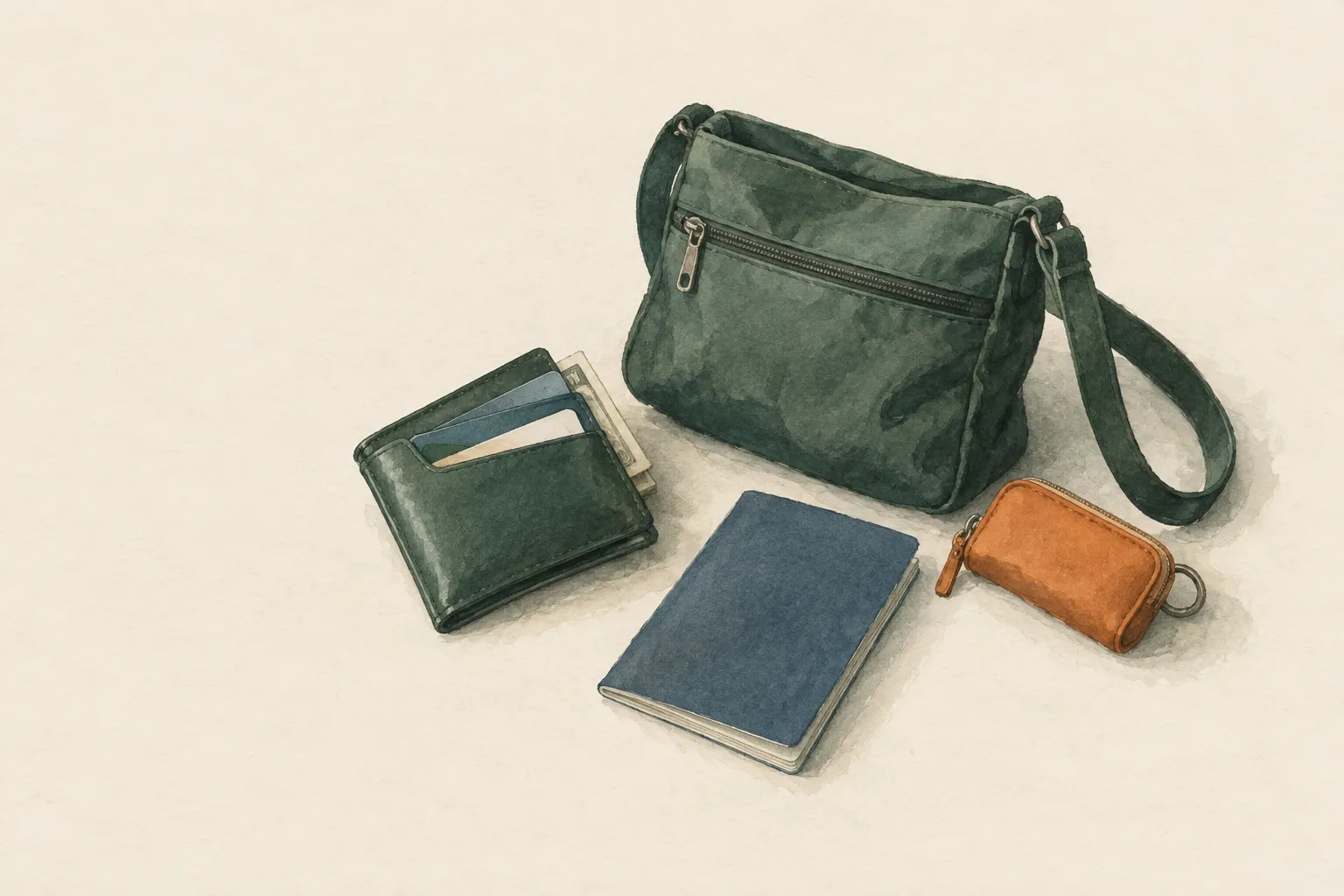
Split: daily money at hand, reserve and second card separately, for example at your lodging or in an inside pocket. Leave the passport in the safe and carry a copy where that is locally permitted – in some countries you must carry the original. Note the blocking numbers for cards and phone beforehand, separately from the cards.
Carry: bags in front or at the side, with the opening towards your body. The phone does not belong in a back pocket or on a street-side café table. At tables, secure your bag to your leg or the chair instead of hanging it over the backrest. At the beach, valuables are not left unattended.
Check offers: book taxis and tours via official stands or your lodging and agree prices in advance. Under pressure, decline politely but firmly. That does not mean refusing all contact – the vast majority of people who talk to you are simply friendly. It is about attention, not fear.
Safety: what to watch out for
When threatened or robbed: defend nothing. Hand over what is demanded, avoid sudden movements and get to a safe, busy place quickly afterwards. Then call the police or the local emergency number (112 in the EU). Resisting can turn a situation that was about objects into a dangerous one.
Do not leave drinks unattended and do not accept open drinks from strangers. If you suddenly feel unusually dazed after a drink, turn immediately to people you trust or to staff, and get medical help.
Use cash machines inside banks or in busy, well-lit places where possible and cover your PIN entry with your hand. Decline help from strangers at the machine; if there is a problem, contact the bank. On the digital side, a screen lock, two-factor sign-in and a backup of your data help; avoid public Wi-Fi for banking.
If something is gone anyway
First block cards and the SIM, so nobody can spend money with them or use your account. That is what the blocking numbers you noted beforehand are for. If the phone is gone, a paper list of these numbers is worth its weight in gold.
Get a report from the police, which many insurers require for reimbursement. If your passport is lost, contact your country's embassy or consulate; copies of your documents speed up the replacement. Note down place, time and what happened while you still remember it well.
Common tricks differ by place and change over time. Your country's official travel advice often names current scams at the destination. For travel to conflict or high-risk areas these everyday rules are not enough – there, official travel advice and professional advice apply.
Step by step
Split
Daily money at hand, reserve and second card separately (lodging, inner pocket). Passport in the safe, copy with you where locally permitted.
- 1
Split
Daily money at hand, reserve and second card separately (lodging, inner pocket). Passport in the safe, copy with you where locally permitted.
- 2
Carry
Bags in front or at the side with the opening towards your body; phone not in back pockets; at tables secure your bag to your leg or chair.
- 3
Recognise distraction
Crowds, bumping, petitions, "stains" on clothing, pushy helpers at machines: stop briefly, hand on valuables, step away.
- 4
Check offers
Book taxis and tours via official stands or your lodging; agree prices in advance; politely decline under pressure ("only now!").
- 5
After a loss
Block cards and SIM, get a police report for insurance, contact your mission if the passport is lost.
Common mistakes
- Everything in one bag
- Valuables unattended at the beach
- Phone on a street-side café table
- Resisting a robbery
- Refusing all contact out of fear
Quick view
Materials
Cash reserve
Store securely and discreetly.
Copies of travel documents
Keep separate from the originals; store digital copies only in protected form.
Mobile phone
The battery drains quickly in cold and with continuous screen and GPS use.
Do not plan on it as your only means of navigation or emergency calls.
Suitable for
- City trips, stations, markets, public transport, beaches
Not suitable for
- Travel to conflict or high-risk areas – follow official travel advice and get professional advice
Prerequisites
- Card and phone blocking numbers noted
- Copies of documents stored separately
Safety
- Do not leave drinks unattended and do not accept open drinks from strangers.
- Use cash machines inside banks or in busy, well-lit places where possible and cover your PIN entry.
How it works
Thieves look for easy opportunities and work with distraction and time pressure. Anyone who spreads valuables, shows little and pauses briefly during distractions is a poor target – without having to distrust everyone. If something is lost anyway, splitting limits the damage.
Advantages
- Little effort
- Limits damage without spoiling the holiday
Disadvantages
- No complete protection
Deep knowledge
Background
The CDC Yellow Book covers safety and security while travelling, including crime against travellers, and advises among other things carrying valuables discreetly and not resisting robbery.
Common tricks differ by place and change over time; your own country's official travel advice often names current local scams.
Variants
- Digital protection
- Screen lock, two-factor sign-in and a backup of important data make a phone theft less damaging; avoid public Wi-Fi for banking.
Common mistakes
- Everything in one bag
- Valuables unattended at the beach
- Phone on a street-side café table
- Resisting a robbery
- Refusing all contact out of fear
Limits and risks
- No self-defence
- No information on crime levels in specific countries
Material alternatives
Derived from material properties: a substitute must have all relevant properties. Observe the notes on the substitute.
- Mobile phone
- Headlamp / flashlight, Battery lantern / LED light
Results come exclusively from structured entries. No improvised instructions are generated.
Sources
Centers for Disease Control and Prevention: CDC Yellow Book: Health Information for International Travel
Safety and security while travelling, crime against travellers, no resistance during robbery
European Commission: 112 – the European emergency number
European emergency number 112