Cash and payments in a power outage
Without power and network, card terminals, cash machines, online banking and often petrol pumps do not work. A small cash reserve in small notes and coins, kept safely, bridges the first days. An overview of standing orders and caution against fraud in a crisis also matter.
- Set up once, check yearly
Explained simply
When you pay by card or phone, a lot happens in the background: the card reader at the till needs electricity, and it sends a message to the bank over a data connection. If the power fails, this chain does not work. Cash machines then do not give out money either, and at the petrol station the pumps often stay silent.
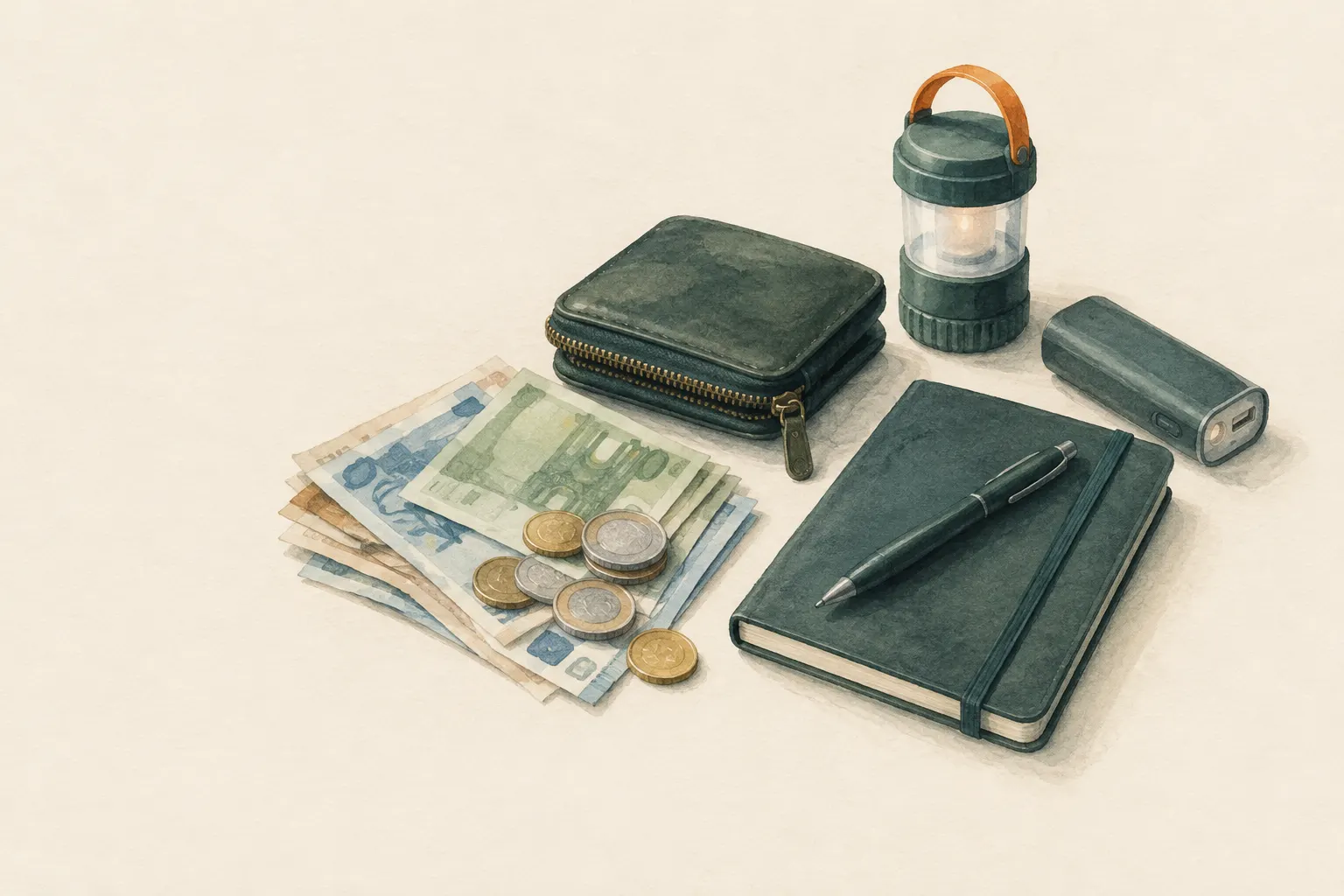
Cash, on the other hand, needs neither electricity nor internet. Shops that still open during an outage can often only accept cash. That is why it is wise to keep a small reserve at home – ideally in small notes and coins, because change may be scarce.
And one safety rule: in a crisis, some people try to cheat others, for example as fake tradespeople. Never pay at the front door, and ask to see an ID.
How it works
Electronic payment needs power at both ends and a data connection in between: the card terminal in the shop, the network and the banks' data centres. If just one of these fails, the payment fails. Online banking does not help either when the internet and mobile network are down or the phone battery is flat.
Cash, by contrast, is a very simple technology: it passes from hand to hand and needs no infrastructure. Some shops can open during an outage with emergency lighting and sell goods for cash. Because their till and their supply of change are limited too, small notes and coins make paying much easier.
What really matters
Think about what a few days of food, medication and possibly travel would cost your household. That gives you a sensible reserve. There is no fixed sum, because every household is different – but a modest reserve is much better than none.
Keep small notes and coins ready and split the money between two places, for example the supplies cupboard and the go bag. That way not everything is gone if one place is lost. When you have used the reserve, refill it straight away, and check once a year that it is still complete.
Also think of other things that depend on payment. Petrol pumps need power, so do not run your tank nearly empty when severe weather is forecast. Bank details, the card blocking number, insurance numbers and important contacts belong on paper in a document folder.
Safety: what to watch out for
Fraud attempts increase in a crisis: fake tradespeople, alleged staff of authorities or utilities, and dubious donation appeals. Ask to see ID, do not pay at the door and do not let anyone into the house whom you do not know and did not call. If you are unsure, inform the police via the local police number or, in urgent cases, the emergency number (112 in the EU).
Do not keep cash visible or in a single place, and do not tell people what supplies you have. Large amounts of cash at home are not a good idea: they increase the risk of theft and are usually not insured.
When it makes sense – and when not
A cash reserve makes sense for households of any size, especially if you otherwise pay almost only by card or phone. Some cash is also good protection when travelling in regions with unreliable power.
Cash also has drawbacks, though: it can be stolen or lost, earns nothing and its purchasing power falls over time. So this is about a small, well-distributed reserve for the first days – not about your savings.
Good to know
Ready.gov includes cash in its emergency kit list, and the BBK also recommends keeping some cash for emergencies. How much makes sense depends on the household; fixed amounts are therefore deliberately not given here.
This entry is not financial or insurance advice. Your insurer can tell you whether and how cash at home is insured.
Step by step
Decide on an amount
Consider what food, medication and possibly travel would cost for a few days. A modest reserve is better than none.
- 1
Decide on an amount
Consider what food, medication and possibly travel would cost for a few days. A modest reserve is better than none.
- 2
Small denominations
Keep small notes and coins, split between two places (e.g. supplies cupboard and go bag).
- 3
Fuel and consumption
Petrol pumps need power. Do not run the tank nearly empty when severe weather is forecast.
- 4
Key details on paper
Keep bank details, card blocking number, insurance numbers and contacts in a document folder.
- 5
Check and refresh
Check the reserve once a year and refill immediately after use.
Common mistakes
- Only large notes
- All cash in one place
- Trusting that cash machines work in an outage
- Spending the reserve on everyday purchases and not replacing it
Quick view
Materials
Cash reserve
Store securely and discreetly.
Document folder (waterproof)
Store securely – contains sensitive personal data.
Suitable for
- Households of any size
- People who otherwise pay almost only by card
- Travel to regions with unreliable power
Not suitable for
- Large amounts of cash at home – theft risk and usually not insured
Prerequisites
- An overview of regular expenses
- A safe place to keep it
Safety
- Fraud attempts increase in crises, e.g. fake tradespeople, alleged officials or donation appeals. Ask for ID, do not pay at the door and if in doubt inform the police via the local emergency number (112 in the EU) or the local police number.
- Do not keep cash in one place or visibly; do not talk about your reserves.
How it works
Electronic payment needs power at both ends and a data connection. Cash needs none of this. Shops that open during an outage can often only take cash – small notes avoid problems with change.
Advantages
- Works without power and network
- Simple
Disadvantages
- Risk of theft and loss
- No return, purchasing power falls over time
Deep knowledge
Background
Ready.gov lists cash in its emergency kit list; the BBK likewise recommends keeping some cash for emergencies.
How much makes sense depends on the household. Fixed amounts are deliberately not given here.
Common mistakes
- Only large notes
- All cash in one place
- Trusting that cash machines work in an outage
- Spending the reserve on everyday purchases and not replacing it
Limits and risks
- No financial or insurance advice
- No recommended amount
Material alternatives
Derived from material properties: a substitute must have all relevant properties. Observe the notes on the substitute.
- Document folder (waterproof)
- Tarp, Plastic sheet / large bin bag (Tears easily; never pull over the head (suffocation risk).), Emergency blanket (Tears easily once punctured; short-term shelter only.), Rain poncho (When used as a shelter, it no longer protects your body from rain.), Bivy bag (Never fully close off the face.), Tent (Do not cook or heat inside the tent (fire and carbon monoxide danger).), Heavy-duty bin bag (large) (Suffocation risk: never pull plastic bags over the head or face and keep them away from small children.), Group shelter bag (Airtight – ventilate regularly.)
Results come exclusively from structured entries. No improvised instructions are generated.
Sources
Ready.gov – U.S. Federal Emergency Management Agency (FEMA): Build A Kit
Cash as part of the emergency kit
Bundesamt für Bevölkerungsschutz und Katastrophenhilfe (BBK), Deutschland: Ratgeber für Notfallvorsorge und richtiges Handeln in Notsituationen
Cash reserve for emergencies