Dew, condensation and plant bags: possibilities and limits
Wiping up dew, collecting condensation or tying a plastic bag over leafy branches – these methods are often recommended but usually yield only small, uncertain amounts. They can supplement an emergency supply but do not replace a real water source, and plants carry their own risks.
- A few minutes to set up; yield only after hours and often small
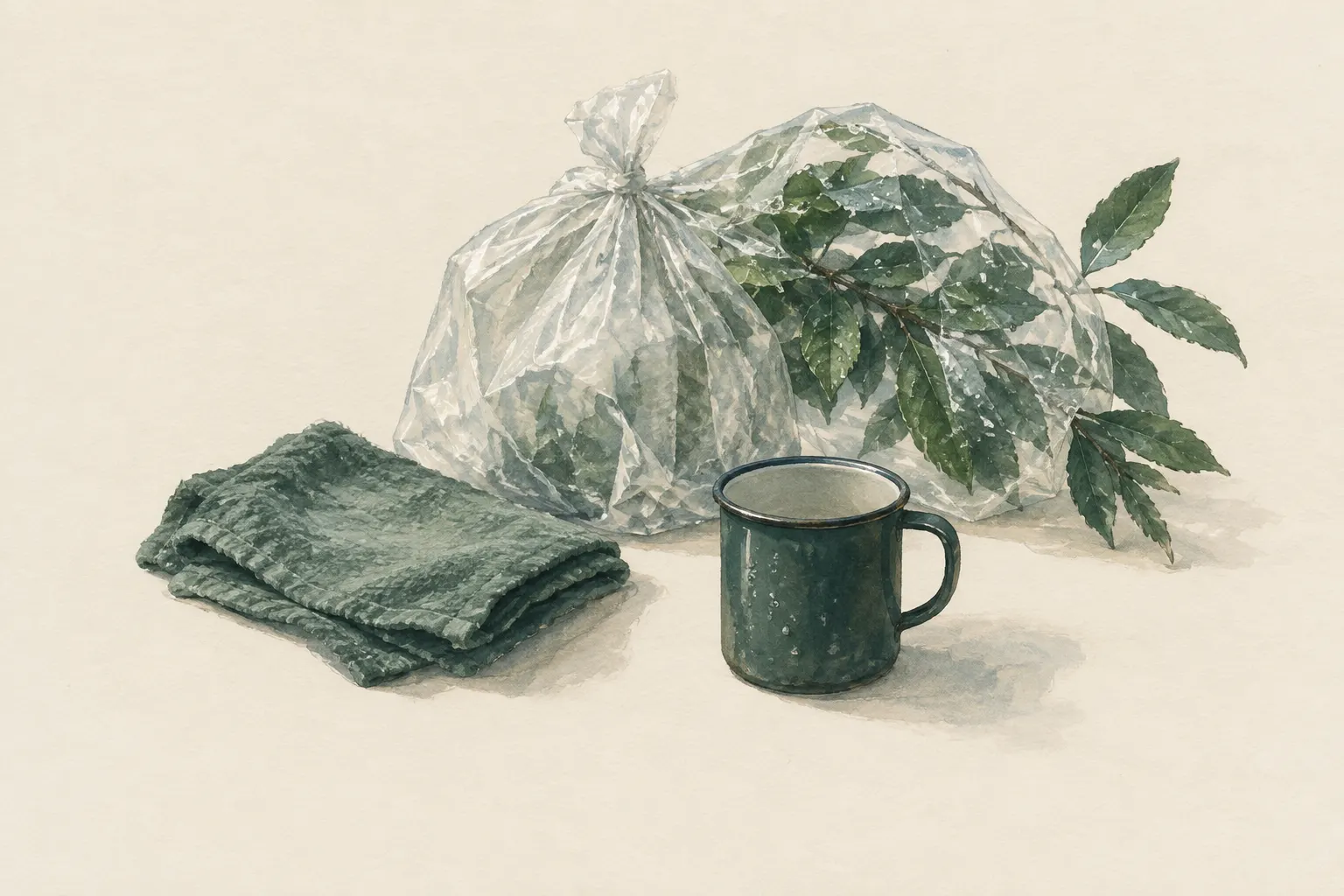
Explained simply
Early in the morning the grass is often wet even though it has not rained. That is dew. It forms when moist air cools down at night – just as a cold bottle from the fridge “fogs up” on the outside. Plants also constantly release a little water vapour through their leaves, a bit like we do when we breathe out.
You can wipe up dew with a cloth, or put a clear plastic bag over a branch and catch the water. That sounds great, but usually only small amounts collect. It is more of an extra during a long wait than a real water source.
Very important: some plants are poisonous, and their poison can get into the water you collect. Only use plants you know for certain are non-toxic. Never drink plant sap, milky latex or liquid from cacti.
How it works: condensation and transpiration
Air always contains some invisible water vapour. How much it can hold depends on temperature: warm air can carry more water vapour than cold air. When moist air cools on a cold surface, the vapour turns back into small droplets – this is called condensation. On clear, still nights, grass, tarps or car windows cool down a lot, and dew forms.
Plants draw water from the ground with their roots and release part of it as vapour through their leaves. This is called transpiration. A tightly closed, transparent bag around a leafy branch catches this vapour. Sunlight warms the bag, the vapour condenses on the inside and runs into the lowest corner.
How much collects depends on humidity, temperature, sun, the plant, soil moisture and how well the bag is sealed. In very dry air hardly any dew forms, and a plant in dried-out soil has little water to spare. That is why this atlas deliberately gives no amounts – the yield is usually small and hard to predict.
When it makes sense – and when not
It can make sense if you are waiting in one place for a long time, for example after a vehicle breakdown, and no real water source can be reached. Then a few bags or wiping up dew in the morning cost little effort, and every small amount adds to your supply.
It does not make sense as your main supply. Never plan to cover your daily needs this way. If you have a choice, it is almost always more worthwhile to catch rainwater, melt snow or look for a real source. And in great heat you should not spend a lot of energy and sweat on a few sips.
What really matters
Collect dew early in the morning, before the sun evaporates it. Drag a clean, absorbent cloth over grass or clean surfaces and wring it out into a container. Condensation also collects overnight on tarps, sheets or vehicle windows. The surfaces must be clean, or you will collect dust, bird droppings or residues as well.
For a plant bag you need a clean, clear bag – never a used bin bag or packaging from chemicals. Put it over a leafy, sunlit branch, seal the opening tightly and let one corner hang lower. Later, pour off the water carefully without taking leaves or plant material with it.
If the water tastes bitter or unusual, pour it away. Treat it if possible, as dew and plant water can be contaminated by animals, dust and surfaces.
Safety: what to watch out for
The biggest danger is poisonous plants. Toxins can get into the collected water with the vapour or via plant material. Use a plant bag only on plants you know for certain are non-toxic. This atlas deliberately names no plants that are supposedly suitable, because plant identification is a specialist field with dangerous risks of confusion.
Do not drink plant saps, milky latex or liquids from cacti or unknown plants. Such liquids can contain substances that cause vomiting or diarrhoea – and so cost you even more water.
If nausea, vomiting or other symptoms appear after drinking, get help via the local emergency number (112 in the EU) or a poison centre, if you can reach them.
Good to know
Military survival manuals such as FM 3-05.70 describe collecting dew and vegetation or transpiration bags as stopgaps for long waits – not as a replacement for water points or carried supplies. They explicitly warn against using poisonous plants.
In films and videos such methods often look more productive than they are in reality. The footage usually shows good conditions and does not say how long it took. If you have realistic expectations, you will not waste energy and will rely on the things that really help: carried water, known sources and less sweat loss.
Step by step
Check real sources first
First check whether rainwater, snow or a source can be reached with reasonable effort.
- 1
Check real sources first
First check whether rainwater, snow or a source can be reached with reasonable effort.
- 2
Wipe up dew
In the early morning, soak up dew from grass or clean surfaces with a clean cloth and wring it into a container. Collection time ends once the sun evaporates the dew.
- 3
Plant bags only on plants known to be non-toxic
Put a clean, clear bag over a leafy, sunlit branch, seal the opening tightly and let one corner hang lower so water collects there.
Do not use plants not reliably known to be non-toxic.
- 4
Collect and treat
Pour the water off carefully without plant material. If it tastes bitter or unusual, discard it. Treat it if possible.
Common mistakes
- Planning on the method as the main supply
- Using unknown plants
- Using used bin bags or chemical packaging as bags
- Spending a lot of energy in the heat for little yield
- Drinking plant sap or cactus liquid
Quick view
Materials
Plastic sheet / large bin bag
A clear, clean bag or sheet, never from chemical packaging or used bin bags
Tears easily; never pull over the head (suffocation risk).
Do not use for drinking water unless food-grade.
Cotton cloth / T-shirt
For wiping up dew
Removes coarse particles only – no disinfection.
Suitable for
- Supplementing supplies when there is no water source
- Long waits in one place, e.g. after a vehicle breakdown
Not suitable for
- Meeting daily needs
- Situations where the effort is better spent finding a real source
- Plants not reliably known to be non-toxic
Prerequisites
- A clean sheet or cloth
- A way to treat the collected water
Safety
- Dew from plants and surfaces and water from plant bags can be contaminated by animals, dust and surfaces. Treat it if possible.
How it works
Dew and condensation form when moist air cools on a cooler surface. Plants release water vapour through their leaves (transpiration); a tightly closed, transparent bag catches it and the vapour condenses on the inside. How much collects depends on humidity, temperature, sun, the plant and how well the bag is sealed – and it is usually little.
Advantages
- Little material needed
- No digging required (unlike the solar still)
Disadvantages
- Usually very low yield
- Risk from toxic plants
- Strongly weather-dependent
Deep knowledge
Background
Military survival manuals such as FM 3-05.70 describe collecting dew as well as vegetation and transpiration bags as stopgaps and warn against using poisonous plants. There they are intended as supplements during long waits, not as replacements for water points or carried supplies.
Plant identification is a specialist field with dangerous risks of confusion. This atlas therefore names no plants that are supposedly suitable.
Variants
- Condensation on tarps and sheets
- Overnight, condensation can collect on tarps, sheets or vehicle windows and be wiped off in the morning. Amounts are usually small, and surfaces must be clean.
Common mistakes
- Planning on the method as the main supply
- Using unknown plants
- Using used bin bags or chemical packaging as bags
- Spending a lot of energy in the heat for little yield
- Drinking plant sap or cactus liquid
Limits and risks
- No yield figures – yield strongly depends on the situation
- No plant identification
- Collected water is not automatically safe
Material alternatives
Derived from material properties: a substitute must have all relevant properties. Observe the notes on the substitute.
- Plastic sheet / large bin bag
- Tarp, Emergency blanket (Tears easily once punctured; short-term shelter only.), Document folder (waterproof) (Store securely – contains sensitive personal data.), Rain poncho (When used as a shelter, it no longer protects your body from rain.), Bivy bag (Never fully close off the face.), Tent (Do not cook or heat inside the tent (fire and carbon monoxide danger).), Heavy-duty bin bag (large) (Suffocation risk: never pull plastic bags over the head or face and keep them away from small children.), Group shelter bag (Airtight – ventilate regularly.)
Results come exclusively from structured entries. No improvised instructions are generated.
Sources
Headquarters, Department of the Army (USA) (2002): FM 3-05.70 Survival
Collecting dew, vegetation and transpiration bags, and warning about poisonous plants