Desalination by stove distillation: principle and limits
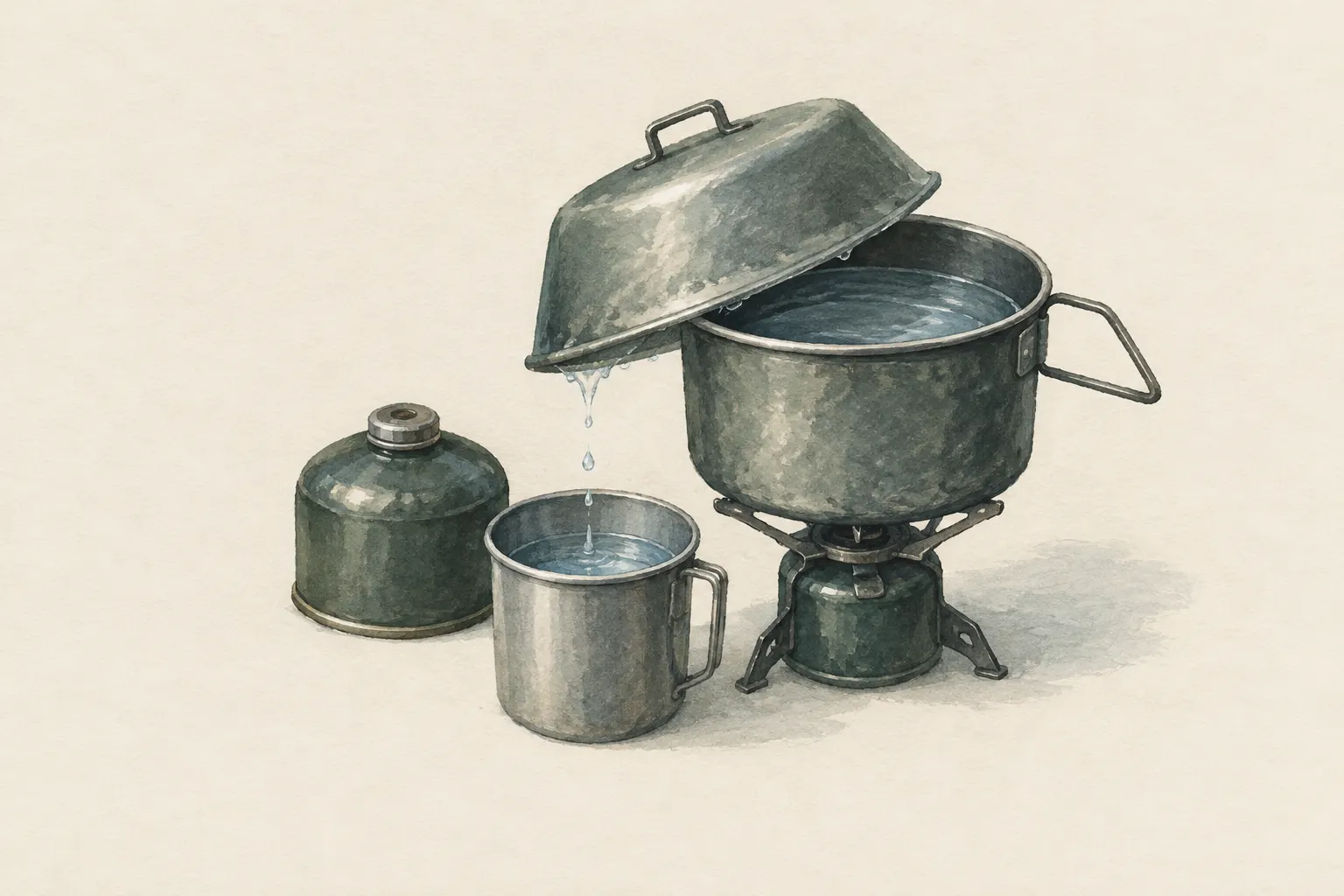
Seawater or brackish water can only be made drinkable by distillation (or special desalination devices) – filters, tablets and boiling do not remove salt. With a pot, an inverted lid and a collecting vessel, small amounts can be distilled in an emergency. Fuel demand is high and yield small. Never drink seawater directly.
- High fuel and time cost for small amounts
Explained simply
Seawater is full of salt. If you drink it, your thirst does not get smaller but bigger, and your body even loses water. Boiling, filtering or tablets do not take the salt out. That is why you never drink seawater – not even a little, and not mixed either.
But there is a trick: when water boils, steam rises. Steam is only water – the salt stays behind in the pot. When the steam meets a cold lid, it turns back into drops, just like on a cold bathroom mirror when you shower. These drops are free of salt. If you catch them in a small vessel, you have drinking water. This is called distilling.
However: only very little water comes out, and you need a lot of fuel. Steam and lid are so hot that they cause bad scalds. And you use a stove or fire only outdoors.
How it works
Salt is dissolved in seawater, but it does not evaporate with it. When you heat salt water, only the water rises as steam, and the salt stays behind in the pot, becoming ever more concentrated. When the steam meets a cooler surface, it gives up its heat and turns liquid again – it condenses. The condensed water is practically free of salt.
In the simple stovetop set-up you place the pot lid upside down, with the dome pointing downwards. The drops forming on the underside run to the lowest point in the middle and drip from there into a small, heat-resistant vessel standing in the pot. Cold water or snow on top of the lid keeps it cool and increases condensation.
The catch is energy. Evaporating water takes much more energy than just heating it to the boil. That is why every sip of distilled water costs a lot of fuel and time, and part of the steam escapes unused at the edges. It is not enough for a group over a longer period.
What really matters
The pot is filled only partly with salt water, and the collecting vessel must stand so that it cannot tip over and no salt water splashes into it. That is why you heat gently, so the water simmers but does not boil vigorously. A vigorous boil throws salty drops into the collecting vessel and ruins the work.
Let the condensate cool and taste a tiny amount. If it tastes salty, salt water has splashed in, and you distil it again. Remove the salt residue from the pot regularly and top up with fresh salt water before the pot runs dry.
Pour the distillate into a clean container. The collecting vessel and the lid must be clean, otherwise germs get into the finished water. Distilled water tastes flat because it lacks minerals and dissolved air; pouring it between clean vessels makes it a little more pleasant.
Safety: what to watch out for
Never drink seawater, not even in small amounts or mixed with fresh water. The body has to get rid of the excess salt using water and loses more water doing so than it took in. The deficit gets worse, not better.
Steam, hot lids and boiling water cause severe scalds. Use pot holders, lift the lid away from your body and keep children away. Run stoves and fires only outdoors or with very good ventilation, because in enclosed spaces there is a risk of carbon monoxide – a gas you can neither see nor smell and that can be deadly. With an open fire, check local rules and fire bans.
Volatile chemicals such as fuels or solvents can carry over with the steam and end up in the distillate. If oil or chemicals are suspected, for example in a harbour or after an accident, do not distil – look for another source.
When it makes sense – and when not
Stove distillation is an emergency solution for coastal situations without fresh water, or for brackish water when no other source can be reached. It bridges the time until fresh water is found or help is reached. Collecting rainwater or looking for a freshwater source near the coast is often far less effort and should be tried in parallel.
For boats and life rafts there are hand-pump desalinators that use reverse osmosis: the water is pressed through a very fine membrane that holds back salt. They are expensive and need maintenance, but deliver water without fuel. They are used only according to the manufacturer's instructions.
Good to know
Distillation is the oldest method of making salt water drinkable. Large desalination plants today mostly use reverse osmosis or optimised evaporation processes.
The same principle – water evaporates, salt and dirt stay behind, steam condenses on a cool surface – is also behind the solar still. There the sun provides the heat instead of the stove, but the yield is even smaller and depends heavily on the weather.
Step by step
Set up
Fill the pot only partly with salt water and place a small heat-resistant collecting vessel inside so that it cannot tip over and no salt water splashes in – or collect the condensate outside via a tube if available.
- 1
Set up
Fill the pot only partly with salt water and place a small heat-resistant collecting vessel inside so that it cannot tip over and no salt water splashes in – or collect the condensate outside via a tube if available.
- 2
Invert the lid
Place the lid upside down so that its lowest point is above the collecting vessel. Cold water or snow on the lid increases condensation.
- 3
Heat gently
Heat so that the water simmers but does not boil vigorously – otherwise salt water splashes into the collecting vessel.
Lid and steam are very hot; use pot holders.
- 4
Check
Let the condensate cool and taste a tiny amount: if it tastes salty, salt water has splashed in – distil again.
- 5
Store cleanly
Pour the distillate into a clean container. Remove the salt residue from the pot regularly.
Common mistakes
- Drinking ‘just a little’ seawater
- Boiling too hard so salt water splashes into the collecting vessel
- Running the stove in a tent or indoors
- Using distillation for oil or fuel contamination
- Underestimating fuel demand
Quick view
Materials
Metal pot (stainless steel, aluminium, titanium)
With a domed or invertible lid
Hot – scalding risk.
Stove
Never operate inside a tent, shelter or enclosed room – carbon monoxide and fire risk.
Stove fuel (canister, liquid fuel, alcohol)
Store fuels apart from food and in original containers or bottles intended for them.
Store cool, well ventilated and out of children's reach.
Single-wall stainless steel bottle
Heat-resistant collecting vessel
Heat only single-wall bottles without paint/plastic; remove the lid before heating.
Never heat double-wall (vacuum-insulated) bottles – risk of rupture.
Suitable for
- Coastal emergencies without fresh water
- Brackish water when no other source can be reached
Not suitable for
- Water with fuel, solvents or other volatile chemicals
- Longer-term supply for larger groups
- Indoors with stoves or fires
Prerequisites
- Stove or fire with plenty of fuel
- Heat-resistant, clean collecting vessel
- Well-ventilated location
Safety
- Volatile chemicals such as fuels can carry over with the steam. If oil or chemicals are suspected, do not distil – find another source.
How it works
When heated, water evaporates and salt stays behind in the pot. When the steam meets a cooler surface, it condenses into salt-free water. An inverted lid lets the droplets run to the lowest point, where a vessel catches them. Because evaporation takes a lot of energy, the yield per unit of fuel is low.
Advantages
- Removes salt and most pathogens
- Possible with simple cooking equipment
Disadvantages
- Very high fuel demand
- Low yield
- Risk of scalding and carbon monoxide
Deep knowledge
Background
Distillation is the oldest method of desalination and is described in survival manuals as an emergency solution for seawater. Large-scale desalination plants today mainly use reverse osmosis or optimised evaporation.
In an emergency, stove distillation is mainly a bridge until fresh water is found or help is reached.
Variants
- Manual desalinators
- For boats and life rafts there are hand-pump desalinators using reverse osmosis. They are expensive and need maintenance but deliver water without fuel. Use only according to the manufacturer.
Common mistakes
- Drinking ‘just a little’ seawater
- Boiling too hard so salt water splashes into the collecting vessel
- Running the stove in a tent or indoors
- Using distillation for oil or fuel contamination
- Underestimating fuel demand
Limits and risks
- Only small amounts
- Volatile chemicals can carry over
- Dependent on fuel
- Collecting vessel must be clean, otherwise recontamination
Material alternatives
Derived from material properties: a substitute must have all relevant properties. Observe the notes on the substitute.
- Metal pot (stainless steel, aluminium, titanium)
- Single-wall stainless steel bottle (Heat only single-wall bottles without paint/plastic; remove the lid before heating.)
- Stove fuel (canister, liquid fuel, alcohol)
- Dry firewood (Collect only where permitted.), Tinder (Carry in waterproof packaging.), Char cloth (charred cotton) (Store dry in a tin.), Finest-grade steel wool (Store separately from batteries – fire risk.), Fatwood (resin-rich wood) (Collect only dead wood where permitted.), Petroleum jelly cotton balls (Use only pure cotton.)
Results come exclusively from structured entries. No improvised instructions are generated.
Sources
Headquarters, Department of the Army (USA) (2002): FM 3-05.70 Survival
Distilling seawater as an emergency method; do not drink seawater
World Health Organization (2022): Guidelines for drinking-water quality, fourth edition incorporating the first and second addenda
Desalination and limits of distillation regarding volatile substances
Centers for Disease Control and Prevention: Carbon Monoxide Poisoning – Prevention guidance
Carbon monoxide risk from stoves in enclosed spaces