Skip to content
In an emergencyAustriaEmergency numbers →
SurviveBetter
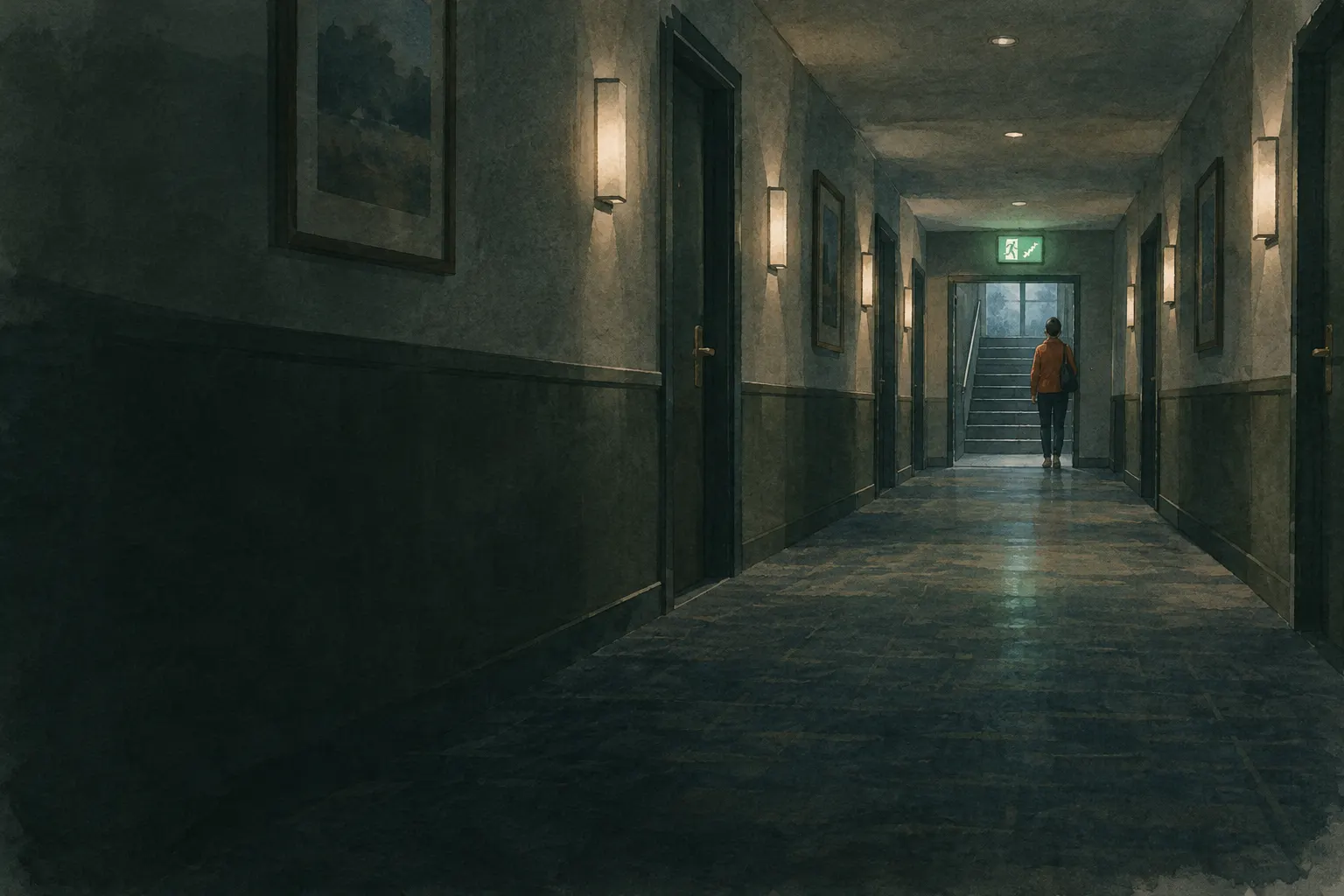
Hotel corridor at night with a green emergency exit light at the end

The fire alarm goes off in my hotel

In the middle of the night the hotel fire alarm goes off – you are in an unfamiliar building and need to find your way out fast.

First

  1. Always take the alarm seriously and act at once – do not stop to investigate or pack.
  2. Before opening, test the door with the back of your hand; if it is hot or smoke is coming in, do not open it.
  3. Take key, phone and torch, close the door behind you, leave by the stairs – never use the lift.
  4. Outside, go to the assembly point and tell staff you are out. If there is fire or smoke: call the local emergency number (112 in the EU).

Call emergency services if

  • Fire or smoke visible
  • Escape route blocked, you are stuck in your room
  • Someone is missing at the assembly point
  • Breathing difficulty or unconsciousness after smoke

What is happening

A hotel alarm often jolts you out of sleep. You are confused, the room is unfamiliar, perhaps you are in another country and do not understand the announcements. Many people first wait, look into the corridor, phone reception or pack – because they assume it is a false alarm. Those very minutes can be decisive.

The greatest danger in a building fire is usually not the flames but the smoke. It spreads quickly through corridors and stairwells, takes away visibility and contains toxic gases that can make you dazed after only a few breaths. Smoke rises; the air close to the floor usually stays breathable for longer.

In an unfamiliar building many people do not know where the nearest emergency exit is. Anyone who only looks for it in a smoke-filled corridor loses their bearings. Another common mistake is to take the lift – it can get stuck or stop at a smoke-filled floor.

What matters: know your escape route from check-in, act immediately when the alarm sounds, test the door, take key and phone, close the door, leave by the stairs and report at the assembly point. If the route is blocked, the closed room is often the safest place until help arrives.

Step by step

  1. Phase 1

    At check-in

    • Read the escape plan on the room door and look at both escape routes to the stairwell.
    • Count the doors between your room and the nearest emergency exit – this helps in darkness or smoke.
    • In the evening put key or keycard, phone, glasses and a torch within reach next to the bed.
    • If you are hard of hearing or would need help on the stairs: tell reception and ask about alarm aids.
  2. Phase 2

    When the alarm sounds

    • Take the alarm seriously and act at once – do not pack, do not go and look first.
    • Test the door with the back of your hand; if it is hot or smoke is coming through the gaps, do not open it.
    • If the door is cool: open it carefully, take key, phone and torch, close the door behind you.
    • Go down by the stairs to the exit – never use the lift.
    • In smoke stay low and feel your way along the wall to the counted exit; if the smoke gets too thick, go back to the room.
  3. Phase 3

    If you are trapped in the room

    • Keep the door shut and seal the gaps with wet towels or bedding.
    • Call the local emergency number (112 in the EU), give the hotel name, address and room number – even if the fire service is already outside.
    • Make yourself seen at the window (light, a bright cloth); only open the window if no smoke is coming in from outside.
    • Do not jump; wait for the fire service.
  4. Phase 4

    Outside

    • Go to the assembly point and tell staff that you are out.
    • Say if someone is missing or you know someone is still in the building – do not go back in yourself.
    • Only go back inside when staff or the fire service allow it.
    • Anyone who has breathed in smoke and is coughing, short of breath or dazed should be checked by medical staff.

What to watch out for

  • Smoke is more dangerous than flames

    Fire smoke contains toxic gases and can quickly cause unconsciousness. Keep doors shut and stay low where the air is better.

  • Getting used to false alarms

    People who have experienced false alarms often hesitate. From inside your room you cannot judge whether there is a fire – leave the building anyway.

  • Lifts

    Lifts can fail in a fire or stop at a smoke-filled floor. Always take the stairs, unless the fire service or staff explicitly say otherwise.

  • Down, not up

    Smoke rises. The roof is generally not a safe destination, and doors to it may be locked. If the way down is blocked, take the second escape route or return to the room.

  • Fire doors

    Fire doors in corridors and stairwells hold back smoke. Close them behind you and never wedge them open.

  • Announcements in a foreign language

    If you do not understand announcements, the rule is: alarm means get out. Follow the green escape-route signs and other guests towards the exit, not into dead ends.

Common mistakes

  • Packing, showering or phoning reception first.
  • Using the lift.
  • Leaving the room door open so smoke gets into the room.
  • Leaving without the key and then being unable to get back into the safe room.
  • Fleeing upwards or onto the roof.
  • Going back into the building to fetch belongings.

Prepare in advance

  • At check-in look at both escape routes and count the doors to the emergency exit.
  • Keep key, phone, glasses and a torch next to the bed at night.
  • If possible choose a room on a lower floor, especially if your mobility is limited.
  • Watch out for blocked or locked emergency exits and report them to the hotel.
  • Agree a meeting point in front of the hotel with your family.

Special consideration

Children
Hold children by the hand and do not let them run ahead. Small children sometimes hide under the bed or in a wardrobe when afraid – if you travel with children, prepare them briefly for an alarm beforehand.
People with disabilities
Anyone who cannot manage the stairs waits in a protected spot by the stairwell or in the closed room and tells reception and the emergency number the exact location at once. People who are hard of hearing can ask about alarm devices with light or vibration.

Sources

  • Home Fires · Ready.gov – U.S. Federal Emergency Management Agency (FEMA)
  • Are You Ready? An In-Depth Guide to Citizen Preparedness · U.S. Federal Emergency Management Agency (FEMA)
  • 112 – the European emergency number · European Commission

Your situation

Corridor and escape route
With you

Matching entries

0 rules apply

No AI decides here. Every recommendation is based on a visible rule.

Add details about your situation above to get more specific guidance.

Basics for this situation

Why: Always applies to this situation – regardless of your answers.

All rules of this situation (5)
  1. [not active] If Corridor and escape route = Smoke in the corridor

    In smoke stay low where the air is better and feel your way along the wall to the counted exit. If the smoke gets too thick: back to the room.

  2. [not active] If Corridor and escape route = Route blocked / door hot

    Stay in the room, seal door gaps with wet towels, call the emergency number and give your room number, make yourself seen at the window. Do not jump.

  3. [not active] If Corridor and escape route = Clear, no smoke

    Leave quickly but without running, by the stairs. Do not go back in until staff or the fire service allow it.

  4. [not active] If With you = Children

    Hold children by the hand and do not let them run ahead. Count heads as soon as you are outside.

  5. [not active] If With you = Someone with limited mobility

    Anyone who cannot manage the stairs waits in a protected spot by the stairwell or in the room and tells reception and the emergency number exactly where at once.