Skip to content
In an emergencyAustriaEmergency numbers →
SurviveBetter
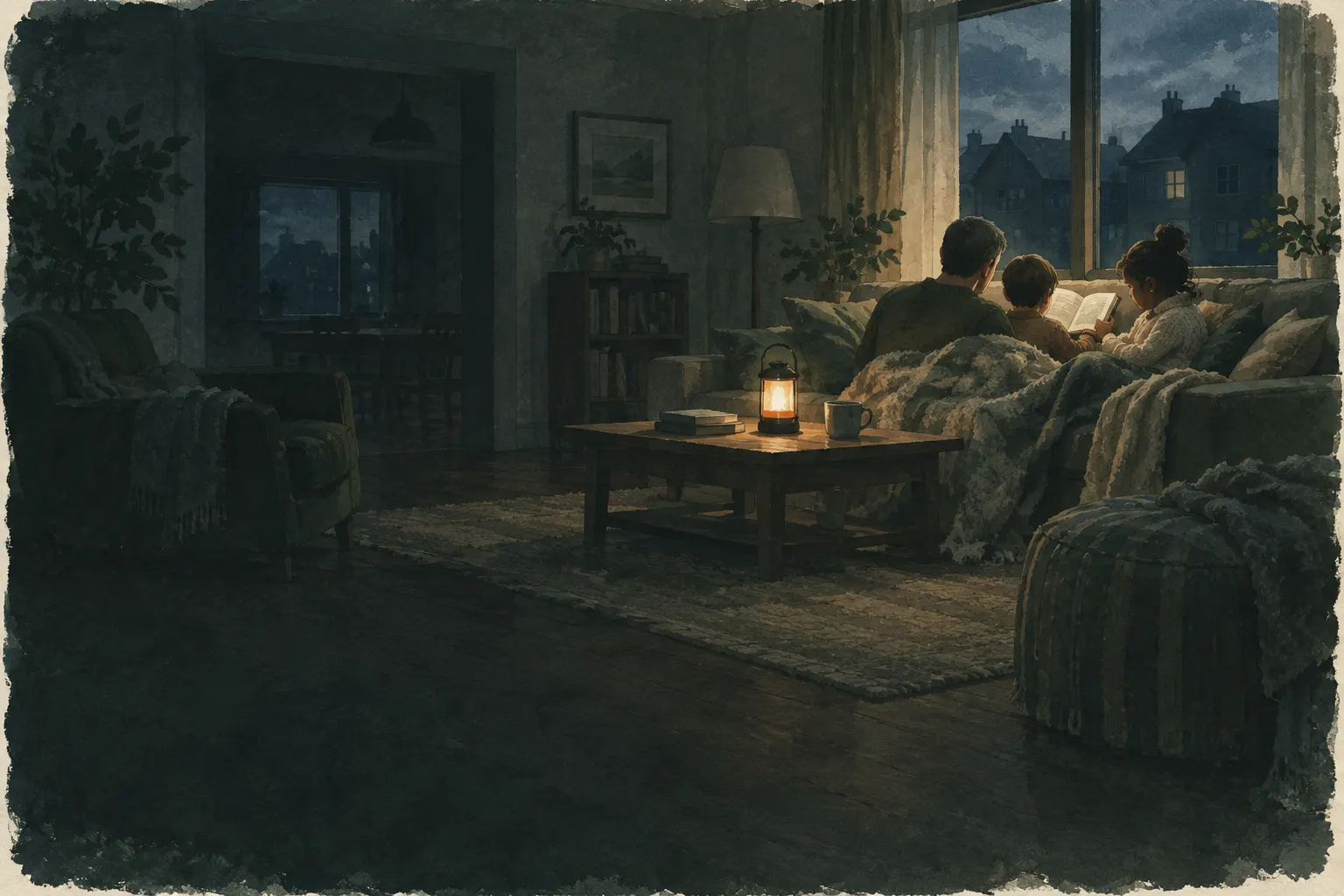
Living room during a power cut, family in the light of a battery lantern

Our power has gone out

Suddenly everything goes dark and quiet: lights, fridge, router and often the heating are off – usually only briefly, sometimes longer.

First

  1. Check whether only your home is affected (fuses, breakers) or the neighbourhood.
  2. Keep the fridge and freezer closed.
  3. Switch on a battery or crank radio and follow official announcements.
  4. Use candles only under supervision; torches or battery lanterns are better.

Call emergency services if

  • Life-sustaining electrical devices fail
  • Suspected carbon monoxide poisoning (headache, dizziness, nausea in several people)
  • Fire

What is happening

A power cut almost always starts without warning: the lights go out, appliances fall silent, the router stops blinking. Most outages last only minutes to a few hours. So at first the main thing is to find out whether only your home is affected – then it is often a tripped fuse or breaker – or whether the street, the neighbourhood or a wider region is dark.

What many people underestimate: a surprising amount depends on electricity, including things that do not seem "electrical". Most gas and oil heating systems need power for controls and pumps, landline phones today usually run through a router, electric door openers, garage doors and lifts stop. Card payments and cash machines often do not work, traffic lights fail. In taller buildings the water can stop too when the pumps stop. The mobile network usually holds out for a while, but can be overloaded or fail after some time.

A power cut rarely becomes dangerous because of the darkness itself, but because of what people improvise: candles left burning unattended, grills or camping stoves used inside, generators in the garage or basement. Carbon monoxide is invisible and odourless and at first only causes headache, dizziness and nausea – symptoms that are easy to mistake for something else. A second serious risk concerns people who depend on electrically powered medical devices.

Realistically, the first hours are about unspectacular things: staying calm, using safe light sources, keeping the fridge and freezer closed, saving batteries and following official announcements on a battery or crank radio. If it becomes clear that the outage will last longer, there is still enough time to prepare for that.

Step by step

  1. Phase 1

    Right away / in the first minutes

    • Get a torch or headlamp rather than searching for candles and matches in the dark.
    • Check whether neighbours and street lights are affected too. If only your home is dark, check the fuse box to see whether a fuse, breaker or residual-current device has tripped.
    • If a breaker trips again immediately after you reset it, stop trying: that points to a fault – unplug the suspect appliance or call a qualified electrician.
    • Switch off the hob, oven, iron, fan heater and other heating appliances that were running – otherwise they start up again unnoticed when power returns.
    • If someone is stuck in a lift, they trigger its alarm; from outside you can also notify the building management or the lift emergency service.
  2. Phase 2

    In the first hour

    • Switch on a battery or crank radio or check the warning app: how large is the affected area, is there a forecast?
    • Do not call the emergency number just to ask about the outage – the lines are needed for real emergencies. Information comes via radio, the network operator or the local council.
    • Keep the fridge and freezer closed. Decide beforehand what you need and open the door only briefly.
    • Unplug sensitive devices such as computers and televisions to protect them from surges when power returns. Leave one lamp switched on so you notice when the power is back.
    • Put your phone into power-saving mode, lower the brightness and close unnecessary apps.
    • Anyone who depends on an electrically powered medical device: check the battery level and estimate how long it will last.
  3. Phase 3

    If it lasts longer than a few hours

    • Check on neighbours, especially older people, those living alone and families with babies.
    • In cold weather make one room the warm room, close doors and put on layers; in hot weather keep the sun out of the home.
    • Eat food from the fridge first and keep the freezer closed as long as possible.
    • Cook only with safe means: camping stoves and grills outdoors only. Run a generator only outside, away from windows and doors, and never connect it to the house wiring yourself.
    • Ration cash, rechargeable batteries and batteries and prepare for a longer outage.
  4. Phase 4

    When the power comes back

    • Switch appliances back on gradually, not all at once.
    • Check chilled and frozen food: when in doubt, throw out what was too warm for too long. Smell and appearance are not a reliable test, and you should not taste it.
    • Check clocks, heating controls, router and alarm system and reset them if needed.
    • Note and replace used batteries, candles and supplies.

What to watch out for

  • Carbon monoxide

    Grills, outdoor gas stoves, patio heaters and generators produce carbon monoxide. The gas is invisible and odourless; a window left ajar does not protect you. If several people get a headache, dizziness or nausea: get into fresh air at once and call the emergency number.

  • Candles and open flames

    Never leave candles burning unattended, and do not place them next to curtains or in children's rooms. Battery or rechargeable lamps are safer and can be carried around the home without risk.

  • Generators and house wiring

    A generator that feeds into the house wiring through a socket or an improvised connection can energise the grid – deadly for line workers, neighbours and you. Plug appliances only directly into the generator; a permanent connection may only be installed by a qualified electrician.

  • Food in the fridge

    According to the US Department of Agriculture (USDA), a closed fridge keeps food cold for about four hours, a full, closed freezer for about 48 hours (about 24 if half full). Every opening shortens this time.

  • Medical devices

    Ventilators, oxygen concentrators and other devices run only as long as their battery lasts. Contact your doctor, care service or device supplier in good time; if a life-sustaining device is about to fail, call the emergency number at once.

  • Traffic without signals

    Traffic lights and street lighting fail. If you have to travel, drive slowly, expect others to make mistakes and follow the right-of-way rules that apply without signals (check local rules).

Common mistakes

  • Calling the emergency number just to ask what caused the outage.
  • Leaving candles burning unattended or fumbling with matches in the dark.
  • Opening the fridge again and again "to check".
  • Running a grill, camping stove or generator indoors, in the garage or right in front of a window.
  • Using up the phone battery on videos and games instead of saving it for information and calls.
  • Resetting a breaker again and again although it trips immediately.

Prepare in advance

  • Torches or headlamps in fixed, known places and spare batteries.
  • A battery or crank radio to receive official announcements.
  • Charged power banks and a car charging cable.
  • Some cash in small notes, because card payments and cash machines can fail.
  • Knowing where the fuse box, the manual release of the garage door or shutters and a mechanical key for the front door are.
  • With powered medical devices: know the battery life and agree an emergency plan with your doctor or supplier.

Special consideration

Children
Children are less afraid in the dark if they have their own torch and someone explains what is happening. Keep candles, lighters and stoves out of reach.
Older people and people needing care
Personal alarm units and phones can fail when their battery runs out or the line runs through a router. Drop by or call while the mobile network still works.
Pets
Aquarium pumps and heaters as well as heat lamps for terrariums stop working. Include your animals' needs in your preparations.

Sources

  • Power Outages · Ready.gov – U.S. Federal Emergency Management Agency (FEMA)
  • Ratgeber für Notfallvorsorge und richtiges Handeln in Notsituationen · Bundesamt für Bevölkerungsschutz und Katastrophenhilfe (BBK), Deutschland
  • Keeping Food Safe During an Emergency · United States Department of Agriculture – Food Safety and Inspection Service (USDA FSIS)
  • Carbon Monoxide Poisoning – Prevention guidance · Centers for Disease Control and Prevention

Your situation

Duration so far
Weather
Household

Matching entries

0 rules apply

No AI decides here. Every recommendation is based on a visible rule.

Add details about your situation above to get more specific guidance.

Basics for this situation

Why: Always applies to this situation – regardless of your answers.

All rules of this situation (6)
  1. [not active] If Duration so far = Longer / unclear

    In a longer outage, ration supplies, water and batteries.

  2. [not active] If Household = Generator available

    Run a generator only outdoors and away from windows – carbon monoxide kills.

  3. [not active] If Household = Electrically powered medical devices

    Know how long device batteries last. If a life-sustaining device is about to fail, call the emergency number at once.

  4. [not active] If Household = Children or pets

    Involve children and keep candles out of reach.

  5. [not active] If Weather = Hot

    Without cooling, heat risk rises, especially for older people, small children and the sick.

  6. [not active] If Weather = Cold / frost

    Keep one room warm; never use grills or outdoor gas appliances indoors.